
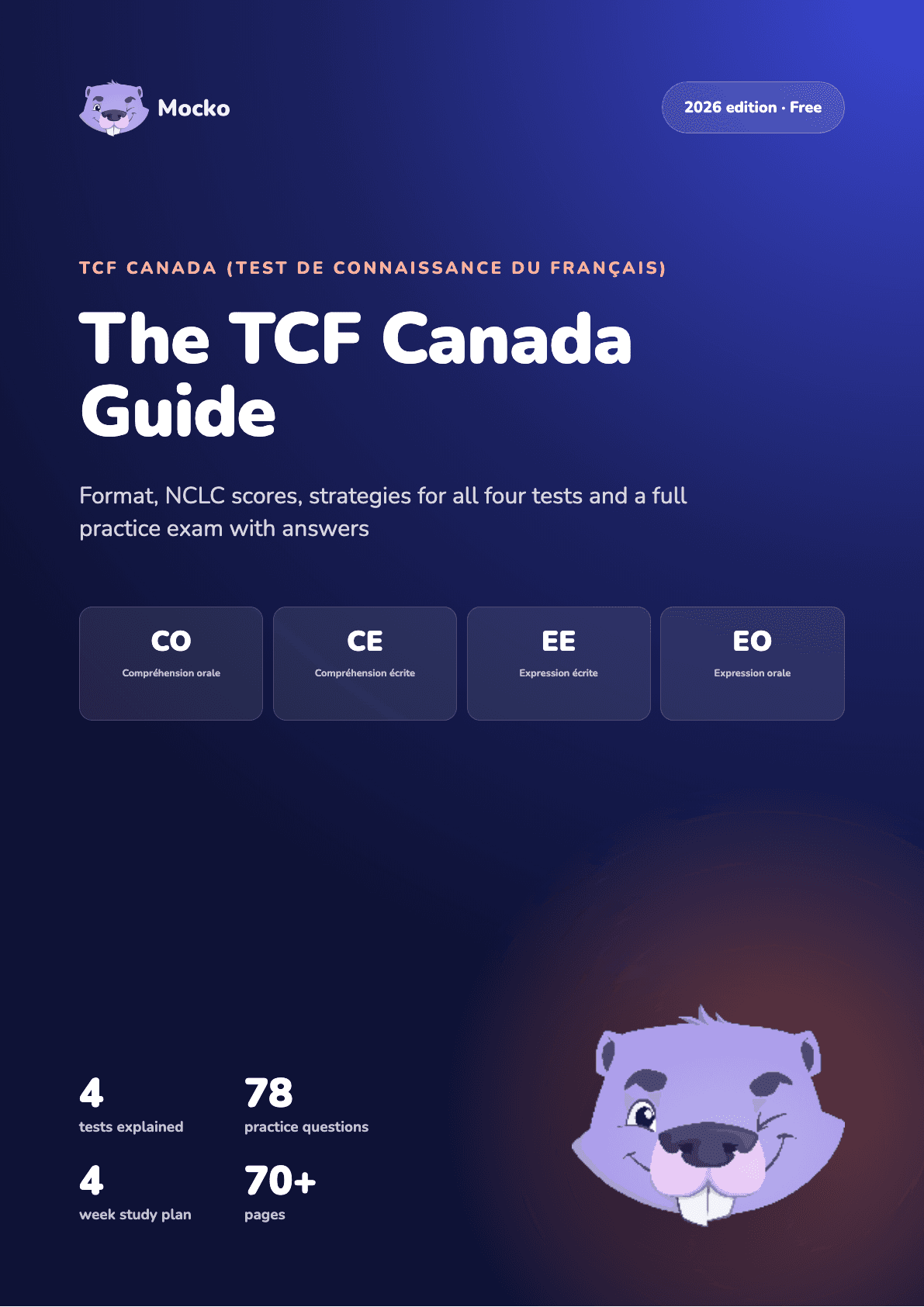
The free TCF Canada guide and practice exam
Everything you need to reach your NCLC target on the TCF Canada: how the four tests work, how scores convert to NCLC levels for Express Entry and citizenship, how to handle the three writing and three speaking tasks, and a full practice exam with an answer key and model answers.
- All four tests explained
- Full 78-question practice exam
- Writing and speaking models
- Free PDF, no signup
Free PDF · 79 pages · 1.3 MB · No signup
What’s inside the ebook
11 chapters on the TCF Canada (Test de connaissance du français), then a full 78-question practice test with an answer key.
- 01
How to use this book
Who the guide is for, and the fastest route through it if your exam date is close.
- 02
What the TCF Canada is and why your score matters
Who accepts the TCF Canada, how it differs from the other TCF versions and the TEF, and how a strong French score changes an Express Entry profile.
- 03
The TCF Canada format at a glance
The four tests, their question counts, tasks and timings, and how the rising difficulty changes your strategy.
- 04
TCF Canada scores and NCLC levels
How each test is scored, the full TCF to NCLC conversion grid, and the levels IRCC programs ask for.
- 05
Listening: compréhension orale
How the 39 listening questions rise from pictures to debates, and how to pace 35 minutes when every recording plays once.
- 06
Reading: compréhension écrite
One text per question from A1 signs to C2 essays: how to bank the easy points fast and keep time for the dense texts at the end.
- 07
Writing: expression écrite
The three writing tasks, their word ranges and registers, and a reusable plan for Task 3, the one that decides NCLC 9.
- 08
Speaking: expression orale
The three speaking tasks in 12 minutes: the guided interview, the role-play and the opinion task, with phrases that score.
- 09
A 4-week study plan
Four weeks of about one hour a day, covering every task twice and including two full timed exams.
- 10
Test-day checklist
What to bring, how the day runs, and the small habits that protect your score.
- 11
Practise the TCF Canada on Mocko
How to take full TCF Canada mocks with real audio, timers and NCLC score reports, starting with one free full exam.
Full TCF Canada practice exam
All four tests: 39 listening and 39 reading questions rising from A1 to C2, the three writing tasks and the three speaking tasks, with an answer key, model answers and a partner script for the listening test.
Before you study: find out your NCLC today
Reading about the TCF Canada tells you how it works. Sitting it tells you what to fix. Mocko runs full TCF Canada mock exams in the real format, with audio played once, the real timers and a score report for every skill.
Reach CLB 7 with the 3-month plan, or get another three months free. See the conditions.
- Real TCF Canada formatAll four tests with the official question counts, rising difficulty and timers.
- Listening with real audioNative-speaker recordings played once, exactly like the real exam.
- Writing and speaking scoredAll three tasks of each test scored out of 20, with detailed feedback in Premium.
- NCLC score reportSee your level in each skill and the level where you start losing points.
What the TCF Canada is and why your score matters
The TCF Canada (Test de connaissance du français) is a French proficiency exam made by France Éducation international (FEI), a public agency of the French Ministry of Education. It is accepted by IRCC for Express Entry, other economic immigration programs and Canadian citizenship. Results are valid for two years.
The exam has four compulsory tests: listening (compréhension orale), reading (compréhension écrite), writing (expression écrite) and speaking (expression orale). Each gets its own score, and IRCC converts each score to a level on the Niveaux de compétence linguistique canadiens (NCLC), the French equivalent of the Canadian Language Benchmarks (CLB).
Why a strong French score is worth so much
- Express Entry points. Your first official language can earn up to 136 core points (128 if you apply with a spouse or partner), and French can be that first language.
- The French bonus. Candidates who reach NCLC 7 or higher in all four French skills get up to 50 additional points: 50 if their English is CLB 5 or higher, 25 if it is CLB 4 or lower or untested.
- French-language draws. IRCC runs category-based Express Entry draws for strong French speakers, and their cut-off scores have often been far lower than general draws.
- Citizenship. Adult applicants need NCLC 4 or higher in speaking and listening, and the TCF Canada is an accepted proof.
Find out how far you are from NCLC 7
Take the free TCF Canada mock on Mocko and see your level in listening, reading, writing and speaking before you pay for the real exam.
Get my free score reportThe TCF Canada format at a glance
The exam takes about 2 hours 47 minutes in total. Listening and reading are multiple-choice tests, taken on computer or on paper depending on the centre. Writing has three tasks, and speaking is a face-to-face interview with an examiner.
| Test | Questions or tasks | Time | Score scale | NCLC 7 from |
|---|---|---|---|---|
| Compréhension orale (listening) | 39 questions, rising difficulty | 35 minutes | up to 699 | 458 |
| Compréhension écrite (reading) | 39 questions, rising difficulty | 60 minutes | up to 699 | 453 |
| Expression écrite (writing) | 3 tasks, 60 to 180 words each | 60 minutes | 0 to 20 | 10 |
| Expression orale (speaking) | 3 tasks, face to face | 12 minutes | 0 to 20 | 10 |
What makes the TCF different
- Difficulty rises from A1 to C2. Question 1 might be a street sign; question 39 a dense opinion piece full of implied meaning. The easy first third is where most candidates bank their points.
- One text, one question. In reading, each question has its own short document, and there are no separate grammar items.
- No going back in listening. Each recording plays once, and on computer you answer in order.
- Three shorter writing and speaking tasks. One weak task does not sink the whole test, but every task has its own requirements and word range.
Rehearse the exact format
Mocko’s TCF Canada mocks follow the same question counts, rising difficulty and timers as the real exam, with listening audio that plays once.
Try a TCF mock on MockoTCF Canada sample questions with answers
A few questions from the practice test in the ebook. The full test has 78.
Look at each picture, listen to four short sentences, and choose the one that describes the picture.
Choisissez la phrase qui correspond à l’image.
Show the answerHide the answer
B
Only B matches both details: « lit sur un banc » and « le chien dort ».
Listen to each dialogue or short report and choose the correct answer to the printed question.
Quelle est une nouveauté de la bibliothèque ?
- AElle ouvre plus tard le soir
- BLes usagers ne paient plus de pénalité de retard
- CElle propose des cours de langue gratuits
- DElle a déménagé dans un nouveau bâtiment
Show the answerHide the answer
B. Les usagers ne paient plus de pénalité de retard
The report says « les frais de retard sont supprimés »; the hours « ne changent pas ».
Read each short sign, notice or message and choose the one answer that matches it.
Que conseille la gérance ?
- AQuitter l’immeuble mercredi matin
- BAppeler la gérance avant 8 h
- CNe pas utiliser l’ascenseur
- DGarder de l’eau en réserve
Show the answerHide the answer
D. Garder de l’eau en réserve
The notice says « Pensez à remplir quelques bouteilles la veille », i.e. keep some water in reserve.
Read each article or opinion piece and choose the answer about its main idea, a detail, its purpose or the author’s view.
Qui utilise surtout les vélos en hiver ?
- ADes sportifs qui aiment les défis
- BDes personnes qui se rendent au travail
- CDes touristes de passage
- DDes étudiants qui n’ont pas de voiture
Show the answerHide the answer
B. Des personnes qui se rendent au travail
Winter users are « surtout des travailleurs qui font de courts trajets entre la maison et le métro ».
Read the two documents, which defend opposite views. Summarise both in your own words, then give and justify your own opinion.
Show the answerHide the answer
Les deux documents s’opposent sur la question des devoirs à l’école primaire. Selon le premier auteur, ils renforcent les inégalités, car tous les enfants ne peuvent pas compter sur l’aide de leurs parents ; de plus, les élèves ont besoin de repos après la classe. Le second, au contraire, estime que les devoirs permettent de consolider les apprentissages, de rendre l’enfant plus autonome et d’informer les familles. Pour ma part, je suis plutôt favorable au maintien des devoirs, à condition qu’ils restent courts. En effet, relire une leçon ou faire quelques exercices chaque soir aide réellement à mémoriser. Mon fils, par exemple, a fait de gros progrès en lecture grâce à quinze minutes de pratique quotidienne. Cela dit, l’argument des inégalités me semble sérieux. C’est pourquoi les écoles devraient proposer une aide aux devoirs gratuite après les cours pour les enfants qui ne peuvent pas être accompagnés à la maison. Ainsi, on conserverait les avantages des devoirs sans pénaliser les élèves les plus fragiles.
The summary must reformulate, not copy: examiners penalise lifted sentences, so paraphrase each view in one or two sentences with reporting verbs (selon, estime que, au contraire). Your own position should be clearly stated, backed by at least one example, and ideally nuanced (cela dit, à condition que), which shows the higher-level argumentation that pushes the score up.

Hear it, speak it, get scored
A PDF cannot play audio or listen to you. Take a full TCF Canada practice test on Mocko with real audio, the same timers and a score report for every skill.
Questions about the TCF Canada ebook
Is the TCF Canada ebook really free?
Yes. The PDF is free to download, print and share, with no signup and no email address required.
Does the ebook include a full TCF Canada practice test with answers?
Yes. It includes a complete practice exam with 39 listening and 39 reading questions from A1 to C2, the three writing tasks and the three speaking tasks, an answer key with explanations, model answers and a partner script for the listening test.
What TCF Canada score do I need for Express Entry?
Most candidates aim for NCLC 7 in all four skills: at least 458 in listening, 453 in reading and 10 out of 20 in writing and speaking. NCLC 7 in all four French skills also unlocks up to 50 additional Express Entry points.
How is the TCF Canada different from the TCF tout public?
Both are made by France Éducation international, but only the TCF Canada is accepted by IRCC for Express Entry and citizenship, and it always includes all four tests. Check that your booking says TCF Canada.
How can I practise TCF listening from a PDF?
The book includes a partner script so a friend can read each recording to you once. To practise with real audio and the real timer, you can take a TCF Canada mock on Mocko. Your first full mock is free.
Should I take the TCF Canada or the TEF Canada?
Both are accepted by IRCC. The TCF has three shorter writing tasks and questions that rise steadily in difficulty; the TEF has a fixed section structure and gap-fill grammar in reading. Mocko also publishes a free TEF Canada guide.
More free TCF Canada resources
Download The TCF Canada Guide
Format, NCLC scores, strategies for all four tests and a full practice exam with answers. Free to download, print and share.
Download the free PDF79 pages · 1.3 MB · No signup