

DALF Exam Preparation Guide
Table of Contents14 sections
The DALF Exam is one of the most advanced French language certifications available for non-native speakers. If you are aiming for university admission, professional recognition, academic research, or proof of near-native French ability, DALF can be a strong choice.
Unlike placement tests that simply measure your level, DALF is a diploma issued by the French Ministry of National Education and is valid for life. This guide explains what the exam includes, who should take it, how DALF C1 and DALF C2 differ, and how to prepare with a focused plan.
What Is the DALF Exam?
The DALF Exam stands for Diplôme approfondi de langue française, or Advanced Diploma in French Language. It is an official French diploma for advanced learners of French as a foreign language. France Éducation international explains that DALF is made of two independent diplomas: DALF C1 and DALF C2, both aligned with the highest CEFR levels.
The DALF Exam is different from DELF. DELF covers A1 to B2, while DALF covers C1 and C2. This means DALF is not designed for beginners or intermediate learners. It is for candidates who can understand complex French, build arguments, write structured texts, and speak with precision in academic, professional, or public contexts.
Because the diploma is valid for life, the DALF Exam can be especially useful if you need permanent proof of advanced French ability. France Éducation international also states that DELF and DALF exams are marked by authorized teams trained under its supervision, which supports the credibility of the assessment process.
The DALF Exam is an official advanced French diploma for non-native speakers. It certifies C1 or C2 French ability under the CEFR scale and is issued by the French Ministry of National Education. Unlike many language tests, the diploma is valid for life.
Who Should Take the DALF Exam?
The DALF Exam is best for learners who already have strong French skills and need formal proof of advanced proficiency. It is commonly chosen by students, professionals, teachers, researchers, translators, and candidates applying to French-speaking universities or institutions.
You should consider the DALF Exam if you:
- Need proof of C1 or C2 French for academic admission
- Want a lifelong diploma instead of a temporary test result
- Work in a field where advanced French matters
- Need to write reports, essays, research papers, or professional documents in French
- Can already discuss complex topics with fluency and accuracy
- Want a recognized French diploma for your CV
DALF Exam is not always the best option for immigration purposes.For Canada-related immigration, TEF Canada and TCF Canada are usually more relevant.
If your goal is immigration, Mocko’s guide to the French exam for Canada PR can help you compare accepted tests. If your goal is academic or professional proof of advanced French, DALF may be more suitable.
Read more: Is DELF or DALF Better for Studying in France? ↗️
DALF C1 vs DALF C2: Which Level Should You Choose?
The DALF Exam has two levels: C1 and C2. You do not need to pass DALF C1 before taking DALF C2. The diplomas are independent, so you can register directly for the level that matches your ability. Institut français notes that the six DELF/DALF diplomas are independent, allowing candidates to choose the exam that fits their level.
Level | Best For | Main Ability Tested | Difficulty |
|---|---|---|---|
DALF C1 | Advanced learners, university applicants, professionals | Independent argumentation, structured writing, fluent speaking | Advanced |
DALF C2 | Near-native users, researchers, high-level professionals | Precision, synthesis, nuance, mastery of complex discourse | Mastery |
DALF C1 is usually the practical target for most advanced learners. It proves that you can handle complex written and spoken French, organize arguments, and communicate independently. DALF C2 is more demanding because it expects a very high level of control, nuance, and accuracy.
A good rule: choose DALF C1 if you can explain complex ideas clearly but still make occasional mistakes. Choose DALF C2 only if you can understand long, dense French materials and produce polished spoken and written responses with strong control.
DALF Exam Format
The DALF Exam format depends on the level. DALF C1 evaluates four skills separately: listening, reading, writing, and speaking. DALF C2 combines skills into two larger tasks: oral comprehension and production, plus written comprehension and production. Public exam descriptions list DALF C1 as four parts scored out of 25 each, while DALF C2 has two parts scored out of 50 each.
DALF C1 Format
The DALF C1 exam usually includes:
Section | What You Do | Approximate Time | Score |
|---|---|---|---|
Listening | Understand recordings and answer questions | About 40 minutes | 25 |
Reading | Analyze written documents | About 50 minutes | 25 |
Writing | Write a synthesis and an argumentative essay | 2 hours 30 minutes | 25 |
Speaking | Prepare and present an argument, then discuss with examiners | 1 hour preparation + about 30 minutes exam | 25 |
The writing section is often the hardest part of DALF C1 because it requires more than correct grammar. You must understand documents, extract key ideas, organize them logically, and write in a formal style.
DALF C2 Format
DALF C2 is more integrated. Instead of four separate sections, it tests advanced communication through two combined tasks:
Section | What You Do | Approximate Time | Score |
|---|---|---|---|
Oral comprehension and production | Listen to a recording, prepare, present, and discuss | 1 hour preparation + about 30 minutes exam | 50 |
Written comprehension and production | Write a structured text based on a document file | About 3 hours 30 minutes | 50 |
The DALF Exam at C2 level is not only about understanding French. It measures whether you can transform information into clear, precise, well-structured communication.
The DALF Exam has two levels. DALF C1 tests listening, reading, writing, and speaking separately. DALF C2 combines skills into two advanced tasks: oral comprehension/production and written comprehension/production. Both levels are scored out of 100.
DALF Exam Scoring and Passing Requirements
The DALF Exam is scored out of 100. For DALF C1, each of the four skills is worth 25 points. To pass, candidates generally need at least 50/100 overall and a minimum score in each section. Several DELF/DALF exam guides describe the standard pass rule as 50/100 overall with at least 5/25 in each skill for four-skill exams.
For DALF C2, the structure is different because there are two sections worth 50 points each. Public exam summaries describe the pass requirement as 50/100 overall, with at least 10 points in each part.
This scoring system matters because you cannot rely on one strong skill to compensate completely for a weak one. For example, a DALF C1 candidate who writes very well but performs poorly in speaking may still fail if the speaking score falls below the minimum requirement.
The smartest preparation strategy is balanced. You should build your strongest skill, but you must also protect your weakest section from dropping below the minimum threshold.
What Makes the DALF Exam Difficult?
The DALF Exam is difficult because it tests advanced communication, not memorized grammar. At C1 and C2, examiners expect you to understand complex topics, organize ideas, support arguments, and adapt your language to the task.
Common challenges include:
- Understanding long recordings with abstract or formal language
- Reading dense texts quickly
- Writing a synthesis without copying source documents
- Building a clear argument under time pressure
- Speaking fluently while defending a position
- Using formal connectors naturally
- Avoiding vague opinions and unsupported claims
Many candidates underestimate the writing and speaking sections. They may have strong comprehension but struggle to produce structured, exam-ready responses. This is why the DALF Exam requires practice with full tasks, not only vocabulary lists or grammar exercises.
How to Register for the DALF Exam
Registration for the DALF Exam is handled by approved exam centers. These may include Alliance Française branches, Institut français centers, universities, or official language institutions. France Éducation international notes that French-language certifications are offered through more than 1,200 exam centers worldwide.
The exact process depends on your country and center, but it usually follows these steps:
- Choose DALF C1 or DALF C2.
- Find an approved exam center.
- Check available exam dates.
- Confirm the registration deadline.
- Submit your documents and pay the exam fee.
- Receive confirmation from the center.
- Prepare using official sample papers and timed practice.
Fees vary by country and center. Dates also vary, so candidates should check early. Some centers offer only a few DALF sessions per year, and places can fill quickly.
Typical exam fees:
Level | Average Fee (varies by country) |
|---|---|
DALF C1 | €100 - €200 |
DALF C2 | €110 - €220 |
If you are still comparing French exams, Mocko’s article on French language exams for study abroad gives a broader overview of DELF, DALF, TCF, and TEF for academic goals.
How to Prepare for the DALF Exam
Preparing for the DALF Exam requires a different approach from lower-level French exams. At this stage, you are not simply learning French; you are learning how to perform advanced tasks in French.
1. Understand the Evaluation Criteria
Before studying, read the official sample tasks and evaluation grids. France Éducation international provides DALF sample materials, including collective and individual exam examples and assessment criteria for DALF C1.
Pay attention to how examiners judge:
- Task completion
- Structure
- Argument quality
- Vocabulary range
- Grammar control
- Coherence
- Pronunciation and fluency
- Ability to interact in discussion
2. Train With Realistic Timing
The DALF Exam is demanding partly because of time pressure. You may understand the topic, but still lose points if you cannot organize your answer quickly. Practice with timers from the beginning.
For writing, train yourself to:
- Read documents quickly
- Identify the main ideas
- Create a plan before writing
- Avoid copying phrases directly
- Leave time for correction
For speaking, practice preparing a structured presentation in one hour. Record yourself and check whether your introduction, argument, examples, and conclusion are clear.
3. Build Topic Depth
DALF topics often involve society, education, work, culture, media, environment, technology, or public policy. You do not need to be an expert in every field, but you need enough vocabulary and ideas to discuss complex issues.
Create topic files with:
- Key vocabulary
- Common arguments
- Useful examples
- Connectors
- Counterarguments
- Formal phrases
This helps you avoid generic responses. The DALF Exam rewards candidates who can develop ideas with precision.
4. Practice Synthesis Writing
Synthesis is one of the most important DALF C1 skills. A synthesis is not a personal opinion essay. You must combine information from documents into a neutral, organized text.
A strong synthesis:
- Presents the shared theme
- Groups ideas logically
- Avoids personal opinion
- Reformulates instead of copying
- Uses clear transitions
- Stays within the required length
Many candidates lose points because they summarize each document separately. A better approach is to organize by ideas, not by document order.
A Practical 8-Week DALF Study Plan
Here is a focused plan for candidates who already have an advanced level and need exam-specific preparation.
Weeks 1–2: Format and Diagnosis
- Read the official format
- Take one sample test
- Identify your weakest section
- Build a topic vocabulary notebook
- Review evaluation criteria
Weeks 3–4: Writing Focus
- Write two syntheses per week
- Write one argumentative essay per week
- Review connectors and formal structures
- Compare your work against scoring criteria
- Track repeated grammar mistakes
Weeks 5–6: Speaking and Listening
- Practice one oral presentation every two days
- Record and review your fluency
- Listen to long-form French audio
- Summarize recordings orally
- Practice defending opinions with examples
Weeks 7–8: Full Exam Simulation
- Complete full timed practice tasks
- Review errors by category
- Reduce planning time
- Practice exam-day routines
- Prepare templates for introductions and transitions
This plan works best if you already have the language level. If your French is still around B2, you may need several months of language development before starting intensive DALF Exam practice.
Expert Insight: DALF Is a Performance Exam
The biggest mistake candidates make is treating the DALF Exam like a language knowledge test. At C1 and C2, knowing French is not enough. You must perform specific academic and professional communication tasks.
A candidate with slightly weaker grammar but excellent structure may score better than a candidate with rich vocabulary but disorganized ideas. Examiners need to see control: clear planning, logical progression, precise examples, and appropriate tone.
So your preparation should answer three questions:
- Can I understand complex input?
- Can I transform it into structured output?
- Can I defend ideas clearly under time pressure?
If the answer is yes, you are preparing in the right direction.
Common DALF Exam Mistakes
Avoid these mistakes when preparing for the DALF Exam:
- Choosing C2 too early
- Ignoring official sample papers
- Memorizing essays instead of learning structure
- Writing summaries instead of syntheses
- Using informal spoken French in formal writing
- Speaking without a clear plan
- Practicing only your strongest skill
- Not timing your preparation
- Forgetting to check local registration deadlines
The DALF Exam rewards maturity of expression. Your goal is not to sound complicated. Your goal is to sound clear, precise, and convincing.
DALF Exam vs DELF, TCF, and TEF
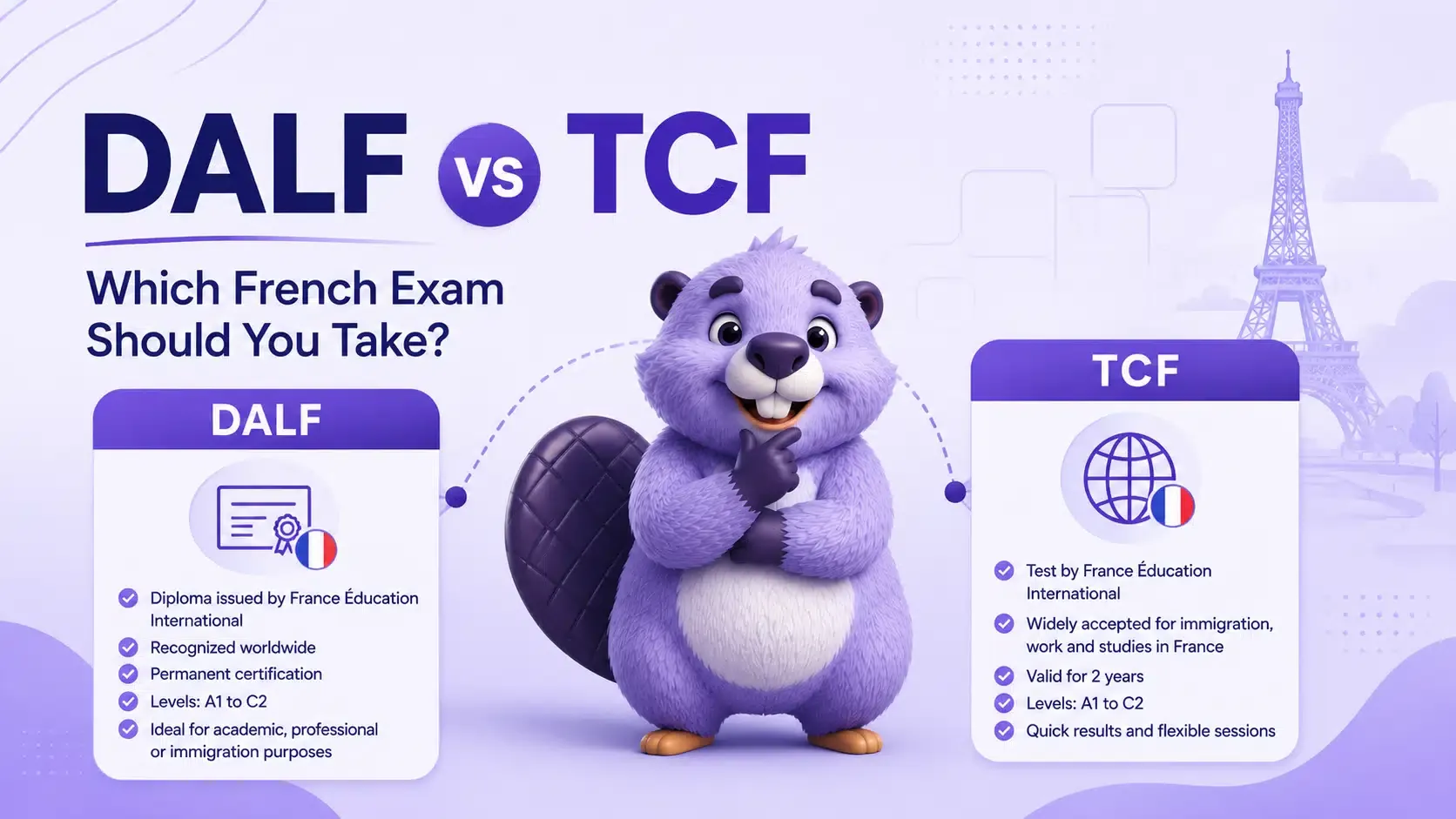
The DALF Exam is often compared with DELF, TCF, and TEF. They all assess French, but they serve different
Exam | Main Purpose | Levels | Validity | Best For |
|---|---|---|---|---|
DELF | Diploma for beginner to upper-intermediate French | A1–B2 | Lifetime | School, work, general proof |
DALF | Advanced French diploma | C1–C2 | Lifetime | University, career, advanced proof |
TCF | French level test | A1–C2 | Usually limited validity | Placement, study, immigration depending on version |
TEF | French test for study, work, immigration | A1–C2 | Usually limited validity | Canada immigration, academic or professional goals |
If your target is Canada immigration, TEF Canada or TCF Canada is usually more relevant than DALF. If your target is a lifelong advanced French diploma, the DALF Exam is stronger.
🎯Related Article: DALF vs TCF
Conclusion
The DALF Exam is a serious but valuable certification for advanced French learners. It proves C1 or C2 ability, stays valid for life, and can support academic, professional, and personal goals. To succeed, focus on structure, timing, synthesis, argumentation, and realistic practice.
Want to check your French test readiness before exam day? Try a mock test at Mocko.ai and build your preparation with clearer feedback.
FAQ About DALF Exam
Yes, the DALF Exam is difficult because it tests advanced French communication. You need to understand complex texts and recordings, write structured responses, and speak clearly about abstract topics.