
Versant Writing Practice
Table of Contents17 sections
Preparing for Versant Writing can feel confusing because the test is not just a normal writing exam. You do not simply write one essay and wait for a human examiner to read it. Instead, you complete several timed tasks that measure how accurately and efficiently you can use written English in practical situations.
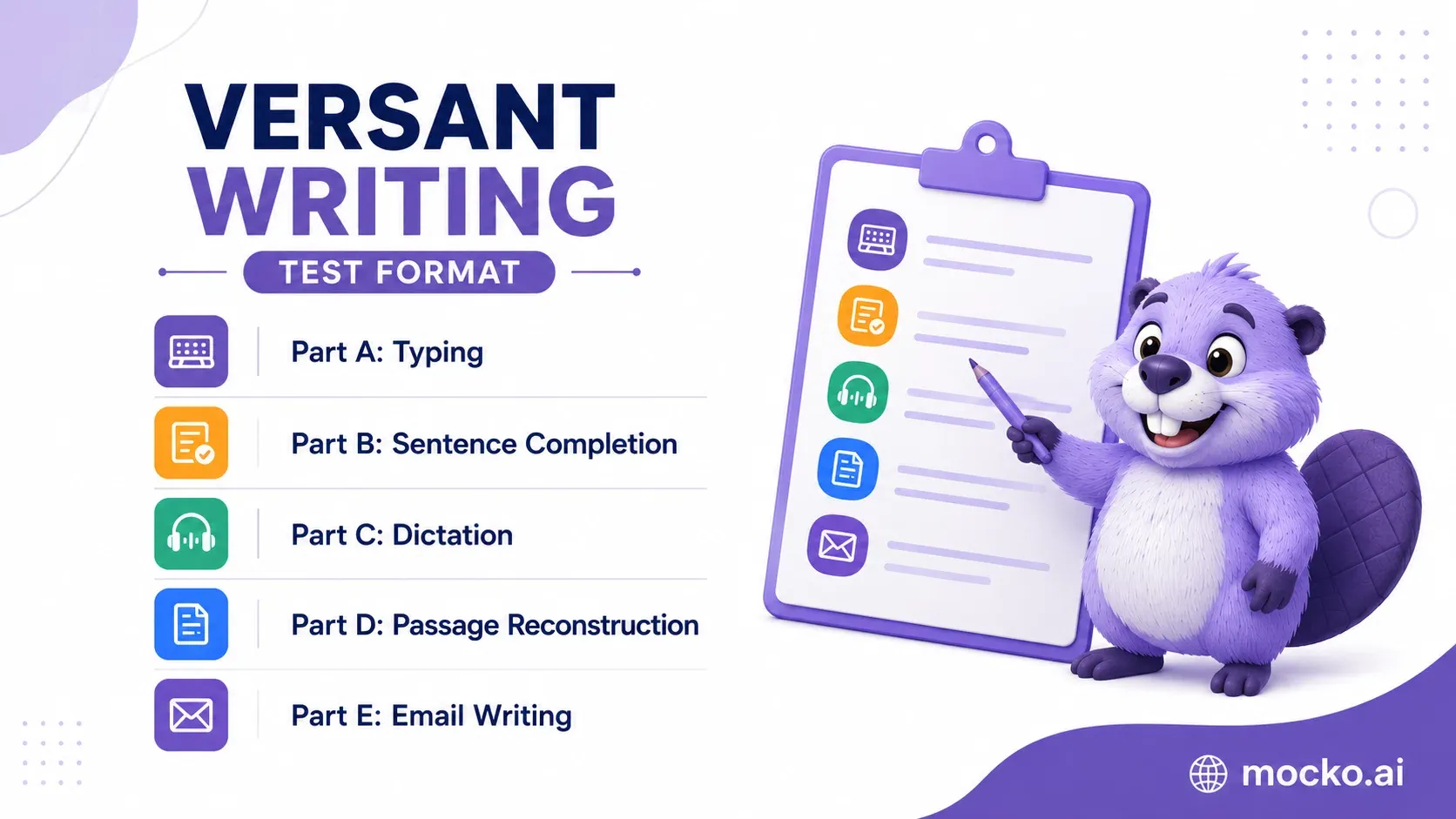
Which tasks you face depends on the test you were sent. On the Versant English Placement Test (VEPT), your Writing score comes from two tasks in the typed half of the paper: Passage Reconstruction and Summary and Opinion. The standalone Versant Writing Test has five parts: Typing, Sentence Completion, Dictation, Passage Reconstruction and Email Writing. Mocko practices both tests.
This guide covers the VEPT writing tasks first, then the full Writing Test format, how scoring works, and how to practice each section with a clear strategy.
Versant Writing on the Placement Test (VEPT)
On the VEPT, writing comes in the typed half of the paper, Parts E to I. Only two of those parts are scored into Writing: Sentence Completion feeds Reading, Dictation feeds Listening, and Typing feeds no score.
Part | Task | Items and Time | Scored Into |
|---|---|---|---|
E | Typing | 1 passage, 60 seconds | Not scored (typing speed and accuracy reported separately) |
F | Sentence Completion | 20 sentences, 25 seconds each | Reading |
G | Dictation | 16 sentences, 25 seconds each | Listening |
H | Passage Reconstruction | 3 passages, 30 seconds to read and 90 seconds to write | Writing |
I | Summary and Opinion | 1 passage, 18 minutes | Writing and Reading |
Part H: Passage Reconstruction
You read a short story of 45 to 65 words for 30 seconds. It disappears, and you have 90 seconds to write it back. You do not need the exact wording: the score depends on how many key points and details you keep, written in correct, clear English.
While reading, track who did what, why, and how it ended. Then write the events in the original order, in full sentences.
Part I: Summary and Opinion
You get one passage of 275 to 300 words that argues a view on an everyday topic, and 18 minutes for everything: reading it, summarizing the author's opinion in 25 to 50 words, and giving your own opinion in at least 50 words.
A workable split: about 4 minutes to read and note the author's view and two reasons, 5 minutes for the summary, 7 minutes for the opinion, and 2 minutes to check spelling and punctuation. Write the summary in your own words rather than copying sentences from the passage, and keep it inside the 25 to 50 word range.
Premium's full-length practice tests on Mocko run Parts E to I at these timings, with AI feedback on your passage reconstructions and your Summary and Opinion.
What Is the Versant Writing Test?
The Versant Writing test is an online English assessment designed to measure written communication in everyday and workplace contexts. It is commonly used by employers, call centers, business organizations, training providers, and educational institutions that need a fast way to evaluate written English ability.
The focus is practical communication. Candidates must show that they can understand English input, type accurately, choose appropriate vocabulary, reconstruct information, and write professional emails.
Unlike many academic writing exams, Versant Writing is highly timed. Each question has a time limit, and candidates cannot treat the test like a slow writing assignment. The challenge is not only knowing English; it is using English accurately at a functional pace.
What is Versant Writing?
The Versant Writing Test is Pearson's standalone writing assessment: Typing, Sentence Completion, Dictation, Passage Reconstruction and Email Writing, in about 35 minutes. It reports grammar, vocabulary, organization, voice and tone, and reading comprehension. On the VEPT, Versant Writing is one of four skill scores and comes from Passage Reconstruction and Summary and Opinion.
Versant Writing Test Format
A complete Versant Writing Practice plan must begin with the actual structure of the exam.
Part | Task | Items | Main Skill Tested | Practice Focus |
Part A | Typing | 1 | Typing speed and accuracy | Fast, accurate copying |
Part B | Sentence Completion | 20 | Vocabulary | Meaning, grammar, and word choice |
Part C | Dictation | 16 | Grammar and comprehension | Listen once and type accurately |
Part D | Passage Reconstruction | 4 | Grammar and reading comprehension | Rebuild meaning in your own words |
Part E | Email Writing | 2 | Vocabulary, organization, tone, grammar, reading comprehension | Write professional emails from a scenario |
This format matters because each part measures a different layer of written English. Someone with good email writing skills may still struggle with Dictation. Someone with strong grammar may still lose points in Passage Reconstruction if they cannot remember and organize the information.
How to Practice Part A: Typing
Typing may look simple, but it can affect your overall test experience. In this part, you see a passage and type as much of it as possible within the time limit.
For Versant Writing, typing practice should focus on two things: speed and accuracy. Do not train yourself to type fast with many mistakes. The better goal is controlled speed.
Practice method:
- Choose a short workplace-style paragraph.
- Set a 60-second timer.
- Type exactly what you see.
- Check spelling, punctuation, missing words, and capitalization.
- Repeat with a new passage.
A useful target is to build enough speed that typing no longer consumes your attention. When your fingers move confidently, your brain has more space for meaning, grammar, and structure in later parts of the test.
Part B: Sentence Completion
Sentence Completion is one of the most underestimated parts of Versant Writing. You see a sentence or two with one missing word and must enter the best word.
This section tests vocabulary in context. It is not enough to know many English words. You need to know which word fits the sentence grammatically and semantically.
For example, in a sentence about solving a business problem, the missing word may depend on collocation, meaning, or sentence structure.
Best practice method:
- Read the full sentence before guessing.
- Look at the words before and after the blank.
- Identify the part of speech needed.
- Think about the topic and tone.
- Type only one word.
- Check spelling and capitalization.
For stronger Versant Writing Practice, create your own gap-fill exercises from workplace emails, short reports, and business articles. Remove one key word and train yourself to choose the most natural option.
Part C: Dictation
Dictation must be included in any serious Versant Writing Practice plan. In this part, you hear a sentence once and type it word-for-word. You usually have very little time, so the task tests listening-to-writing transfer, grammar awareness, spelling, punctuation, capitalization, and short-term memory.
Many candidates think Dictation is only a listening exercise. It is not. You must hear the sentence, understand its structure, remember the exact wording, and type it correctly.
A strong Dictation routine:
- Listen to one sentence only once.
- Start typing as soon as you understand the first phrase.
- Keep the sentence structure in mind.
- Add punctuation and capitalization.
- Compare your answer with the original sentence.
- Mark the error type: missed word, spelling, grammar, punctuation, or memory.
Common Dictation mistakes include missing articles, dropping plural endings, confusing prepositions, forgetting capital letters, and typing the meaning instead of the exact sentence.
How should I practice Dictation for Versant Writing?
Practice Dictation by listening to short English sentences once, typing them immediately, and checking spelling, punctuation, capitalization, grammar, and missing words. The goal is not just listening comprehension; it is accurate transfer from spoken English into written English under time pressure.
Part D: Passage Reconstruction
Passage Reconstruction is where many candidates realize that Versant Writing is not based on memorization alone. In this part, you read a short passage, the passage disappears, and you rewrite it in your own words.
The goal is not to copy the exact text. The goal is to preserve the meaning, key details, and logical order.
Practice method:
- Read a short passage for meaning.
- Identify the main idea.
- Notice two or three supporting details.
- Remember the sequence.
- Hide the text.
- Rewrite it in complete sentences.
- Compare your version with the original.
Do not write a very short summary. Passage Reconstruction rewards your ability to include as much relevant detail as possible while using correct grammar and clear structure.
A practical technique is the “3-part memory frame”:
- What is the topic?
- What happened or what is explained?
- What is the final result or conclusion?
This helps you rebuild the passage without trying to memorize every word.
How to Practice Part E: Email Writing
Email Writing is the most obviously workplace-focused part of Versant Writing. You read a short scenario and write an email to a specific person, with nine minutes per email; Pearson expects at least 100 words. The task usually requires you to cover specific points, write in your own words, and use an appropriate professional tone.
A strong email should include:
- A suitable greeting
- A clear purpose
- All required points
- Supporting details
- A polite closing
- Complete grammatical sentences
The biggest mistake is writing a generic email that ignores the scenario. In Versant Writing, the reader, purpose, and required themes matter. If the prompt asks you to explain three reasons, you must cover all three. If the recipient is a supervisor, the tone should be professional rather than casual.
Useful structure:
Dear Mr. Johnson,
I am writing to explain...
First,...
Second,...
Finally,...
Thank you for your understanding.
Best regards,
[Name]
This structure is simple, but it works because it supports Organization, Voice and Tone, Grammar, Vocabulary, and Reading Comprehension at the same time.
Why the Number of Items Matters for Versant Writing Practice
The Versant Writing test usually presents around 43 items across five sections. This number is important because it shows that the test is not dominated by one long writing task. In fact, many items come from Sentence Completion and Dictation, which means candidates need strong accuracy in short, timed responses.
The items are selected from a large item pool, so most candidates will not receive the same set of questions from one test administration to another. For this reason, memorizing sample answers is not an effective preparation strategy. A better approach is skill-based practice: improving typing accuracy, vocabulary in context, dictation precision, passage memory, and professional email writing.
The exact number of items may change slightly over time because Pearson may add or remove new items. Some new items may be unscored and used only to support future test development. For candidates, the key lesson is simple: prepare for the task types and skills, not for fixed questions.
How Versant Writing Is Scored
The scoring logic behind Versant Writing is broader than grammar. Pearson’s framework reports five subscores: Grammar, Vocabulary, Organization, Voice and Tone, and Reading Comprehension.
Pearson's validation summary for the Writing Test weights them as Grammar 30%, Vocabulary 30%, Reading Comprehension 20%, Organization 10% and Voice and Tone 10%, and groups them into three aspects:
Scoring Area | Weight | Subscores | What It Means |
|---|---|---|---|
Linguistic quality | 60% | Grammar 30%, Vocabulary 30% | Range and accuracy of word use and sentence structure |
Content / Reading Comprehension | 20% | Reading Comprehension 20% | Understanding input and using it correctly in your response |
Rhetoric | 20% | Organization 10%, Voice and Tone 10% | Organization, clarity, voice, and tone |
These weights apply to the standalone Writing Test. The VEPT reports Writing as a single skill score on the GSE, from Passage Reconstruction and Summary and Opinion.
This is why Versant Writing Practice should not be limited to grammar drills. Grammar is important, but the test also rewards candidates who can understand context, preserve meaning, organize information, and write in a suitable tone.
1. Linguistic Quality (60%)
This includes:
- Grammar
- Vocabulary
- Sentence structure
- Word choice
Errors that reduce clarity can lower this portion of your score.
2. Content Accuracy (20%)
For Passage Reconstruction, the system evaluates whether you understood and conveyed the essential information from the original text.
Candidates often lose points because they remember individual words instead of the main ideas.
3. Organization and Voice (20%)
Writing should feel natural and easy to follow.
The scoring system rewards:
- Logical flow
- Clear sentence connections
- Appropriate tone
- Concise communication
Is Versant Writing only about grammar?
No. Versant Writing evaluates grammar, but it also measures vocabulary, reading comprehension, organization, voice and tone, and the ability to write accurately under time pressure. A candidate can lose points even with good grammar if the response misses key information or uses the wrong tone.
What the Test Really Measures
The Versant Writing construct is based on functional written English. In simple terms, the test asks: can this person understand English input and produce appropriate written English quickly enough for real-life or workplace use?
Three hidden skills are especially important.
- First, context matters. In Sentence Completion, you cannot choose a word by looking at grammar alone. You must understand the meaning of the sentence. In Email Writing, you must understand who the reader is and why you are writing.
- Second, memory matters. Dictation and Passage Reconstruction require you to retain language or meaning for a short period. You need to remember what you heard or read, then reproduce it accurately.
- Third, functional pace matters. The test is timed. Good English written too slowly may not produce a complete response.
The Skills Human Raters Value
Although scoring is automated, the evaluation models were developed using expert human judgments.
Experienced language specialists assessed writing based on qualities such as:
- Vocabulary
- Grammar
- Organization
- Voice and tone
- Email conventions
- Task completion
That means effective Versant Writing Practice should focus on communication rather than memorized patterns.
Common Versant Writing Mistakes
A complete Versant Writing Practice plan should target the mistakes candidates actually make.
Common mistakes include:
- Practicing only Email Writing and ignoring Typing, Sentence Completion, and Dictation
- Treating Passage Reconstruction as a short summary
- Focusing on grammar but missing task requirements
- Writing too informally in emails
- Ignoring punctuation and capitalization
- Practicing without a timer
- Typing slowly and running out of time
- Memorizing templates instead of learning flexible structures
Timing often surprises test-takers. Some people know the task types but still struggle because they do not know how fast they need to respond. This is why mock test practice is more useful than passive studying.
A Weekly Versant Writing Practice Plan
Day | Activity |
|---|---|
Monday | One Passage Reconstruction exercise |
Tuesday | Two professional email responses |
Wednesday | Reading summary practice |
Thursday | Timed reconstruction drills |
Friday | Email editing and rewriting |
Saturday | Full writing simulation |
Sunday | Error analysis and review |
Consistency is more valuable than long study sessions.
Twenty focused minutes a day is worth more than one long session a week.
How to Use Mock Tests Effectively
Mock tests are useful only if you review them correctly. After each Versant Writing simulation, do not simply look at the overall result. Break your performance into sections.
Ask yourself:
- Did I type quickly enough?
- Did I miss easy words in Sentence Completion?
- Did I lose exact wording in Dictation?
- Did I include enough details in Passage Reconstruction?
- Did my email cover all required points?
- Was my tone professional?
For broader preparation, you can start with Complete Versant Test preparation to understand the full exam environment. If Dictation or audio-based memory feels difficult, combine your writing work with Versant Listening practice. If your written sentences feel unnatural, Versant Speaking practice can help you build faster sentence formation and a more natural English rhythm. You can also use Versant Reading practice to improve your understanding of sentence structure, vocabulary, and how ideas are connected in English.
Final Tips Before Test Day
- Read for meaning, not memorization.
- Keep sentences clear and concise.
- Follow a logical structure.
- Avoid unnecessary complexity.
- Practice under timed conditions.
- Review both content and grammar.
Strong Versant Writing Practice develops communication skills that extend beyond the exam itself.
Conclusion
Success in Versant Writing comes from understanding how the test evaluates communication. Grammar matters, but accurate content and clear organization are equally important.
The best preparation combines realistic exercises, regular feedback, and balanced skill development. To simulate the real test, start with one free Versant practice test; Premium includes 10 full-length practice tests.
FAQ
001How long is the Versant Writing Test?
About 35 minutes for the standalone Versant Writing Test: five parts and about 43 items. On the Versant English Placement Test, the typed Parts E to I are part of one sitting of about 50 minutes, and Part I alone has an 18-minute clock.
002What are the main task types?
It depends on the test. The standalone Versant Writing Test has Typing, Sentence Completion, Dictation, Passage Reconstruction and two Email Writing tasks. The VEPT has no email task: its Writing score comes from Passage Reconstruction and Summary and Opinion.
003Is the Versant Writing Test graded by humans?
The final score is generated automatically by Pearson's AI scoring system, although the underlying models were developed using expert human ratings.
004How can I improve my Versant Writing score?
Practice each part on its own clock: 60 seconds of copy-typing, one-word gap fills in 25 seconds, dictation sentences typed exactly, passages rebuilt in 90 seconds, and either emails in nine minutes (Writing Test) or Summary and Opinion in 18 minutes (VEPT). Then review your errors by type: spelling, grammar, missing content or tone.
005Is Versant Writing difficult?
The language is everyday English, but the clocks are tight: 25 seconds per Sentence Completion and Dictation item, 90 seconds to rebuild each passage, and nine minutes per email, or 18 minutes for the whole of Summary and Opinion on the VEPT. Timed practice is what makes it manageable.
Rated 5.0 by the Product Hunt community
Real, public reviews from candidates who prepared with Mocko. Verify them on Product Hunt