
DILF Exam - Prepare for the DILF test
Table of Contents17 sections
The DILF Exam is the first official French diploma for learners who are at the very beginning of their French journey. It is designed for adults and older teenagers who can use basic French in simple daily situations, such as understanding a public announcement, filling in a form, asking for a price, or explaining a simple need. If DELF A1 still feels too difficult, the DILF Exam may be the right starting point.
This guide explains what the DILF Exam is, who should take it, how the test is structured, how scoring works, and how to prepare in a practical way.
What Is the DILF Exam?
The DILF Exam stands for Diplôme Initial de Langue Française. It validates level A1.1, which is below DELF A1 and represents the very first stage of French language learning. The diploma is issued by the French Ministry of National Education and belongs to the same official diploma pathway as DELF and DALF.
The DILF Exam is not a general advanced French test. It is built for beginners who need to prove that they can understand and produce very simple French in real-life situations. The exam focuses heavily on oral communication because many candidates are new arrivals in France or learners who are still developing reading and writing confidence.
The DILF Exam is an official French diploma for beginner learners at A1.1 level. It tests listening, reading, speaking, and writing, with stronger weight on oral skills. It is mainly for adults and older teenagers starting French, especially learners living in France.
Who Should Take the DILF Exam?
The DILF Exam is best for learners who are not ready for DELF A1 yet. You may be a good candidate if you can understand basic words, respond to simple questions, recognize numbers and times, and complete very short written tasks.
The DILF Exam is especially useful for:
- New French learners who want an official first diploma
- Adults beginning French after moving to France
- Learners who need confidence before DELF A1
- Students in beginner French programs
- Candidates who struggle with reading and writing but can communicate orally
The minimum age is 16 on the date of the first test. This makes the DILF Exam suitable for older teenagers and adults, but not for young children.
DILF Exam vs DELF A1: What Is the Difference?
Many learners confuse the DILF Exam with DELF A1. They are connected, but they are not the same.
Exam | Level | Best For | Main Focus |
|---|---|---|---|
DILF Exam | A1.1 | Absolute beginners | Basic daily communication |
DELF A1 | A1 | Beginner learners with more French | Broader basic language skills |
DELF A2 | A2 | Elementary learners | More independent communication |
The DILF Exam is the first step. DELF A1 comes after it. If you can introduce yourself, ask simple questions, understand basic information, and write a short message, you may be close to A1. If these tasks still feel difficult, the DILF Exam is a more realistic target.
DILF Exam Format
The DILF Exam has four parts:
Section | Duration | Score |
|---|---|---|
Listening comprehension | 25 minutes | 35 points |
Reading comprehension | 25 minutes | 15 points |
Written production | 15 minutes | 15 points |
Speaking production | 10 minutes | 35 points |
Total | 1 hour 15 minutes | 100 points |
The DILF Exam gives 70 points to oral skills and 30 points to written skills. This is one of the most important things to understand. The exam is not designed to punish beginners for imperfect writing. It checks whether you can function in basic situations.
Listening Comprehension
In the listening section of the DILF Exam, you hear short audio situations. You may need to understand a public announcement, a simple instruction, a direction, a number, a time, or basic information.
Example skills include:
- Understanding “Le train part à 10 heures”
- Recognizing a phone number
- Identifying a place or direction
- Following a short instruction
- Understanding a simple announcement
To prepare, listen to slow beginner French every day. Focus on numbers, dates, times, places, family words, food, health, transport, and appointments.
Reading Comprehension
The reading section of the DILF Exam is short and practical. You may read a simple sign, form, notice, message, or instruction. The goal is not to analyze long texts. The goal is to find essential information.
You should practice reading:
- Addresses
- Opening hours
- Prices
- Simple forms
- Appointment cards
- Public signs
- Short messages
A good strategy is to collect real-world French examples from daily life. Look at metro signs, pharmacy notices, school forms, supermarket labels, and simple emails.
Written Production
The written part of the DILF Exam checks whether you can write basic information correctly enough to be understood. You may need to copy an address, write a number, complete a form, or leave a simple message.
Typical tasks may include:
- Writing your name and address
- Writing a date or price
- Completing personal information
- Leaving a short note
- Writing a basic sentence about a need
For beginners, the key is accuracy with everyday details. Practice writing your full name, address, phone number, birthday, nationality, profession, and short messages such as “Je suis malade” or “Je voudrais un rendez-vous.”
Speaking Production
Speaking is the most important part of the DILF Exam. It is worth 35 points and is done individually with assessors. The tasks are simple but practical.
You may need to:
- Introduce yourself
- Ask for a price
- Give a price
- Describe a person
- Describe a place
- Ask for an appointment
- Express a need
- Explain a basic health problem
This section rewards clear communication, not perfect grammar. A candidate who speaks slowly, answers the question, and uses simple correct phrases can do well.
Expert insight:
For the DILF Exam, memorizing long sentences is less useful than mastering flexible sentence patterns. Learn structures like “Je voudrais…”, “J’ai besoin de…”, “Où est…?”, “Combien ça coûte?”, and “Je ne comprends pas.” These help you survive many speaking tasks.
How Is the DILF Exam Scored?
The DILF Exam is scored out of 100. To obtain the diploma, you need:
- 50/100 overall
- At least 35/70 in oral sections
This means oral performance is essential. A candidate cannot rely only on reading and writing. You need to show that you can understand and speak basic French.
The diploma is valid for life, so you do not need to retake it once you pass. This makes the DILF Exam useful as a first official milestone before moving toward DELF A1 or DELF A2.
Where Can You Take the DILF Exam?
The DILF Exam is offered only in France. Registration is done through approved exam centres. Session dates and prices are set by centres, so candidates should contact a local approved centre directly.
Before registering, check:
- The next available session
- Registration deadline
- Exam fee
- Required ID documents
- Whether preparation courses are available
- When results will be issued
Do not wait until the last week. Some centres have limited places, and beginner learners often need help understanding the registration process.
How to Prepare for the DILF Exam
The best way to prepare for the DILF Exam is to train with real-life tasks. This is not an exam where you need complex essays or advanced grammar. You need practical French.
Step 1: Learn survival French phrases
Start with phrases you can use in many situations:
- Bonjour, je m’appelle…
- Je voudrais…
- J’ai besoin de…
- Je cherche…
- Combien ça coûte?
- Où est…?
- Je ne comprends pas.
- Pouvez-vous répéter?
These phrases help in speaking and listening.
Step 2: Master numbers, dates, and time
The DILF Exam often checks basic information such as prices, times, dates, and phone numbers. Practice hearing and writing numbers from 0 to 100, common prices, days of the week, months, and appointment times.
Step 3: Practice forms and personal information
Many beginners lose points because they cannot write personal details clearly. Practice completing forms with your name, address, phone number, nationality, date of birth, and signature.
Step 4: Use official-style speaking tasks
Practice short role-plays. For example:
Examiner: “Vous voulez un rendez-vous chez le médecin.”
Candidate: “Bonjour. Je voudrais un rendez-vous, s’il vous plaît. J’ai mal à la tête.”
This is simple, but it matches the practical spirit of the DILF Exam.
Step 5: Take beginner mock tests
A mock test helps you understand timing and pressure. Even if Mocko.ai focuses more on exams like TEF and TCF, using the homepage to start structured French practice can help you build the habits needed for official French exams. You can also use Mocko.ai’s TEF preparation resources later if your goal becomes immigration or a higher French level.
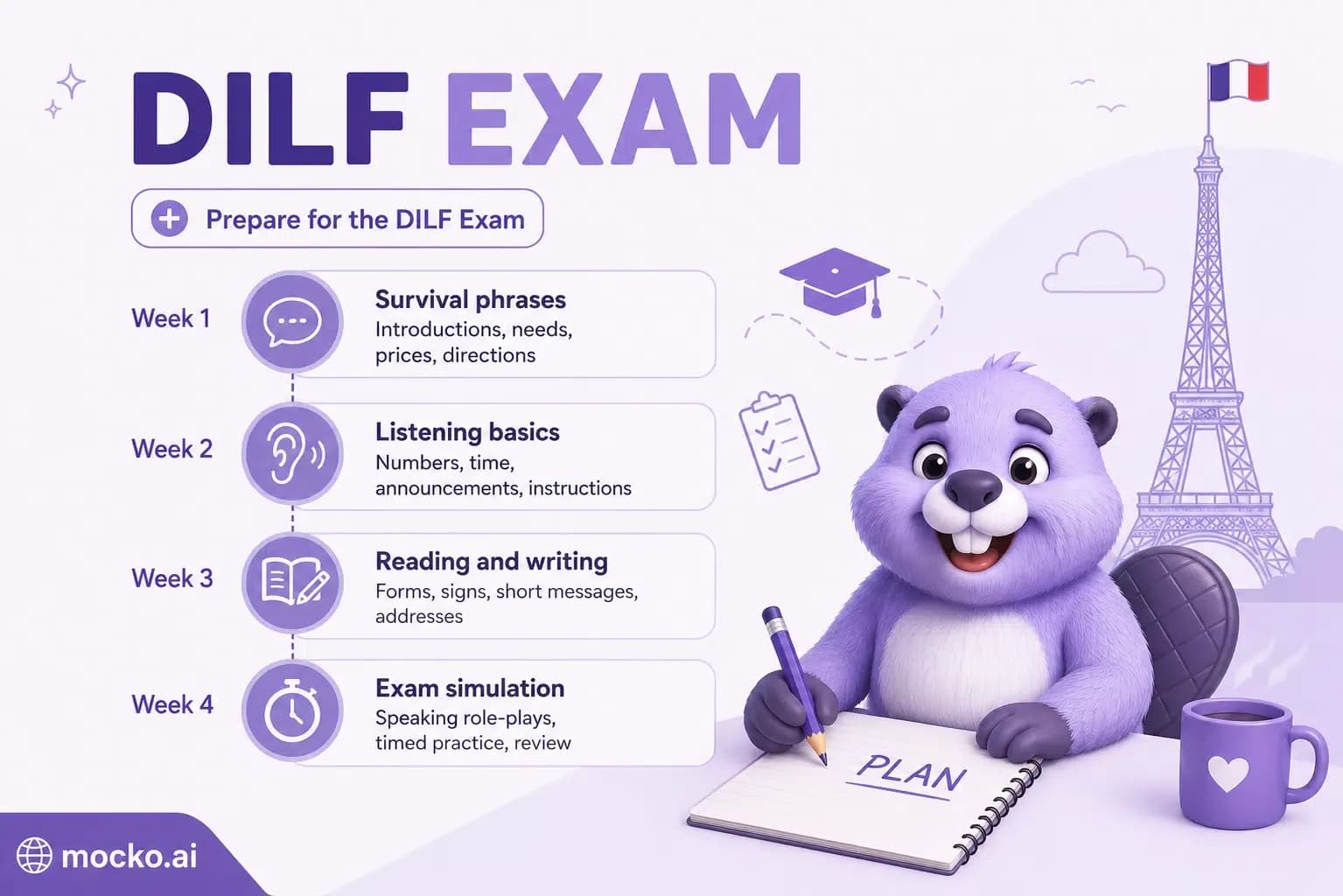
A Practical 4-Week DILF Exam Study Plan
Week | Focus | Tasks |
|---|---|---|
Week 1 | Survival phrases | Introductions, needs, prices, directions |
Week 2 | Listening basics | Numbers, time, announcements, instructions |
Week 3 | Reading and writing | Forms, signs, short messages, addresses |
Week 4 | Exam simulation | Speaking role-plays, timed practice, review |
Study for 30–45 minutes a day. Short daily practice works better than one long weekly session. The DILF Exam measures automatic basic communication, so repetition matters.
Common Mistakes to Avoid
Many candidates prepare for the DILF Exam in the wrong way. They try to study too much grammar and ignore practical communication.
Avoid these mistakes:
- Memorizing grammar rules without speaking
- Ignoring numbers and dates
- Not practicing forms
- Speaking too fast
- Giving no answer when confused
- Preparing for DELF A1 instead of A1.1
- Studying only with apps and no real exam tasks
If you do not understand a question, use a survival phrase: “Pouvez-vous répéter, s’il vous plaît?” This is better than staying silent.
Is the DILF Exam Difficult?
The DILF Exam is not difficult for learners who prepare for the correct level. It becomes difficult when candidates expect it to be like a normal school exam or when they do not practice speaking.
The exam checks basic communication. You do not need advanced grammar, long writing, or complex vocabulary. You need to understand simple French and respond clearly.
The DILF Exam is usually manageable for prepared A1.1 learners. It is easier than DELF A1, but candidates must practice oral communication, numbers, forms, and simple daily situations. Speaking and listening are the most important areas because they carry most of the score.
What Comes After the DILF Exam?
After the DILF Exam, the next logical step is DELF A1. Then you can continue to DELF A2, DELF B1, DELF B2, and later DALF C1 or C2.
If your goal is immigration, university admission, or professional proof of French, you may eventually need another test such as TEF or TCF. For example, learners preparing for Canadian immigration often move toward TEF Canada after building a stronger foundation. Mocko.ai’s TEF Canada guide can help you understand that future pathway when you are ready.
If you want to compare official French testing options later, Mocko.ai also has resources on TCF Tout Public and advanced French exams such as DALF. These are not replacements for the DILF Exam, but they help you understand the bigger French certification map.
Final Preparation Checklist
Before test day, make sure you can:
- Introduce yourself
- Ask for a price
- Understand simple numbers
- Understand the time
- Complete a basic form
- Write a short message
- Ask for an appointment
- Explain a simple need
- Describe a person or place
- Ask someone to repeat
If you can do these tasks calmly, you are close to the level expected in the DILF Exam.
Conclusion
The DILF Exam is an ideal first certification for beginner French learners. By focusing on practical communication at the A1.1 level, it helps candidates build confidence and establish a solid foundation for future exams such as DELF A1 and beyond.
FAQ
No. The DILF Exam validates A1.1, which is below DELF A1. DELF A1 requires broader beginner skills.