

Versant Listening Practice
Table of Contents13 sections
Preparing for the Versant test can feel different from studying for IELTS, CELPIP, or PTE. The exam moves quickly, responses are timed, and the listening component plays a major role in determining your overall performance. Effective Versant Listening preparation is not simply about understanding English. It is about processing information quickly, retaining details, and responding accurately under pressure.
Many candidates discover that their biggest challenge is not vocabulary or grammar. Instead, they struggle to understand spoken English in real time while maintaining concentration throughout the test.
This guide explains how Versant Listening works, what question types you can expect, and how to build a practical study plan that improves your listening performance before test day.
What Is Versant Listening?
Versant Listening measures your ability to understand spoken English in real-world situations. The test evaluates how effectively you process information, identify meaning, and respond to audio prompts.
Unlike traditional academic exams, the Versant test focuses on practical communication skills. The system analyzes how well you understand spoken English rather than how many grammar rules you can memorize.
What is Versant Listening?
Versant Listening is one of the four skill scores on the Versant English Placement Test (VEPT). It comes from two parts: Part D Conversations, where you answer a question about a short dialogue out loud, and Part G Dictation, where you type each sentence you hear exactly.
How the Listening Section Works
On the Versant English Placement Test (VEPT) there is no separate listening section. Your Listening score comes from two parts, one in each half of the paper:
Part | What You Do | Items | Time per Item |
|---|---|---|---|
D: Conversations | Hear a short conversation between two speakers, then a question, and answer out loud in a word or short phrase | 12 | 15 seconds |
G: Dictation | Hear a sentence once and type it exactly as you heard it | 16 | 25 seconds |
All audio plays once, and every item runs on its own clock. Part B Repeat and Part C Sentence Builds also start with audio, but they are scored into Speaking; see our Versant Speaking guide.
Pearson publishes other Versant tests, such as the Speaking and Listening Test and the Professional English Test, with different listening tasks. Mocko does not practice those, so check which test your invitation names.
Types of Versant Listening Questions
Understanding the structure of Versant Listening questions helps you prepare more effectively.
Part D: Conversations
You hear a conversation between two speakers, usually three turns long, followed by a question about it. You answer out loud with a word or a short phrase. The speakers are not named, so questions refer to "the man" or "the woman".
Example:
Woman: Are you coming to the team lunch on Friday?
Man: I'd like to, but I have a dentist appointment at noon.
Woman: That's a shame. Maybe next time.
Question: Why can't the man go to the lunch?
Answer: He has a dentist appointment.
Tips for Part D
- Note which voice is the man and which is the woman as soon as the conversation starts.
- Listen for the situation, not every word: who wants what, what the problem is and what they decide.
- Answer only the question. "A dentist appointment" is enough; a long explanation wastes the window and adds words that can be misheard.
- Speak clearly: your answer is spoken, so the scoring has to recognize it.
- If you missed part of it, give your best short answer rather than staying silent.
Part G: Dictation
You hear a sentence once and type it exactly as you heard it, with 25 seconds per sentence. The 16 sentences get longer as the part goes on, from about 3 to 14 words, and they are read by a range of voices, including non-native speakers.
Example: you hear "Could you send me the updated schedule before Thursday?" and type it word for word, with the capital letters and the question mark.
Tips for Part G
- Hold the meaning, then rebuild the words. Strong listeners remember what a sentence said and use grammar to fill in the small words.
- Watch the small words: articles, prepositions, plural -s, past tense -ed and contractions such as I'll or don't.
- Spell carefully and type the punctuation; across sixteen sentences, small slips add up.
- Start typing as soon as the audio ends, then use the remaining seconds to check.
- If you miss a word, type everything else you heard rather than leaving the sentence unfinished.
Common Mistakes
Many candidates lose points because they overthink simple questions. In most cases, a short and accurate answer is all that is required. Long explanations can reduce fluency and waste valuable response time.
How Versant Listening Is Scored
The VEPT reports Listening as one of four skills, on the Global Scale of English (GSE) from 10 to 90 with a CEFR band. Pearson weights the four skills equally, so Listening is a quarter of the overall score.
Part | What the Scoring Checks |
|---|---|
D: Conversations | Whether your spoken answer contains the words that answer the question |
G: Dictation | Whether your typed sentence has the expected words, in the right order and correctly spelled |
Fluency and pronunciation are Speaking traits. On the Listening side, what counts is whether you understood, so a short, correct answer is exactly what Part D asks for.
How is Versant Listening scored?
Versant Listening is scored automatically from Part D Conversations and Part G Dictation and reported on the GSE 10-90 scale with a CEFR band. The scoring checks whether your answers contain the expected words, so understanding matters more than how polished you sound.
Common Challenges in Versant Listening
Many candidates face similar obstacles.
1. Fast Speech
Native-speed English can feel overwhelming.
Many learners understand English during classroom exercises but struggle when speech becomes natural and conversational.
2. Limited Thinking Time
The exam leaves little time to analyze information.
Candidates must process, remember, and respond almost immediately.
3. Unfamiliar Accents
Dictation sentences are read by a range of voices, including non-native speakers, and every Part D conversation has two speakers.
Exposure to various accents improves comprehension flexibility.
4. Memory Load
Both Listening parts require remembering details after hearing them only once.
This combines listening skill with working memory.
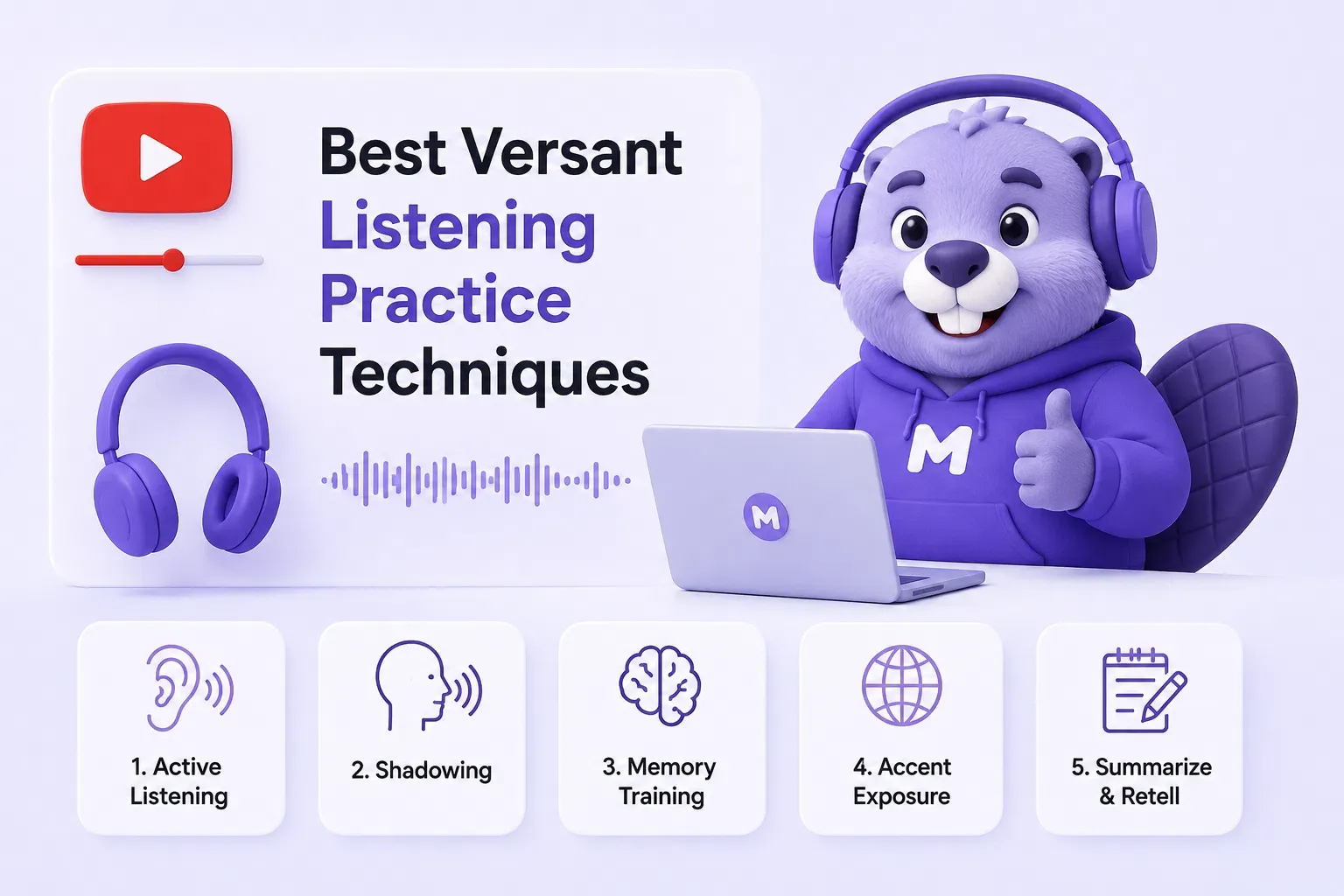
Best Versant Listening Practice Techniques
The most effective Versant Listening preparation focuses on realistic listening conditions.
1. Practice Active Listening
Passive listening rarely improves scores.
Instead:
- Listen carefully
- Identify key ideas
- Predict information
- Summarize what you heard
This mirrors real exam demands.
2. Use the Shadowing Method
Shadowing involves repeating speech immediately after hearing it.
Benefits include:
- Better listening accuracy
- Improved pronunciation
- Faster processing speed
This technique is especially valuable for Versant Listening preparation.
3. Train Short-Term Memory
For Dictation, memory is crucial: you have to hold a sentence of up to about 14 words long enough to type it.
Practice by:
- Listening to a sentence once
- Waiting three seconds
- Typing it completely, then checking it against the original
Gradually increase sentence length.
4. Listen to Multiple English Accents
Use sources from:
- United States
- Canada
- United Kingdom
- Australia
Exposure reduces surprises on test day.
5. Answer Questions About Short Exchanges
Use short dialogues from podcasts, TV series or language-learning audio:
- Listen to three or four lines once
- Ask yourself a who, what or why question about them
- Answer out loud in a few words within 15 seconds
This directly trains Part D Conversations.
A Daily Versant Listening Practice Plan
Candidates often ask how much preparation is needed.
The following routine works well for most learners.
Activity | Time |
|---|---|
Dictation drill: type sentences you hear once, 25 seconds each | 10 min |
Short dialogues with one question, answered out loud | 10 min |
Audio-only listening (podcasts, news) without subtitles | 15 min |
Shadowing | 10 min |
Timed practice items for Parts D and G | 15 min |
Total daily time:
60 minutes
Consistency matters more than occasional long study sessions.
How can I improve Versant Listening quickly?
Practice the two scored parts every day: short dialogues followed by one question you answer in a few words (Part D), and sentences you type exactly after one playback (Part G). Add audio-only listening without subtitles, and finish with timed practice tests.
Why Many Candidates Plateau
An overlooked issue in Versant Listening preparation is overreliance on subtitles.
Many learners consume English content with captions and believe they understand spoken English well.
However, the brain often reads instead of listens.
To build genuine listening ability:
- Remove subtitles gradually
- Focus on audio-only content
- Train your ears rather than your eyes
That matters on the Versant test, where everything plays once and nothing is captioned.
Mistakes That Lower Versant Listening Scores
Focusing Only on Grammar
Grammar knowledge helps, but listening performance requires practical comprehension.
Ignoring Pronunciation
Speaking clearly improves the system's ability to recognize responses.
Practicing Without Time Limits
Untimed practice does not prepare you for the real exam environment.
Using Easy Audio Only
Many learners stay within their comfort zone. Challenge yourself with authentic spoken English.
Not Reviewing Errors
Improvement comes from understanding your mistakes, so review missed words, misunderstood phrases, vocabulary gaps, and accent-related difficulties after every practice session.
Using Mock Tests Effectively
Mock tests are one of the best ways to improve Versant Listening performance because they replicate exam pressure.
Benefits include:
- Familiarity with timing
- Reduced anxiety
- Better pacing
- Performance tracking
Candidates who regularly complete realistic simulations often develop stronger confidence before test day.
On Mocko, you can start with one free Versant practice test, AI-scored in minutes. Premium includes 10 full-length practice tests of the nine-part paper, so Parts D and G come at their real timings and your Listening score is reported on the GSE with a CEFR band.
Prefer to see a paper first? The free Versant sample exam is a full nine-part paper you can read before you sit anything.
Building a Strong Listening Environment
Improvement often happens outside dedicated study sessions.
Consider:
- Listening to podcasts during walks
- Following English news daily
- Watching interviews without subtitles
- Repeating short clips aloud
These activities strengthen the same skills evaluated in Versant Listening.
Final Thoughts
Doing well on the Versant test usually comes from regular practice, repeated exposure to English, and learning how to respond under time pressure. It is not enough to only understand English in a general way. You also need to process what you hear or read quickly, choose the right response, and stay accurate while the clock is running.
For better preparation, try to balance your study time across the main parts of the exam. Listening practice can help you follow information more quickly, while Versant Speaking Practice can improve your pronunciation, fluency, and response speed. It is also useful to spend time on Versant Writing Practice so you can organize your ideas clearly and avoid common grammar mistakes.
As you get closer to your test date, full practice tests can help you understand your current level more realistically. A complete mock exam gives you a clearer picture of which skills are already strong and which areas still need more focused practice. You can also review our guides on Versant Reading Practice and other Versant sections to build a more complete preparation plan.
FAQ
001Is Versant Listening difficult?
Many candidates find it challenging because answers are timed and audio plays only once. Practicing the two scored parts, Conversations and Dictation, under their real timings makes the format familiar.
002How long should I study for Versant Listening?
It depends on your deadline and your starting level. Most candidates get days rather than weeks, so start with one timed run of Parts D and G, then spend the remaining days on whichever of the two cost you more.
003Does Versant Listening use different accents?
Yes. Pearson says the Dictation sentences are read at a natural pace by a range of native and non-native speakers, in voices different from the examiner's. Practice with audio from more than one country.
004What is the best way to practice Versant Listening?
Practice the two parts that are scored: short dialogues followed by one question you answer out loud in a few words (Part D), and sentences you hear once and type exactly, with spelling and punctuation (Part G). Shadowing and audio-only listening help both.
005Can I improve my Versant Listening score in one month?
A month is enough to get comfortable with the format: answering in a few words in Part D and typing full, correctly spelled sentences in Part G. How far your score moves depends on your starting level, so measure it with a timed run at the start and at the end.
Rated 5.0 by the Product Hunt community
Real, public reviews from candidates who prepared with Mocko. Verify them on Product Hunt