

CELPIP Writing Practice Test
Table of Contents9 sections
The CELPIP Writing test challenges thousands of test-takers every month, and most struggle with the same issues: running out of time, unclear structure, or missing the task requirements. If you're preparing for Canadian immigration or professional designation, understanding how CELPIP Writing works isn't optional, it's essential. This guide breaks down both writing tasks, reveals what evaluators actually look for, and gives you actionable strategies to score 9 or higher.
What is CELPIP Writing?
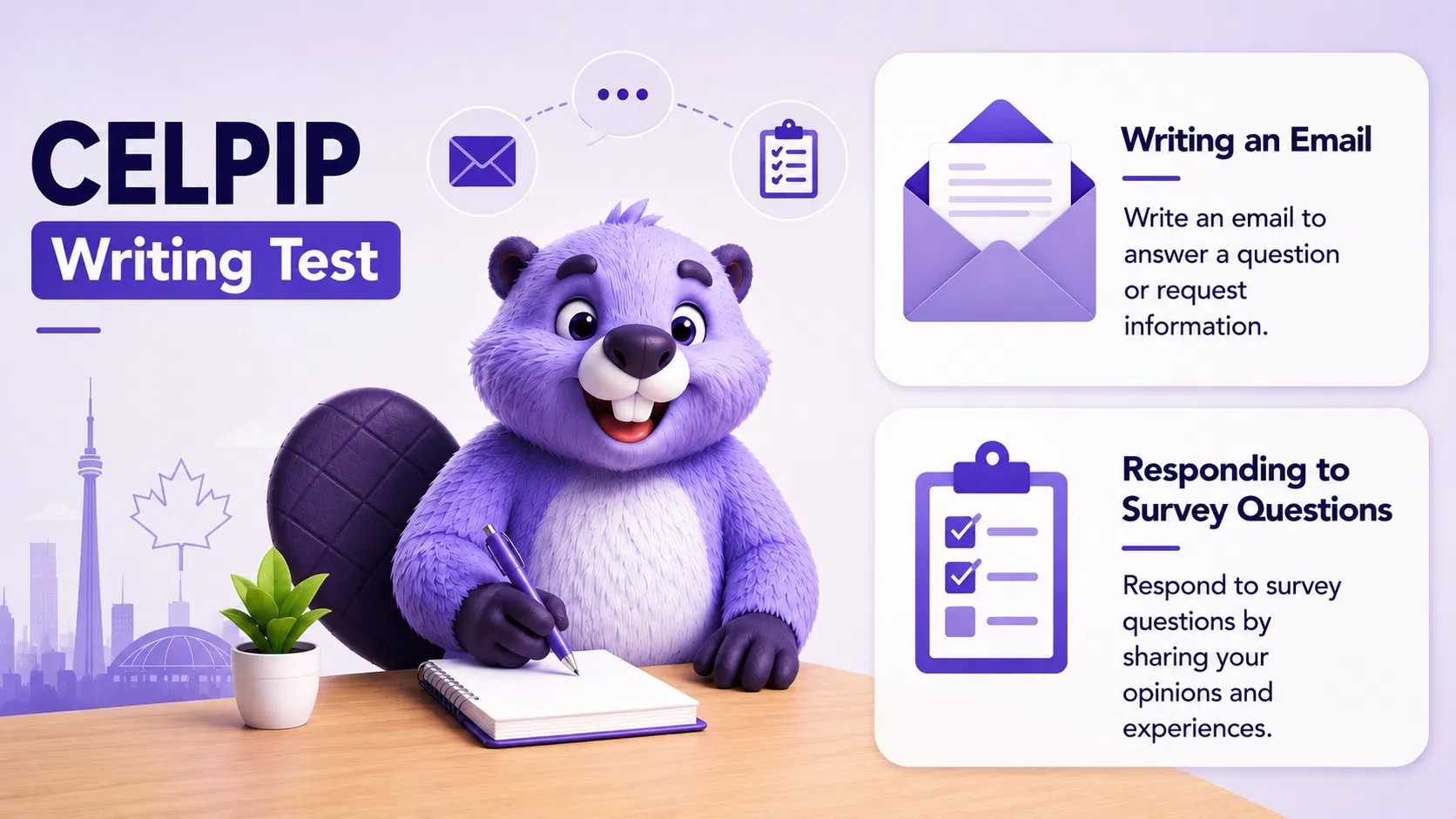
CELPIP Writing is the third component of the CELPIP-General test, consisting of two distinct tasks completed in 53-60 minutes. Unlike IELTS, CELPIP Writing is entirely computer-based, requiring you to type your responses directly into the testing interface. Task 1 focuses on email writing (formal or semi-formal), while Task 2 requires you to respond to a survey question with a persuasive essay.
What Does CELPIP Writing Measure?
The CELPIP Writing section is designed to evaluate how effectively you can communicate in situations that resemble everyday life, workplace communication, and community interactions. Examiners are not simply looking for advanced vocabulary or perfect grammar. They also assess how well you develop your ideas, organize information, and communicate your message to the intended reader.
Feature | Details |
|---|---|
Number of Tasks | 2 |
Total Time | Approximately 53 minutes |
Task 1 | Writing an Email |
Task 2 | Responding to Survey Questions |
Test Format | Computer-delivered |
Main Focus | Practical written communication |
Skills Assessed | Task fulfillment, organization, idea development, vocabulary, grammar, and tone |
Most Common Mistake | Failing to fully address the prompt |
Key to a High Score | Clear communication supported by relevant reasons and examples |
CELPIP Writing Task 1: Writing an Email
Understanding Task 1 Requirements
Task 1 presents a scenario requiring you to write an email, typically between 150-200 words. You have 27 minutes total, but the system automatically moves you to Task 2 after this time expires—no extensions.
The email scenarios fall into three categories:
- Formal emails: Writing to supervisors, landlords, or service providers
- Semi-formal emails: Communicating with colleagues or acquaintances
- Problem-solving emails: Addressing complaints, requests, or scheduling conflicts
Each prompt includes specific points you must address. Missing even one requirement significantly impacts your score.
Task 1 Structure That Works:
➡️Opening (1-2 sentences):
- Greet the recipient appropriately
- State your purpose immediately
Example: "Dear Ms. Thompson, I am writing to inform you about a scheduling conflict with the upcoming project meeting."
➡️Body (3-4 paragraphs):
- Address each bullet point from the prompt in order
- Dedicate one paragraph per requirement
- Use clear topic sentences
- Provide specific details or examples
➡️Closing (1-2 sentences):
- Summarize your main request or offer next steps
- Use appropriate sign-off language
✅ Example: "I appreciate your understanding and look forward to your response. Best regards, [Your name]"
Timing Breakdown for Task 1:
Phase | Time Allocation | Action |
|---|---|---|
Planning | 3–4 minutes | Read the prompt, identify requirements, and create a brief outline |
Writing | 18–20 minutes | Write the email using the planned structure |
Review | 3–4 minutes | Proofread for content, grammar, spelling, and clarity |
Common Task 1 Mistakes
- Wrong tone: Using casual language in formal contexts or overly stiff language with colleagues
- Incomplete coverage: Missing one of the required bullet points
- Poor organization: Jumping between points without clear paragraphs
- Generic responses: Not providing specific details requested in the prompt
- Length issues: Writing under 150 words or rambling beyond 200
CELPIP Writing Task 2: Responding to Survey Questions
What Task 2 Tests
Task 2 presents an opinion question related to everyday Canadian life, community issues, or personal preferences. You must choose between two options and defend your position in 150-200 words within 26 minutes.
Typical question formats:
- "Do you prefer Option A or Option B? Explain your choice."
- "Which option would benefit [specific group] more?"
- "Should [policy/practice] be implemented? Why or why not?"
Quick Answer: CELPIP Writing Task 2 requires a persuasive essay defending one side of a given issue. Success depends on clear position statement, logical reasoning, specific examples, and addressing counterarguments, all within 150-200 words.
Winning Task 2 Structure
➡️Introduction (2-3 sentences)
- Restate the question in your own words
- Clearly state your position
- Preview your main reasons
✅ Example: "When considering transportation options for urban commuters, I believe public transit offers greater advantages than personal vehicles. This choice benefits both individual finances and environmental sustainability."
➡️ Body Paragraph 1 (4-5 sentences)
- Present your strongest argument
- Support with specific example or data
- Connect to real-world impact
➡️ Body Paragraph 2 (4-5 sentences)
- Present your second argument
- Include personal experience or observable evidence
- Strengthen your position
➡️ Conclusion (2-3 sentences)
- Reaffirm your position
- Summarize key benefits
- End with forward-looking statement
Task 2 Timing Strategy
Phase | Time | Action |
|---|---|---|
Planning | 2–3 minutes | Choose a position and brainstorm 2 strong supporting reasons |
Writing | 18–20 minutes | Draft the response and include relevant examples |
Review | 3–4 minutes | Verify that your position is clear and check grammar, spelling, and punctuation |
Effective Reasoning Techniques
➡️Use the "Because-Therefore" Method
- Weak: "Public transit is better because it's cheaper."
- Strong: "Public transit significantly reduces individual expenses because monthly passes cost $100-150, whereas car ownership involves insurance, fuel, maintenance, and parking often exceeding $500 monthly. Therefore, budget-conscious commuters benefit substantially from transit options."
➡️Incorporate Specific Examples
Instead of: "Many people prefer this option." Write: "In Toronto, over 65% of downtown workers use public transit during peak hours, demonstrating its practical value."
Common Task 2 Mistakes:
Giving Opinions Without Support
- Weak: Public transportation is better.
- Strong: Public transportation is often more affordable because commuters avoid expenses such as fuel, parking, and vehicle maintenance.
Repeating the Same Idea
Many candidates express the same point several times using different words.
Instead, introduce new supporting arguments.
Ignoring the Alternative Option
Strong responses often explain why the chosen option is preferable.
Using Generic Examples
Examples should be specific enough to strengthen the argument.
Focusing on Vocabulary Instead of Communication
Advanced vocabulary alone will not create a persuasive response.
Clear reasoning is far more important.
CELPIP Writing Scoring Criteria Explained
The Four Performance Dimensions
CELPIP Writing uses a 12-point scale across four areas:
1. Content/Coherence (30%)
- Are all prompt requirements addressed?
- Do ideas flow logically?
- Is the position clear and consistent?
2. Vocabulary (25%)
- Range of word choice
- Precision and appropriateness
- Collocations and expressions
3. Readability (25%)
- Sentence variety
- Grammar accuracy
- Punctuation and spelling
4. Task Fulfillment (20%)
- Appropriate length (150-200 words)
- Suitable tone and register
- Complete response to all parts
Score Bands Breakdown
Score | Description | Key Indicators |
|---|---|---|
10–12 | Advanced | Sophisticated vocabulary, minor errors, complete task coverage, and excellent organization |
7–9 | Proficient | Good range of vocabulary and grammar, few errors, adequate development of ideas, and a clear structure |
4–6 | Developing | Limited vocabulary, noticeable errors, partial task completion, and some organizational structure |
1–3 | Basic | Very limited language range, frequent errors, incomplete response, and minimal structure |
✅Read the Full Article: CELPIP Score Chart
CELPIP Writing vs IELTS Writing: Key Differences
If you're deciding between tests or have IELTS experience, understanding these differences helps:
Format
- CELPIP: Fully typed, computer-based
- IELTS: Handwritten (usually) or computer option
Task Types
- CELPIP: Email + Survey response
- IELTS: Graph/chart description + Essay
Word Count
- CELPIP: 150-200 words per task
- IELTS: Task 1: 150 words, Task 2: 250 words
Timing
- CELPIP: Strict time limits per task (27 + 26 minutes)
- IELTS: 60 minutes total, you manage allocation
Context
- CELPIP: Canadian workplace/community scenarios
- IELTS: Academic and general topics
Typing Speed Impact:
For CELPIP Writing, typing proficiency matters significantly. Test-takers who type under 30 words per minute often struggle to complete responses. If you're uncomfortable with keyboards, practice typing exercises weeks before your test date.
7 Proven Strategies to Boost Your CELPIP Writing Score
1. Master the Pre-Writing Phase
Spend 2-3 minutes outlining before typing. Jot down:
- Key points you must cover
- Examples you'll use
- Your position (Task 2)
This investment prevents mid-writing confusion and ensures complete coverage.
2. Use Transitional Signposting
Guide evaluators through your logic:
- "Firstly," "Additionally," "Furthermore"
- "For instance," "Specifically," "In particular"
- "Consequently," "As a result," "Therefore"
- "In conclusion," "Ultimately," "Overall"
3. Develop a Vocabulary Bank
For emails:
- Requesting: "I would appreciate," "Could you please," "I am writing to request"
- Apologizing: "I sincerely apologize," "Please accept my apologies," "I regret any inconvenience"
- Informing: "I am pleased to inform," "I wanted to update you," "This is to notify you"
For surveys:
- Opinion markers: "In my view," "From my perspective," "I firmly believe"
- Comparison: "In contrast," "Alternatively," "On the other hand"
- Emphasis: "Significantly," "Notably," "Particularly important"
4. Practice Under Timed Conditions
Real improvement comes from simulated test conditions:
- Set a timer for exact task durations
- Type your response (no handwriting)
- No pausing or extending time
- No dictionary access
Complete 10-15 practice tasks per writing type before test day.
5. Address All Bullet Points Explicitly
In Task 1, each prompt requirement deserves clear attention. Use phrases like:
- "Regarding your first point about..."
- "As for the scheduling concern..."
- "To address your question about..."
This explicit coverage signals to evaluators that you've understood and completed the task.
6. Vary Sentence Structure
Mix simple, compound, and complex sentences:
Simple: "Public transit reduces costs." Compound: "Public transit reduces costs, and it benefits the environment." Complex: "Because public transit reduces individual expenses while benefiting the environment, it represents the better choice for urban commuters."
Aim for 60% complex, 30% compound, 10% simple sentences.
7. Reserve Time for Strategic Review
In your final 3-4 minutes:
- Verify all prompt points are covered
- Check subject-verb agreement
- Scan for repeated words (vary vocabulary)
- Confirm appropriate tone
- Verify word count (150-200)
Don't attempt major rewrites—focus on quick fixes.
CELPIP Writing Preparation Timeline
6-8 Weeks Before Test
- Understand scoring criteria thoroughly
- Complete diagnostic practice test
- Identify specific weaknesses
- Build vocabulary bank (10 new words/phrases weekly)
4-5 Weeks Before Test
- Practice 2-3 tasks per week under timed conditions
- Review sample high-scoring responses
- Work on typing speed (target 40+ WPM)
- Study grammar rules for common errors
2-3 Weeks Before Test
- Complete full writing sections (both tasks together)
- Get feedback on 3-5 practice responses
- Memorize email and essay templates
- Practice with various prompt types
Final Week
- Complete 2-3 full mock tests
- Review all feedback received
- Refine time management
- Rest adequately before test day
Take Your CELPIP Writing Preparation to the Next Level
Mastering CELPIP Writing requires more than reading strategies, you need realistic practice under test conditions. At Mocko.ai, our AI-powered platform provides unlimited CELPIP Writing practice with instant feedback on your responses, helping you identify weaknesses and track improvement.
Start with our free diagnostic test to establish your baseline score, then access task-specific practice covering every scenario type you'll encounter. Our scoring algorithm mirrors official CELPIP criteria, giving you accurate performance insights.
Your Canadian dream depends on strong English proficiency. Don't leave your CELPIP Writing score to chance, practice with purpose, get expert feedback, and achieve the scores you need.
Frequently Asked Questions About CELPIP Writing
No. CELPIP Writing requires full prose paragraphs. Bullet points or numbered lists are inappropriate and will negatively impact your readability and task fulfillment scores.
Rated 5.0 by the Product Hunt community
Real, public reviews from candidates who prepared with Mocko. Verify them on Product Hunt