
Versant Test Practice - Free online test
Table of Contents14 sections
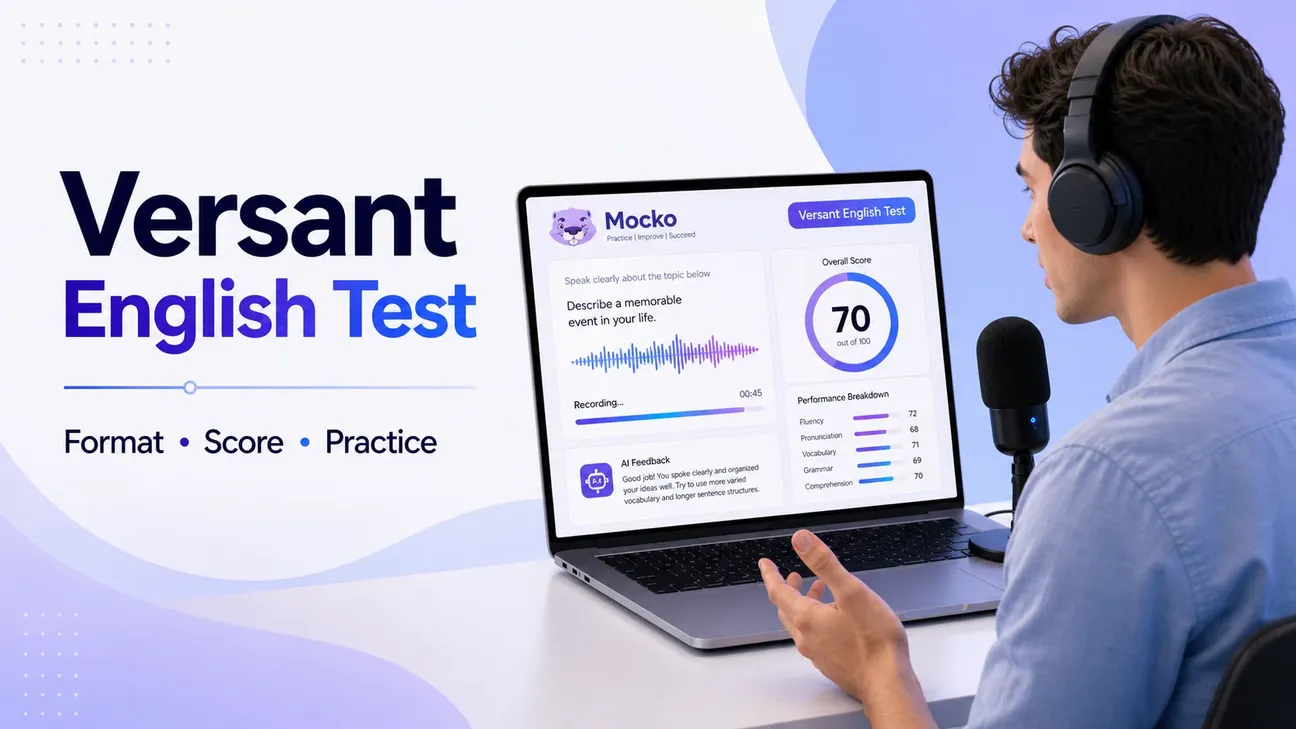
Most candidates get a Versant link from an employer or school with a short deadline — and have never seen the test. Versant is short, fully automated and strictly timed: there is no examiner, every response is scored by machine, and results usually come back in minutes.
The version behind most invitations is the Versant English Placement Test (VEPT): nine parts labelled A to I, 81 items, about 50 minutes. This guide walks the current format part by part, explains how the GSE scoring actually works and what counts as a good score — and shows you how to try the real task types with a free quick test before test day.
Sitting the placement version specifically? The VEPT has its own dedicated page: see our VEPT practice test guide for the placement-specific details and free practice.
What Is the Versant English Test?
Versant is a family of automated English tests published by Pearson — not a single exam. Every response is scored by machine rather than by a human rater, which is what lets an organization send the test as a link and get a result back in minutes instead of days.
Versant is a placement and screening instrument, not an admission or immigration test. It tells an employer or institution roughly where your English sits so they can shortlist you, stream you into a training track, or place you in the right course level. That is why it is unproctored, short, and cheap compared to IELTS or CELPIP.
You may be asked to take a Versant test if:
- a call center or BPO employer screens spoken English for customer-facing roles
- an airline, hospitality or healthcare recruiter needs a fast language check
- a university or language program places students into course levels
- a corporate training program measures employee progress
- a licensing body screens language before assessing credentials — Canada's NCA does this for internationally trained lawyers
Which Versant Test Will You Take?
Pearson publishes several Versant tests, and they do not share a format. Before you prepare, confirm with whoever sent the link which one you are sitting — preparing for the wrong version is the most expensive mistake you can make.
Versant English Placement Test (VEPT)
The nine-part, 81-item paper covered on this page. Reports all four skills — Speaking, Listening, Reading and Writing — in about 50 minutes. The version most employers and schools send.
Versant English Speaking Test
A shorter, speaking-only paper used for voice-role screening. Different parts, different score report.
Versant Writing Test
A written-English paper used where writing quality matters, with its own task types such as email writing.
Versant Professional and 4 Skills tests
Workplace variants that combine spoken and written sections. Check your invitation for the exact name.
Everything below describes the nine-part placement test. If your invitation names a Speaking-only or Writing-only test, that is a different, shorter paper.
Versant Test Format: All Nine Parts in Order
The VEPT delivers two sections — a spoken one (Parts A to D) and a typed one (Parts E to I) — but reports four skills. Several parts are scored into a skill other than the one you perform in, which is the single most misunderstood thing about this test.
Part | Task | Items | Time | Scored into |
|---|---|---|---|---|
A | Read Aloud | 2 passages | 30 seconds each | Speaking + Reading |
B | Repeat | 16 sentences | 15 seconds each | Speaking |
C | Sentence Builds | 10 sentences | 15 seconds each | Speaking |
D | Conversations | 12 questions | 15 seconds each | Listening |
E | Typing | 1 passage | 60 seconds | Not scored (typing indicators) |
F | Sentence Completion | 20 sentences | 25 seconds each | Reading |
G | Dictation | 16 sentences | 25 seconds each | Listening |
H | Passage Reconstruction | 3 passages | 30s read + 90s write | Writing |
I | Summary & Opinion | 1 passage, 2 tasks | 18 minutes | Writing + Reading |
Read the last column twice. Conversations is spoken but feeds your Listening score; Sentence Completion is typed but feeds Reading; Typing feeds nothing at all (it is reported separately as speed and accuracy); and Read Aloud and Summary & Opinion each feed two skills at once. Candidates routinely drill the wrong skill because they map sections to scores the obvious way.
Every item runs on its own clock, all audio plays once, and there is no back button. That pressure is real — but it is also what makes the test predictable once you have practiced the format.
How Is the Versant Test Scored?
Scoring is entirely automated — no human rater sees your responses. Each of the four skills is reported on the Global Scale of English (GSE) from 10 to 90 with a CEFR band attached, from below A1 up to C2. Speech is analyzed for pronunciation, fluency, sentence mastery and vocabulary; written answers for grammar, vocabulary, organization and comprehension of the source passage.
CEFR band | GSE score | What it means in practice |
|---|---|---|
C2 | 85–90 | Fully proficient, including nuance and idiom. |
C1 | 76–84 | Advanced. Comfortable in demanding professional settings. |
B2+ | 67–75 | Strong upper-intermediate, above most role requirements. |
B2 | 59–66 | Upper-intermediate. Where many employer cut-offs sit. |
B1+ | 51–58 | Solid intermediate. Stretched by fast or technical speech. |
B1 | 43–50 | Intermediate. Manages familiar topics with effort. |
A2+ | 36–42 | Elementary plus. Short, predictable exchanges. |
A2 | 30–35 | Elementary. Basic phrases and immediate needs. |
A1 | 22–29 | Beginner. Isolated words and set expressions. |
Below A1 | 10–21 | Little measurable production. |
If your employer quotes a score between 20 and 80, that is the older legacy Versant scale, not the GSE. For example, Canada's NCA sets its lawyer-screening minimum at 61 on the Versant scale, which corresponds to 66 on the GSE. If your target looks like a 20–80 number, ask which scale it refers to before comparing it with a GSE score.
What Is a Good Versant Score?
There is no universal pass mark. Versant returns a placement score, not a verdict — the cut-off is set by whoever sent you the test. As a working reference, a GSE score of 59 or above is CEFR B2, the region most customer-facing roles ask for, and 67 or above is B2+.
The detail that decides most outcomes: employers frequently set their bar on one skill — most often Speaking — rather than on the average. A profile that looks fine in aggregate can still be screened out by a single weak skill, so ask which skill the requirement applies to before you decide what to practice.
One concrete example of a hard cut-off: since March 2026, Canada's National Committee on Accreditation requires internationally trained lawyers to pass a VEPT language screen — minimum 61 Versant / 66 GSE, single attempt — before their credentials are assessed. Our NCA language screening guide covers that process in detail.
Is Versant Accepted for Immigration?
No. For Canadian permanent residence, IRCC accepts CELPIP-General, IELTS General Training, PTE Core, TEF Canada and TCF Canada — Versant is not on the list, and GSE scores do not convert to CLB levels for an Express Entry profile. Other countries' immigration programs likewise specify their own accepted tests.
Where Versant does appear in official processes is screening: an employer, school or licensing body uses it to decide whether you proceed. If your actual goal is immigration, prepare for an accepted test instead — Mocko also covers CELPIP, TEF Canada and TCF Canada, and the CLB converter shows what score you need.
Which Versant test does Mocko practise?
Three of them, and the right one is whichever is named on your invitation. The parts genuinely differ, so practising the wrong paper costs you the days you have.
- English Placement Test (VEPT) — nine parts, 81 items, about 50 minutes, all four skills reported.
- English 4-Skills Essential — six parts, 70 items, about 30 minutes: Repeat, Sentence Builds, Conversations, Sentence Completion, Dictation and Passage Reconstruction. All four skills reported.
- English Writing Test — five parts, 43 items, about 35 minutes, writing only: Typing, Sentence Completion, Dictation, Passage Reconstruction and two nine-minute email tasks.
You choose which one you are preparing for when you start a full mock. We do not yet practise the Speaking and Listening Test or the Professional English Test. Full details are in our launch write-up.
How to Prepare for the Versant Test
Most candidates get days, not weeks. This order front-loads what actually moves a score in that window.
1. Confirm which Versant test you were sent
Ask whether it is the Placement Test, a Speaking-only or Writing-only paper, or a 4-Skills variant. The parts genuinely differ, and preparing for the wrong one wastes the days you have.
2. Sit a timed practice run before you study anything
Versant reports four separate skills, so one timed run tells you which skill is actually behind — usually not the one you expected. Start with the free quick test, Speaking or Writing, then use the 10 full-length practice tests in Premium to read the scores per skill, not just the overall impression.
3. Fix your recording setup before test day
Use a wired headset with a boom microphone, in a quiet room, on the computer you will use for the real test. Automated scoring works from the recording, so a noisy or clipped one costs marks no amount of English can recover.
4. Drill the no-thinking-time parts
Repeat and Sentence Builds give you about fifteen seconds and no preparation. They are pattern recognition under pressure, and they improve fast with repetition — unlike vocabulary, which moves slowly.
5. Practice Part I against a real 18-minute clock
Summary & Opinion is where the clock does the damage: eighteen minutes covers reading the passage, a 25–50 word summary and an opinion of at least 50 words. Rehearse the pacing until it is automatic — overrunning the summary eats the time the opinion needs.
6. Re-test and compare skill by skill
A few days later, run the practice again and compare per-skill movement. Because several parts feed a skill other than the one you performed in, per-skill scores are the only reliable signal of progress.
Common Mistakes That Cost Marks
Assuming the spoken section is your Speaking score
Part D is spoken but scored into Listening; Part F is typed but scored into Reading. Practice by scored skill, not by what the section looks like.
Treating Read Aloud as a speed test
You are not expected to finish the passage, and the instructions say so. Rushing costs pronunciation and fluency marks for no gain.
Ignoring spelling and punctuation in Dictation
Part G scores both, across sixteen sentences. Small slips add up to a meaningful piece of your Listening score.
Writing a long summary in Part I
The summary has a 25–50 word range and the opinion has a 50-word floor. The opinion is the longer task — budget your clock for it.
Panicking about the typing part
Part E feeds none of the four skills; it reports typing speed and accuracy separately. A slow typist has not damaged their English scores.
Using a laptop microphone in a shared room
There is no examiner to make allowances. Background noise and a distant microphone degrade the recording the scoring model works from — a quiet room and a headset are worth real marks.
Technical Setup for the Versant Test
Before the real test:
- test your microphone on the same computer you will use on the day
- use a wired headset with a boom microphone if you can
- choose a quiet room without echo, and close the door
- check your internet connection and close everything else
- complete any system check your test provider sends in advance
Versant vs IELTS, TOEFL, and PTE
These tests are not substitutes for one another. Versant is a screening and placement instrument; IELTS, TOEFL and PTE are proctored admission and immigration tests. The practical difference is what the score can be used for.
Test | Scored by | Scale | Mainly used for | Accepted by IRCC |
|---|---|---|---|---|
Versant (VEPT) | Automated only | GSE 10–90 + CEFR | Employer screening, placement | No |
IELTS General Training | Human raters (Speaking, Writing) | Bands 1–9 | Immigration, work, study | Yes |
PTE Core | Automated only | 10–90 | Canadian immigration and work permits | Yes |
CELPIP-General | Trained human raters | Levels 1–12 (equal to CLB) | Canadian immigration and citizenship | Yes |
TOEFL iBT sits in the same proctored family, used mainly for academic admission. If your goal is a university offer or an immigration file, check the accepted-test list first; if an employer sent you a Versant link, Versant is the test you need to pass.
How to Practice for Versant: Free and Premium
Mocko's free Versant quick test gives you one free quick test, Speaking (Parts A to D) or Writing (Parts E to I), built from the nine-part paper: the same task types, the same order, the same per-item timings, AI-scored in minutes with a limited report and no credit card. It is the fastest way to find out whether the format — not your English — is what would cost you marks.
When you are ready for the full experience, Premium includes 10 full-length practice tests (the complete 81-item paper, Parts A to I in one sitting) plus unlimited Speaking and Writing section practice. Every full test gives you a GSE score with a CEFR band for each of the four skills, the full item-by-item report, AI examiner feedback on your written passages and essay, and a map of which part fed which score. The 3-Month plan also carries our Versant score guarantee.
Prefer to see the test on paper first? Download the free Versant sample exam PDF — a full nine-part paper you can read before you sit anything.
Mocko is an independent practice platform with no affiliation to Pearson. Every practice item is written by Mocko rather than taken from a real test, and practice scores are estimates, not official Versant results.
Prepare for Each Versant Skill
Each reported skill has its own dedicated practice guide: Versant Speaking (Read Aloud, Repeat, Sentence Builds), Versant Listening (Conversations and Dictation), Versant Writing (Passage Reconstruction, Summary & Opinion), and Versant Reading (Sentence Completion plus the reading side of Parts A and I).
Conclusion
The Versant test rewards clear, consistent, automatic English under time pressure — and it is far more predictable than it first looks. Learn the nine parts, drill the fifteen-second parts until they feel routine, respect the Part I clock, and check your progress per skill rather than on the overall number.
Start with the free quick test, Speaking or Writing, see where you stand, and walk into the real link knowing exactly what happens after you press start.
The Versant English Placement Test has nine parts, 81 items, and takes about 50 minutes. Every item runs on its own clock and audio plays once, so you cannot pause or go back. Single-skill versions such as the Versant Speaking Test are shorter — check your invitation for the exact version.
Rated 5.0 by the Product Hunt community
Real, public reviews from candidates who prepared with Mocko. Verify them on Product Hunt