

CELPIP Listening Practice Test
Table of Contents14 sections
CELPIP Listening is one of the most important parts of the CELPIP test for Canadian immigration applicants because it measures how well you understand spoken English in everyday Canadian situations.
The section includes conversations, news-style audio, discussions, and viewpoints. In this guide, you will learn the CELPIP Listening format, how scoring works, what each part tests, common mistakes, and how to practice smarter before test day.
What Is CELPIP Listening?
CELPIP Listening is the first component of the CELPIP-General and CELPIP-General LS tests. It assesses your ability to understand spoken English in practical situations, such as solving a problem, following a conversation, understanding information, listening to a news item, and comparing opinions.
CELPIP Listening is a computer-based listening test that evaluates how well you understand spoken English in everyday Canadian contexts. It includes six main parts, around 38 scored questions, and takes about 46–55 minutes depending on the test version and unscored items.
For many test takers, Listening feels easier than Speaking or Writing at first. But it can become difficult because the audio plays only once, the answer choices may be close in meaning, and some questions test implied meaning rather than simple facts.
CELPIP Listening Format
The CELPIP Listening section has six main parts. Each part uses a different real-life listening situation.
Part | Task Type | Questions | What It Tests |
|---|---|---|---|
Part 1 | Listening to Problem Solving | 8 | Understanding choices, problems, and practical decisions |
Part 2 | Listening to a Daily Life Conversation | 5 | Following informal conversations |
Part 3 | Listening for Information | 6 | Identifying key facts and details |
Part 4 | Listening to a News Item | 5 | Understanding reports, events, and main ideas |
Part 5 | Listening to a Discussion | 8 | Tracking multiple speakers and opinions |
Part 6 | Listening to Viewpoints | 6 | Understanding arguments, opinions, and implications |
There may also be an unscored item used for research or test development. You will not know which part is unscored, so treat every question seriously.
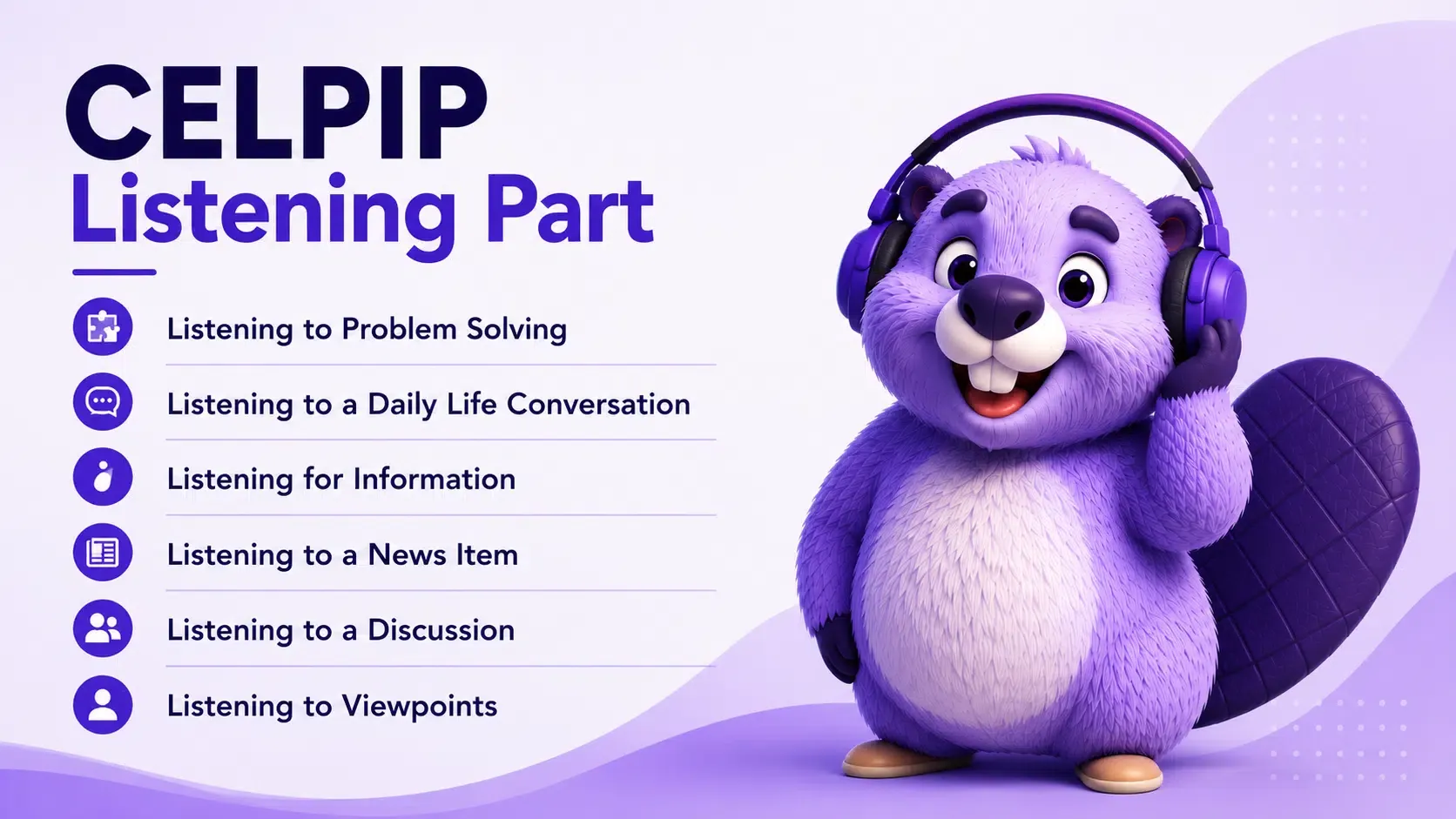
What Each CELPIP Listening Part Really Tests
Part 1: Listening to Problem Solving
This part usually includes a practical situation where people discuss a problem and possible solutions. You need to understand what the problem is, what options are considered, and why one option may be better.
The mistake many test takers make is listening only for keywords. CELPIP often tests the final decision, not just the first option mentioned. Listen for contrast words like “but,” “however,” “actually,” and “instead.”
Part 2: Listening to a Daily Life Conversation
This section tests casual conversation. The language may sound simple, but the answers can depend on tone, intention, or context.
For example, a speaker may say something politely but actually disagree. You need to understand what they mean, not only what they say.
Part 3: Listening for Information
This part is more information-heavy. You may hear details about a service, event, schedule, policy, or process. Your job is to identify accurate information without getting lost in unnecessary details.
A good strategy is to write short notes using symbols. Do not write full sentences. Focus on names, times, reasons, numbers, changes, and final decisions.
Part 4: Listening to a News Item
This section sounds like a short news report. It usually tests the main idea, key details, cause and effect, and sometimes the significance of an event.
Many learners struggle here because news language is denser than casual conversation. Build practice with short Canadian news clips and summarize the main point in one sentence.
Part 5: Listening to a Discussion
This is often one of the most difficult parts because multiple speakers may express different views. You need to track who thinks what.
Use initials or simple labels in your notes. For example:
A = supports plan
B = worried about cost
C = suggests delay
The goal is not to write everything. The goal is to separate opinions clearly.
Part 6: Listening to Viewpoints
This part tests opinion, argument, and implied meaning. It is not just about facts. You need to understand the speaker’s position and the reasoning behind it.
This is where advanced test takers can lose points. They understand the words but miss the attitude. Pay attention to whether the speaker is certain, doubtful, critical, supportive, or neutral.
CELPIP Listening Scoring
CELPIP Listening has 38 scored questions. Each correct answer gives you one raw point, and your raw score is converted into a CELPIP level.
Approximate Raw Score | CELPIP Level |
|---|---|
35–38 | 10–12 |
33–35 | 9 |
30–33 | 8 |
27–31 | 7 |
22–28 | 6 |
17–23 | 5 |
11–18 | 4 |
7–12 | 3 |
0–7 | M |
The key point is that you do not need perfection for a strong score. For example, a test taker aiming for CLB 9 usually needs a very high level of accuracy, but not necessarily 38 out of 38. Your goal should be based on your immigration pathway, not just a general idea of “good English.”
CELPIP Listening vs IELTS Listening
CELPIP Listening is fully computer-based and uses Canadian English in practical daily-life contexts. IELTS Listening includes a wider range of accents and question types. CELPIP often feels more predictable in format, while IELTS may feel more varied because of its paper/computer formats and mixed task styles.
For Canadian immigration applicants, CELPIP can be attractive because the scoring scale directly uses CELPIP levels that align closely with CLB levels. However, the best test depends on your strengths. If you are comfortable with Canadian-style conversations, computer-based testing, and multiple-choice listening, CELPIP may suit you.
✅Read More: CELPIP vs IELTS
Expert Insight: CELPIP Listening Is Not Just Listening
A strong CELPIP Listening score depends on three skills working together:
- Listening comprehension
- Fast reading of answer choices
- Decision-making under time pressure
Many test takers improve their listening but still miss questions because they read the options too slowly or compare answers poorly. That is why practice should include full timed tasks, not only passive listening to podcasts or videos.
Practical Scenario
Imagine you are aiming for CLB 9 for Express Entry. You take a CELPIP Listening mock test and score 29 out of 38. That may feel close, but your review shows a pattern: you missed most questions in Discussion and Viewpoints.
In this case, listening to general English videos for two more weeks may not solve the problem. Your issue is not basic comprehension. Your issue is tracking opinions and implied meaning. A better plan would be:
- Practice Part 5 and Part 6 separately
- Review wrong answers by category
- Write down why the correct answer is better
- Repeat full timed Listening every 3–4 days
This is how you turn practice into score improvement.
Common Mistakes in CELPIP Listening
Trying to Understand Every Word
You do not need every word. You need the answer. Focus on purpose, decision, attitude, and key details.
Choosing the First Matching Keyword
CELPIP answer choices may repeat words from the audio, but that does not always make them correct. The correct answer usually matches the meaning, not just the vocabulary.
Taking Too Many Notes
Notes should support listening, not replace it. If you write too much, you stop listening. Use short keywords, arrows, numbers, and speaker labels.
Ignoring Tone
Tone matters, especially in daily conversation, discussion, and viewpoints. A speaker may sound doubtful, annoyed, excited, or cautious. These signals help you answer implication questions.
Practicing Without Review
Taking ten mock tests without review is less useful than taking three and deeply analyzing every mistake. Improvement comes from understanding why you missed a question.
How to Choose the Right Answer
Use this four-step framework during practice:
1. Predict the Question Type
Before the audio starts, quickly scan the question and answer choices. Ask yourself: Is this about a detail, main idea, opinion, reason, or final decision?
2. Listen for Meaning, Not Words
Do not wait for the exact phrase in the answer choice. Listen for paraphrases.
3. Eliminate Traps
Remove answers that are:
- Mentioned but not chosen
- Too extreme
- True but not answering the question
- Based on the wrong speaker
- Opposite of the speaker’s attitude
4. Choose and Move On
Do not overthink one question. CELPIP Listening rewards steady accuracy across the full section.
The hardest CELPIP Listening questions often test “answer distance.” This means the correct answer is not located in one obvious sentence. You may need to connect two or three pieces of information.
For example, one speaker may mention a problem at the beginning, reject one solution in the middle, and agree to a different plan at the end. If you only catch one part, you may choose a tempting but wrong answer.
This is why Part 1, Part 5, and Part 6 require timeline awareness. Your notes should show how the conversation changes, not just what words you heard.
How to Improve CELPIP Listening
To improve CELPIP Listening, learn the test format first, practice each part separately, take timed mock tests, review every wrong answer, and track patterns. Focus on Canadian English, paraphrasing, speaker attitude, and decision changes rather than trying to understand every word.
Build a Canadian English Routine
Use English audio that reflects daily Canadian life: conversations, service situations, news, interviews, and public announcements.
Practice by Question Type
Do not only practice full tests. Separate your practice into:
- Main idea questions
- Detail questions
- Inference questions
- Speaker attitude questions
- Final decision questions
Review Wrong Answers Properly
For every wrong answer, write:
- What I chose
- Why I chose it
- Why it was wrong
- What clue showed the correct answer
- What I should listen for next time
This creates a feedback loop.
14-Day CELPIP Listening Practice Plan
Days | Focus | Task |
|---|---|---|
1–2 | Format | Learn all 6 parts and take one diagnostic test |
3–4 | Parts 1–2 | Practice problem solving and daily conversation |
5–6 | Part 3 | Practice information-heavy audio and note-taking |
7 | Review | Analyze mistakes from days 1–6 |
8–9 | Part 4 | Practice news-style audio and summarizing |
10–11 | Parts 5–6 | Track speakers, opinions, and viewpoints |
12 | Full Mock | Take one timed Listening mock test |
13 | Deep Review | Categorize all mistakes |
14 | Final Simulation | Take another timed mock and compare results |
If you are below your target score, do not just repeat the same plan. Identify your weakest two parts and focus there first.
How Mock Tests Help
Mock tests are essential because CELPIP Listening is not only about English ability. It is also about timing, focus, stamina, and test familiarity.
A good mock test should help you:
- Experience the real section order
- Practice under time pressure
- Identify weak parts
- Review answer explanations
- Track score progress over time
Try a CELPIP Listening mock test on Mocko.ai to see which parts are costing you the most points before your real exam.
Who Should Focus Most on CELPIP Listening?
You should give extra attention to Listening if:
- You need CLB 7, CLB 8, or CLB 9 for immigration
- You understand written English better than spoken English
- You lose focus during long audio
- You struggle with Canadian accents or fast conversations
- You often choose answers based on keywords
- Your mock scores change a lot from test to test
Listening can be one of the fastest sections to improve if your review process is structured.
Final Recommendation
CELPIP Listening is predictable in structure, but not easy. The test rewards candidates who understand the format, listen for meaning, manage notes, and review mistakes carefully.
Start with the official format, take a diagnostic mock test, identify your weakest parts, and practice with a clear plan. When you are ready, try a mock test on Mocko.ai and use your results to build a smarter final preparation strategy.
FAQ
About 46–55 minutes.
Rated 5.0 by the Product Hunt community
Real, public reviews from candidates who prepared with Mocko. Verify them on Product Hunt