

CELPIP Exam - Guide to Registration & Preparation
Table of Contents9 sections
If you're planning to immigrate to Canada, apply for citizenship, or prove your English proficiency for professional purposes, the CELPIP Exam is one of the most recognized language tests available. Designed specifically for Canadian English, this test evaluates real-life communication skills through practical tasks that reflect everyday situations.
Many candidates know they need a language test but are unsure which version to take, how scoring works, or what preparation strategy delivers the best results. This guide explains everything you need to know about the CELPIP Exam, from its structure and scoring system to registration and preparation tips.
What Is the CELPIP Exam?
The CELPIP Exam (Canadian English Language Proficiency Index Program) is a standardized English language assessment used primarily in Canada. It measures a candidate's ability to communicate effectively in English across listening, reading, writing, and speaking.
Unlike some international English tests that use a mixture of accents and contexts, the CELPIP Exam focuses on Canadian English and everyday situations that candidates may encounter while living, studying, or working in Canada.
The test is entirely computer-based, including the speaking component, which means candidates record their responses through a computer rather than speaking to a live examiner.
What is the CELPIP Exam?
The CELPIP Exam is a Canadian English language proficiency test that evaluates listening, reading, writing, and speaking skills. It is widely accepted for immigration, citizenship, and professional designation purposes across Canada.
Why People Take the CELPIP Exam
The CELPIP Exam is commonly used for:
- Canadian permanent residence applications
- Canadian citizenship applications
- Professional certification requirements
- Employment opportunities
- Language proficiency verification
One reason many candidates choose CELPIP is that the content reflects real-life Canadian communication scenarios. Tasks often involve conversations, workplace interactions, community announcements, and practical situations rather than highly academic topics.
For individuals preparing for Canadian immigration, understanding the required score before booking the test is essential. Different immigration programs may require different language benchmarks.
Types of CELPIP Tests
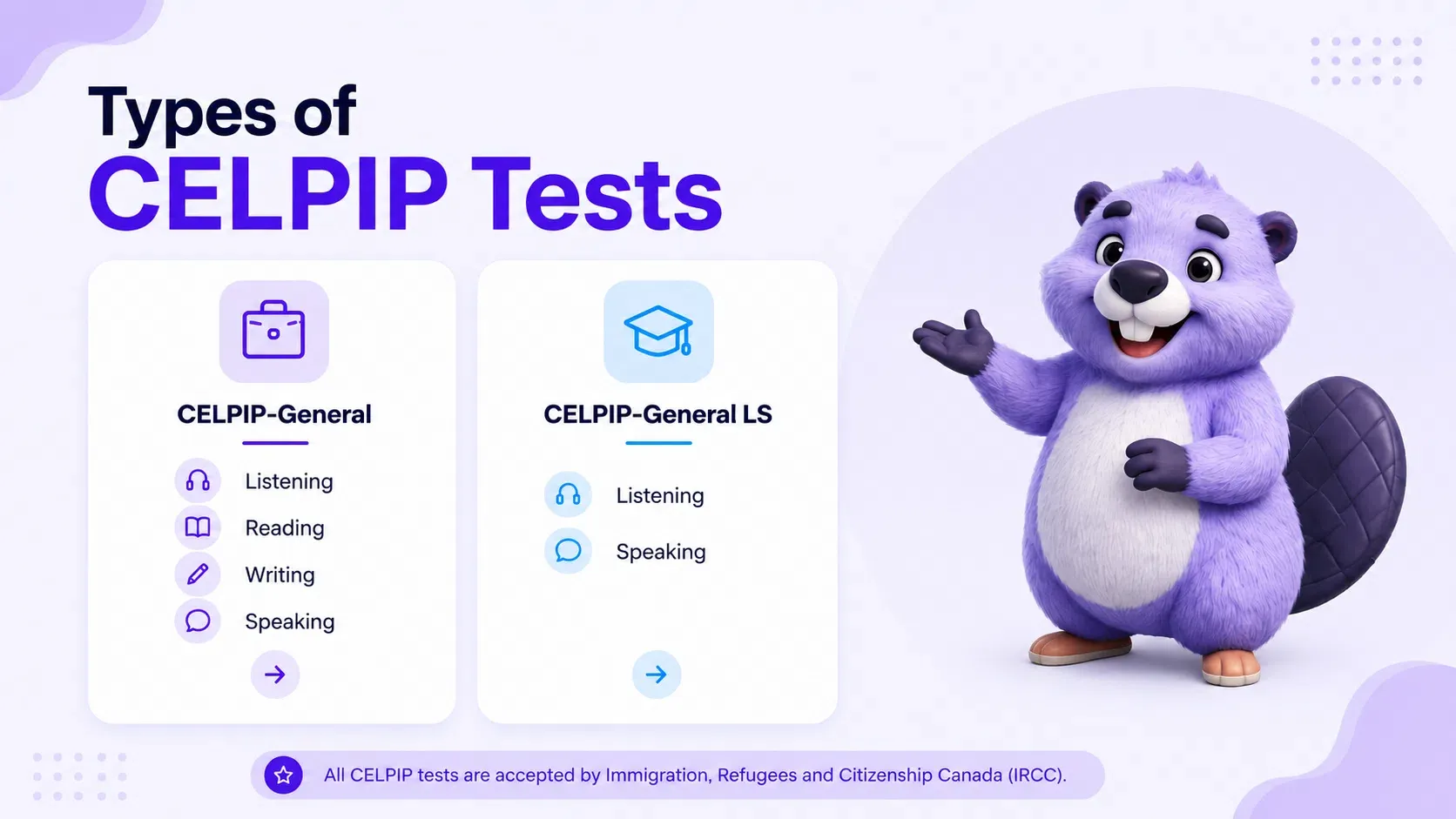
There are two versions of the CELPIP Exam available.
CELPIP-General
CELPIP-General evaluates all four language skills:
- Listening
- Reading
- Writing
- Speaking
This version is commonly required for:
- Permanent residence applications
- Professional designation requirements
- Employment-related purposes
CELPIP-General LS
CELPIP-General LS evaluates only:
- Listening
- Speaking
This version is typically used for Canadian citizenship applications.
Feature | CELPIP-General | CELPIP-General LS |
|---|---|---|
Listening | Yes | Yes |
Reading | Yes | No |
Writing | Yes | No |
Speaking | Yes | Yes |
Immigration Use | Permanent Residence | Citizenship |
What is the difference between CELPIP-General and CELPIP-General LS?
CELPIP-General assesses listening, reading, writing, and speaking skills, while CELPIP-General LS evaluates only listening and speaking. Permanent residence applicants usually take CELPIP-General, whereas citizenship applicants often take CELPIP-General LS.
CELPIP Exam Format
The CELPIP Exam is fully computer-delivered and designed to measure practical communication abilities.
Listening Section
The CELPIP Listening section measures your ability to understand spoken English in a variety of everyday situations. It consists of six parts, each designed to assess a different listening skill.
- Listening to Problem Solving
You will listen to a conversation in which a problem is discussed and answer questions based on the information provided. - Listening to a Daily Life Conversation
You will hear a conversation that reflects a common real-life situation and answer questions about what was said. - Listening for Information
This part focuses on understanding facts, details, and key information from a spoken passage. - Listening to a News Item
You will listen to a short news report and answer questions about the main points and supporting details. - Listening to a Discussion
You will hear multiple speakers discussing a topic and answer questions about their ideas and opinions. - Listening to Viewpoints
You will listen to different perspectives on an issue and identify opinions, attitudes, and supporting arguments.
Throughout the section, you may be asked to identify important details, understand the speaker's purpose, recognize opinions, and draw conclusions based on what you hear.
Reading Section
The CELPIP Reading section evaluates your ability to understand written English in a variety of everyday situations. It consists of four parts, each focusing on a different type of reading task.
- Reading Correspondence
You will read emails, letters, or messages and answer questions about the information they contain. - Reading to Apply a Diagram
You will use information from a diagram, schedule, map, or chart to answer related questions. - Reading for Information
You will read informational texts and identify key details, main ideas, and supporting information. - Reading for Viewpoints
You will read texts that present opinions or different perspectives and answer questions about the writers’ views and arguments.
Throughout the section, you may need to locate specific information, understand the meaning of words in context, identify the writer’s purpose, and draw conclusions based on what you read.
Writing Section
The CELPIP Writing section measures your ability to communicate clearly and effectively in written English. Rather than focusing on academic essays, it evaluates the types of writing tasks that people commonly encounter in everyday life, school, and the workplace.
The section includes two tasks and takes 53 minutes in total.
- Task 1: Writing an Email
In this task, you are given a situation and asked to write an email. Depending on the scenario, you may need to request information, respond to a problem, make a suggestion, express a concern, or explain a situation. You have 27 minutes and should write 150 to 200 words.
- Task 2: Responding to Survey Questions
You are presented with a survey topic and two options. You must choose one option, explain your choice, and provide reasons to support your opinion. You have 26 minutes and should write 150 to 200 words.
When your response is scored, examiners look at more than just grammar. They also consider how well you address the task, organize your ideas, support your points, and communicate your message clearly.
Many test takers assume that using complex vocabulary or long sentences will lead to a higher score. In reality, clear organization, relevant details, and accurate language are often more important than sounding overly formal or sophisticated.
Because the writing tasks are based on practical situations, it is helpful to practice writing emails, expressing opinions, and explaining decisions in a clear and natural way before test day.
Speaking Section
The CELPIP Speaking section is a computer-delivered test in which candidates record their answers to on-screen prompts. There is no live examiner, so test takers must be comfortable speaking clearly and naturally into a microphone within a limited time.
The section consists of eight tasks:
- Giving Advice
- Talking about a Personal Experience
- Describing a Scene
- Making Predictions
- Comparing and Persuading
- Dealing with a Difficult Situation
- Expressing Opinions
- Describing an Unusual Situation
These tasks are designed to reflect situations that people may encounter in everyday life, work, and community settings. Successful responses demonstrate clear communication, relevant details, and the ability to express ideas naturally within the time limit.
CELPIP Scoring System
The CELPIP Exam uses a scoring scale that aligns closely with the Canadian Language Benchmarks (CLB), the national standard used to measure English language proficiency in Canada.
Each skill receives an individual score:
- Listening
- Reading
- Writing
- Speaking
These scores are reported separately rather than combined into a single overall band score.
CELPIP Level | CLB Equivalent | General Interpretation |
|---|---|---|
12 | CLB 12 | Advanced proficiency |
11 | CLB 11 | Very strong proficiency |
10 | CLB 10 | Strong proficiency |
9 | CLB 9 | Effective workplace communication |
8 | CLB 8 | Good operational proficiency |
7 | CLB 7 | Adequate proficiency for many immigration pathways |
6 | CLB 6 | Developing proficiency |
5 and below | CLB 5 and below | Limited proficiency for immigration requirements |
Many Canadian immigration programs reference CLB requirements rather than CELPIP scores directly. For this reason, candidates should always verify the language requirements of their target program before scheduling their CELPIP Exam.
How is the CELPIP Exam scored?
The CELPIP Exam provides separate scores for listening, reading, writing, and speaking. These scores correspond to Canadian Language Benchmarks (CLB), which are commonly used by Canadian immigration programs to assess language proficiency.
CELPIP Exam vs IELTS
Many English learners wonder whether they should take the CELPIP Exam or IELTS.
Both tests are widely recognized, but they differ in format and user experience.
Feature | CELPIP Exam | IELTS |
|---|---|---|
Focus | Canadian English | International English |
Delivery | Fully computer-based | Paper or computer options |
Speaking Test | Recorded responses | Live examiner |
Accents | Primarily Canadian | Multiple international accents |
Scoring System | CELPIP Levels / CLB | Band Scores |
Immigration Use | Widely accepted in Canada | Widely accepted worldwide |
The CELPIP Exam is often preferred by immigration candidates who plan to settle in Canada because the language and situations feel more familiar to everyday Canadian life.
On the other hand, IELTS may be a better choice for candidates who need a test recognized by universities and employers across multiple countries.
✅Read More: PTE vs. CELPIP
Expert Insight:
Candidates who feel nervous during face-to-face interviews often perform better on the CELPIP Exam because they can focus entirely on the prompt rather than interacting with a live examiner.
How to Register for the CELPIP Exam
Registration for the CELPIP Exam is straightforward and completed online.
Step 1: Create an Account
Visit the official CELPIP registration portal and create a candidate account.
Step 2: Select Your Test Type
Choose between:
- CELPIP-General
- CELPIP-General LS
Selecting the wrong version is one of the most common mistakes candidates make, so verify your immigration or citizenship requirements beforehand.
Step 3: Choose a Test Date and Location
Available test dates vary by city and country. Popular locations can fill quickly, especially during peak immigration periods.
Step 4: Complete Payment
After selecting your preferred test session, pay the registration fee and receive confirmation.
✅Read More: CELPIP Exam Fee
Step 5: Prepare Before Test Day
Use practice materials and mock exams to become familiar with the format before your test date.
How to Prepare for the CELPIP Exam
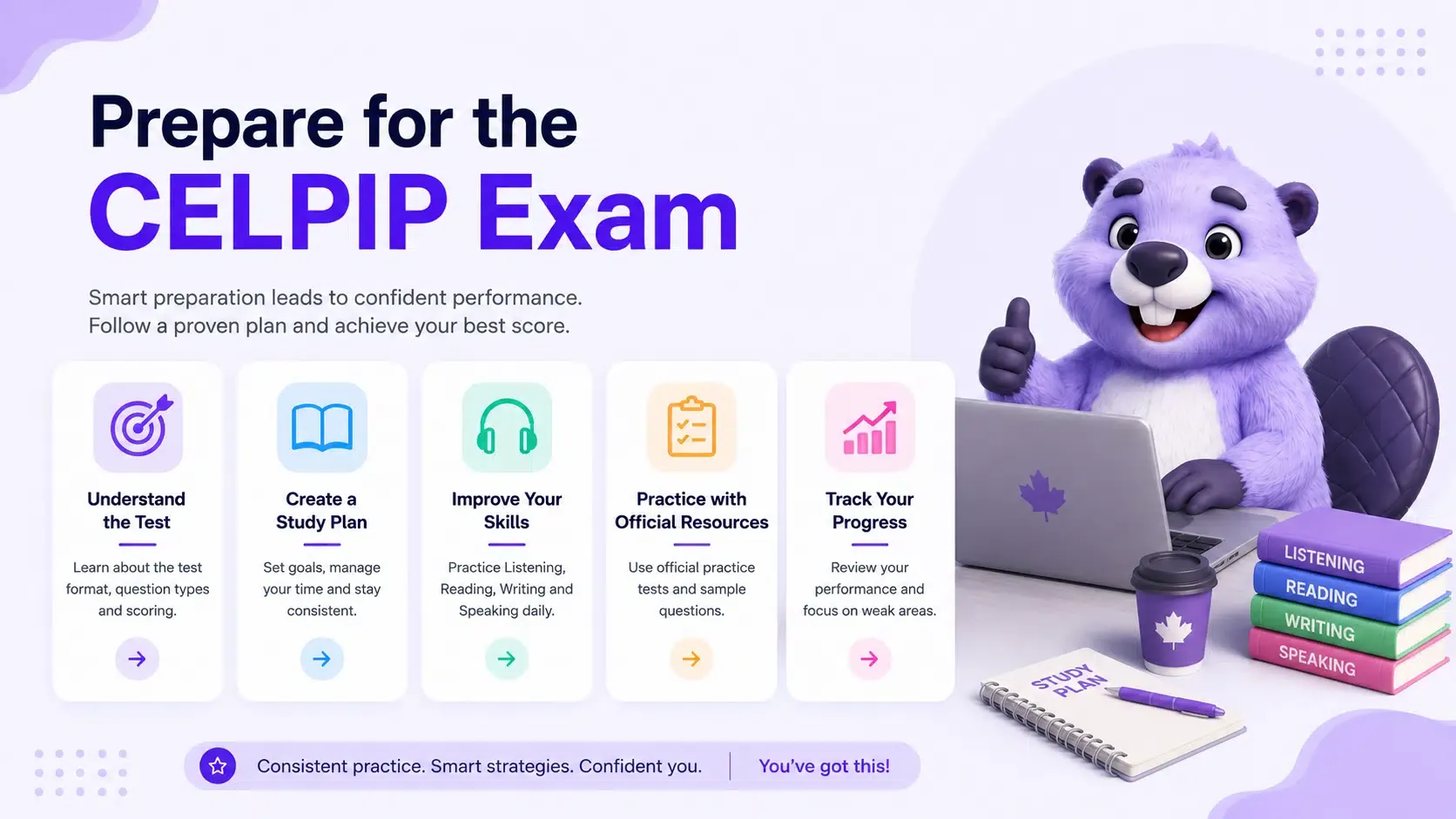
Preparation should focus on skill development rather than memorization.
Many candidates spend months studying grammar but never practice under realistic test conditions. This often leads to disappointing results.
Build Familiarity with the Format
Understanding question types can significantly reduce stress on test day.
You should know:
- Timing limits
- Task requirements
- Navigation tools
- Response expectations
Practice Listening Daily
Strong listening skills are essential because the listening section moves between conversations, a news item, a discussion and viewpoints, mainly in Canadian English.
Useful activities include:
- Listening to Canadian podcasts
- Watching Canadian news
- Following English interviews
- Taking timed listening exercises
Improve Reading Efficiency
Reading success depends on speed and comprehension.
Practice:
- Skimming for main ideas
- Scanning for details
- Understanding context clues
- Identifying opinions and intentions
Strengthen Writing Skills
For writing tasks:
- Focus on structure
- Organize ideas logically
- Support opinions with examples
- Leave time for proofreading
Because the CELPIP Exam is fully computer-based, regular typing practice should be part of your preparation strategy.
Develop Speaking Confidence
Many candidates understand English well but struggle to organize spoken responses.
Practice:
- Speaking under time limits
- Recording responses
- Reviewing pronunciation
- Improving answer structure
A useful approach is to follow a simple framework:
- State your main point.
- Explain your reasoning.
- Give an example.
- Conclude clearly.
Practice Under Real Test Conditions
One of the most effective preparation methods is using realistic mock exams.
Candidates often discover that their biggest challenge is not English itself but time management.
This is where platforms such as Mocko.ai can help learners experience exam-style conditions and identify weaknesses before the actual test.
For learners looking for additional English proficiency practice, exploring the platform's English proficiency practice tests can help build confidence across all language skills.
Common Mistakes Candidates Make
Ignoring Timing
Many candidates know the correct answers but run out of time before completing sections.
Overcomplicating Speaking Responses
Long, complicated answers often contain more mistakes. Clear and organized responses usually perform better.
Neglecting Typing Practice
Typing speed directly affects writing performance in the CELPIP Exam.
Memorizing Templates
Examiners reward effective communication rather than memorized content. Templates may help with organization, but relying on them too heavily can reduce score potential.
Skipping Mock Tests
Candidates frequently underestimate how different the real testing experience feels. Using AI-powered mock exams before test day can reveal weaknesses that ordinary study sessions may not expose.
Conclusion
The CELPIP Exam is one of the most important English proficiency tests for individuals pursuing Canadian immigration, citizenship, and professional opportunities. Understanding the test format, scoring system, and preparation strategies can significantly improve your chances of achieving your target score.
Before booking your test, spend time practicing under realistic conditions and identifying your weakest skills. You can start preparing today with mock tests and AI-powered practice tools available on Mocko.ai.
FAQ
001What is the CELPIP Exam used for?
The CELPIP Exam is commonly used for Canadian immigration, citizenship applications, and professional certification requirements.
002Is the CELPIP Exam easier than IELTS?
Neither test is objectively easier. Some candidates prefer CELPIP because it focuses on Canadian English and uses recorded speaking responses rather than a live interview.
003How long does the CELPIP Exam take?
CELPIP-General takes just under 3 hours in one sitting: Listening 46 to 55 minutes, Reading 43 to 56 minutes, Writing 53 minutes and Speaking about 15 minutes. CELPIP-General LS has only Listening and Speaking and takes about 1 hour 10 minutes.
004Can I take the CELPIP Exam outside Canada?
Yes. The CELPIP Exam is offered at authorized testing locations in several countries.
005What score do I need for Canadian immigration?
It depends on the program, and CELPIP levels map one to one to CLB levels (CELPIP 7 equals CLB 7). Federal Skilled Worker needs CLB 7 in all four skills. Canadian Experience Class needs CLB 7 for TEER 0 or 1 jobs and CLB 5 for TEER 2 or 3 jobs. Federal Skilled Trades needs CLB 5 in speaking and listening and CLB 4 in reading and writing. Citizenship applicants aged 18 to 54 need CLB 4 in speaking and listening, which CELPIP-General LS covers. Scores above the minimum earn more CRS points in Express Entry.
006How should I prepare for the CELPIP Exam?
A balanced approach that includes listening, reading, writing, speaking practice, and realistic mock exams is typically the most effective strategy.
Rated 5.0 by the Product Hunt community
Real, public reviews from candidates who prepared with Mocko. Verify them on Product Hunt