
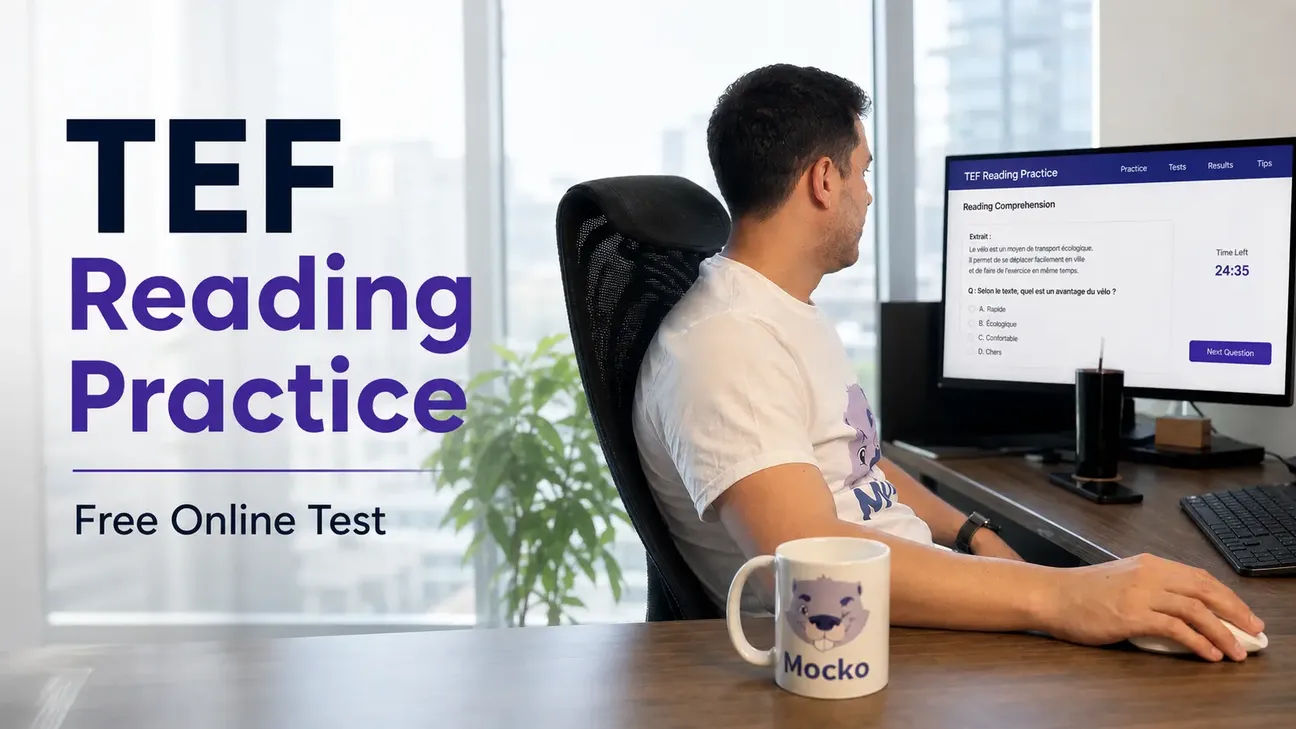
TEF Reading Practice – Free Online Test
Table of Contents14 sections
The TEF Reading Comprehension section can feel challenging, especially when you have to read quickly and choose the right answer under time pressure. But with the right practice, it becomes much more manageable.
This part of the TEF exam tests how well you understand written French in everyday, academic, and professional situations. You may see short messages, ads, articles, or longer texts that ask you to find details, understand the main idea, or recognize the writer’s purpose.
In this guide, you’ll not only understand the format, but you’ll also get TEF reading practice exercises, sample questions, and realistic strategies that actually reflect the exam experience.
What is TEF Reading Comprehension?
The TEF Reading Comprehension module evaluates your ability to understand written French texts of varying difficulty. You’ll face questions based on:
- Short passages such as emails or advertisements
- Longer academic or professional articles
- Vocabulary and grammar embedded in context
- Critical thinking tasks like identifying the author’s opinion or the purpose of the text
It’s not just about reading; you must show you can interpret, analyze, and respond under time pressure.
Why is Reading Comprehension Important for the TEF Exam?
Reading comprehension plays a key role in your final TEF score. Strong performance here helps prove your ability to function in French at work, in study, and in daily life.
- Many Canadian immigration programs require competitive TEF scores.
- Universities and employers look at reading skills as proof of academic readiness.
- Reading comprehension influences your overall French fluency level.
In short, mastering this section makes a direct impact on your future opportunities.
How Is TEF Reading Scored? Understanding the Criteria
The TEF Reading Comprehension section is evaluated using a standardized scoring system that measures your ability to understand, interpret, and analyze written French. Each correct answer contributes to your total score, which is then mapped to an official proficiency level recognized by Canadian authorities.
Scoring Breakdown
- Point System: The reading module is typically scored out of 300 points. Your raw score is based on the number of correct responses.
- Proficiency Levels: Scores are grouped into levels that align with the Common European Framework of Reference for Languages (CEFR), ranging from A1 (beginner) to C1 (advanced). Higher scores reflect a greater ability to comprehend complex texts and nuanced information.
- No Penalty for Guessing: There is no negative marking. You are encouraged to answer every question, as only correct answers count toward your score.
What Do Examiners Look For?
- Accurate Comprehension: Examiners assess whether you can identify main ideas, specific details, and the author’s intent across different text types.
- Contextual Understanding: You must demonstrate the ability to interpret vocabulary and grammar in context, not just in isolation.
- Critical Analysis: At higher levels, questions may test your ability to infer meaning, recognize tone, or distinguish between fact and opinion.
Score Reporting and Level Mapping
Your final score is reported alongside a CEFR level and a Canadian Language Benchmark (CLB) equivalent. This mapping is important for immigration and academic purposes, as institutions and authorities set minimum required levels for different applications.
Key Points to Remember:
- All questions have equal value.
- The test is designed to assess both speed and accuracy under timed conditions.
- Your score reflects your real-world ability to read and understand French in a variety of contexts.
Common Challenges In TEF Reading Test-Takers Face
Many TEF candidates struggle with this part of the exam because of:
Time pressure:
Passages are long, and questions must be answered quickly.
Complex vocabulary:
Even familiar words can have new meanings in context.
Distractors in answers:
Wrong options often look very similar to the correct one.
Concentration fatigue:
Sustained focus across multiple passages is demanding.
Recognizing these challenges early helps you prepare smarter.
Practical Tips & Strategies For TEF Reading
Use these expert strategies to maximize your TEF Reading score:
- Skim before you dive, read quickly for the main idea, then focus on details.
- Highlight keywords, identify important dates, names, or numbers.
- Eliminate wrong answers, narrow choices by spotting distractors.
- Practice timed sessions, train under exam conditions to build speed.
- Review mistakes, each error is a clue to improve your strategy.
Want to test yourself? Try short reading exercises daily. Mocko provides interactive samples designed to mimic the real exam.
TEF Registration and Examination Conditions
Getting registered for the TEF Canada or TEF Québec is straightforward but requires some planning, spots fill up fast, especially in popular cities or during peak immigration seasons.
The official organizer is the Chambre de commerce et d'industrie Paris Île-de-France (via Le français des affaires website). Registration happens directly with an approved test center, not through a central portal.
There are over 500 accredited centers in more than 110 countries, including many Alliance Française locations, universities, and private language schools in Canada.
How to register (step by step in 2026):
- Head to the official site: lefrancaisdesaffaires.fr and use the “Find a center” tool to locate the nearest approved location.
- Contact your chosen center (most use online booking forms now). Some, like Alliance Française branches or universities (e.g., Université de Montréal, Concordia), have their own calendars and online registration portals.
- Pick your test type: TEF Canada (for federal immigration/citizenship) or TEF Québec/TEFAQ (for Quebec selection + recognized federally). The reading section is identical in format and duration for both.
- Pay the fee at registration; prices vary by center and country (typically CAD 300–450 for the full test in Canada, but check locally). Payment is usually required upfront, and registrations are final with no refunds in most cases.
- Book early, at least 1–4 weeks in advance depending on the center. Popular dates can sell out months ahead.
Key Examination Conditions and Rules
- Age: Minimum 16 years old (no diploma or prior qualification needed).
- ID required: Valid passport (or two official photo IDs in some centers). Bring the original, photocopies or expired docs won't work.
- Arrival: Show up at least 30–45 minutes early. Late candidates are usually not admitted.
- What to bring: Only ID and your confirmation email/invitation. No personal items (phones, watches, notes, dictionaries) allowed in the testing room, everything goes in a locker.
- Computer-based test: You'll take it on a provided computer (standard QWERTY keyboard + virtual accents). Headsets are supplied for listening.
- Retake policy: You can retake as many times as needed, but there's a minimum 20–30 day waiting period between attempts (exact rule depends on the center; IRCC accepts the highest valid score).
- Special needs: If you require accommodations (e.g., extra time, own headset), declare it during registration, proof may be needed.
- On the day: The reading section is 60 minutes, no breaks during it. No negative marking, so answer everything. You can navigate freely between questions.
- Results: Available online 4–6 weeks later (sometimes faster). Certificate sent digitally or by mail.
Pro tip: Read the registration and examination conditions on the official site or your center's page, accepting them is mandatory when you register. It covers cheating rules (instant disqualification), behavior, and validity (results good for 2 years for immigration).
TEF Reading Resources (Official, Free and Paid)
You don't need to spend a fortune on prep, there are excellent official and free resources straight from the source that match the current 2026 format perfectly.
Top official free resources from Le français des affaires (the people who make the test):
- Sample questions (Exemples d’épreuves): Download the PDF with real past-style reading questions, including short ads, fill-in-the-blanks, articles, and graphs. Direct link often shared: check their prep page for the latest (e.g., tef-exemples-epreuves-ce.pdf).
- Interactive tutorial (Tutoriel d’entraînement): A free online module that walks you through the interface, question types, and sample texts. Super useful for getting used to the computer screens and navigation.
- Preparation workshop replay (Atelier de préparation): Free YouTube video explaining the reading section, strategies, and live examples. Search “Atelier de préparation TEF Compréhension écrite” on their channel, it's gold for understanding what examiners want.
- General prep page: Go to lefrancaisdesaffaires.fr → TEF Canada/Québec → “Se préparer” for all these tools in one spot.
Other great free or low-cost options (updated for 2026 format):
- Official TEF book sample: Hachette's free PDF excerpt includes a full reading comprehension practice set (40 questions, 60 min), search “TEF test blanc PDF” or find it linked on prep blogs.
- YouTube full mocks: Channels post timed 2026-format reading mocks with corrections (e.g., search “TEF Canada Compréhension Écrite 2026 Mock Test Nouveau Format”). Many are free and mirror the real interface.
- Mocko.ai: Free mini-quizzes or one full reading mock test to gauge your level.
How Mocko Helps You Prepare for TEF Reading
Mocko.ai makes TEF preparation efficient and personalized. With interactive tools, you can strengthen your reading skills step by step.
- Adaptive practice tests – simulate real TEF Reading Comprehension tasks with instant feedback.
- AI-driven insights – identify weak points in vocabulary, speed, or strategy.
- Full TEF coverage – combine reading practice with modules like TEF Oral exam preparation for balanced progress.
- Flexible study – practice anytime on desktop or mobile.
By training with Mocko, you not only build skills but also reduce test anxiety through familiarity.
Start with the official samples; they’re the closest thing to the real exam. Do the tutorial first to avoid interface surprises, then hit the PDF examples and a timed mock. Once you’re comfortable, layer in daily reading (La Presse, RFI facile) to build speed.
These resources alone have helped tons of people jump from CLB 6 to 8–9 without paid courses. Use them consistently, and the reading section will feel way more manageable.
TEF Reading Practice: Sample Exercise 1
Let’s get practical.
Passage
Offre spéciale :
Tous les abonnements annuels bénéficient d’une réduction de 20 % jusqu’au 30 juin.
Offre valable uniquement pour les nouveaux clients.
Inscription en ligne obligatoire.
❓Question
What is the main condition to benefit from the discount?
A) It applies to all customers
B) It is only valid for online purchases
C) It is limited to new customers
D) It requires a monthly subscription
✅ Answer: C
Explanation
This is a classic TEF trap. Many candidates pick B because “inscription en ligne” is mentioned.
But the key condition is “nouveaux clients” — that’s the real filter.
👉 This is exactly why TEF reading practice matters:
The right answer is often hidden behind something that looks less important at first glance.
TEF Reading Practice: Sample Exercise 2
Passage
Selon une étude récente, les employés qui travaillent à distance sont en moyenne 15 % plus productifs. Cependant, certains experts soulignent un risque d’isolement social.
❓ Question
What is the main idea of the text?
A) Remote work is harmful
B) Remote work increases productivity but has downsides
C) Employees prefer working in offices
D) Social isolation improves performance
✅ Answer: B
Explanation
TEF often tests your ability to balance information, not just pick one side.
Here, both productivity and isolation are mentioned — so the correct answer reflects both.
.webp&w=3840&q=75)
How to Practice TEF Reading Effectively (Daily Plan)
If you want real improvement, consistency beats intensity.
A simple structure:
- 1 short passage (5–10 min)
- 1 timed mini test (15–20 min)
- Review mistakes (10 min)
That’s less than an hour a day — but it’s enough to improve noticeably within a few weeks.
Conclusion
Improving your TEF Reading Comprehension score takes practice, patience, and the right strategy. Focus on reading faster, understanding the main idea, and learning how to spot tricky answer choices.
With regular practice and realistic TEF reading exercises, you can build confidence and feel more prepared on exam day. Start small, stay consistent, and keep improving one passage at a time.
FAQs
The TEF Reading Comprehension section tests your ability to understand written French texts of different types, including emails, advertisements, and academic articles. You must identify main ideas, details, and the author’s intention.
Rated 5.0 by the Product Hunt community
Real, public reviews from candidates who prepared with Mocko. Verify them on Product Hunt
As someone who works in immigration and often guides clients preparing for TEF Canada, I can say Mocko is a game-changer. Unlike regular practice materials, it really simulates the exam experience — from the style of listening tests to the structure of reading and writing tasks.
I believe Mocko is a reliable, well-designed, and practical resource for anyone aiming to improve their French and perform well on the TEF exam. It’s definitely worth the investment for serious learners who want structured and realistic preparation.
I’d been looking for an app like this for a long time, and this product turned out to be the dependable tool I needed to prepare for the TEF exam. It’s an excellent resource, truly remarkable and absolutely worth the cost.