

CELPIP Speaking Practice Test
Table of Contents14 sections
The CELPIP Speaking test can feel stressful because you have to speak to a computer, answer quickly, and organize your ideas under time pressure. The good news is that the test is predictable. Once you understand the task types, scoring criteria, and response structure, you can prepare with much more confidence.
This guide explains what the CELPIP Speaking Test includes, how it is scored, what each task expects, common mistakes to avoid, and how to practice effectively before test day.
What Is the CELPIP Speaking Test?
The CELPIP Speaking Test is the speaking section of the CELPIP English exam. It measures how well you can communicate in everyday English situations, especially in Canadian workplace, community, and immigration-related contexts.
In the test, you respond verbally to on-screen prompts. You do not speak with a live examiner. Your answers are recorded and assessed later.
CELPIP Speaking is a computer-delivered speaking test that evaluates your ability to give advice, describe experiences, explain situations, compare options, persuade someone, express opinions, and respond clearly in real-life English contexts.
Who Needs CELPIP Speaking?
CELPIP Speaking is important for people who need English test results for Canadian immigration, citizenship, work, or professional purposes.
Most test takers fall into one of these groups:
Test Taker Goal | Relevant CELPIP Test | Why Speaking Matters |
|---|---|---|
Canadian permanent residence | CELPIP General | Speaking contributes to CLB score |
Express Entry | CELPIP General | Higher CLB can improve CRS points |
Canadian citizenship | CELPIP General LS | Listening and speaking proof required |
Professional designation | Depends on organization | Speaking may be part of eligibility |
Personal English proof | CELPIP General or LS | Shows practical communication ability |
For PR and Express Entry, candidates usually need CELPIP General. For Canadian citizenship, CELPIP General LS may be enough because it focuses on Listening and Speaking.
✅Related Article: PTE vs. CELPIP: Which Is Better for Canada Immigration?
CELPIP Speaking Format
The CELPIP Speaking section usually takes about 15–20 minutes. It appears at the end of the CELPIP test. You answer several speaking tasks, each with a short preparation time and a fixed speaking time.
Speaking Task | Primary Communication Skill | What to Focus On |
|---|---|---|
Task 1: Giving Advice | Problem-solving | Offer practical and specific advice. |
Task 2: Personal Experience | Storytelling | Follow a clear timeline and include relevant details. |
Task 3: Describing a Scene | Observation | Describe key details logically and accurately. |
Task 4: Making Predictions | Inference | Explain what is likely to happen and why. |
Task 5: Comparing and Persuading | Persuasion | Compare options and justify your recommendation. |
Task 6: Difficult Situation | Conflict Resolution | Use a polite tone and propose realistic solutions. |
Task 7: Expressing Opinions | Argumentation | State your opinion clearly and support it with reasons. |
Task 8: Describing an Unusual Situation | Communication | Describe the picture precisely to someone who cannot see it. |
Task-by-Task Strategy
Task 1: Giving Advice
You usually need to advise someone about a problem. A strong answer should include:
- A direct recommendation
- Two reasons
- A practical next step
Example structure:
“Honestly, I think you should… The first reason is… Another thing to consider is… So my advice would be to…”
Avoid giving vague advice like “do what feels right.” CELPIP rewards useful, developed responses.
Task 2: Talking About a Personal Experience
This is a storytelling task. Use a simple timeline:
- When and where it happened
- What happened
- Why it mattered
- How you felt or what you learned
Do not invent an overly dramatic story. A simple, realistic experience is easier to explain clearly.
Task 3: Describing a Scene
You may see an image and describe what is happening. Organize your answer by location:
- Overall scene
- Left side
- Right side
- Background
- Possible mood or purpose
A good answer sounds like you are helping someone imagine the scene.
Task 4: Making Predictions
This task usually follows the scene description. You need to predict what might happen next.
Use probability language:
- “It looks like…”
- “They will probably…”
- “I think this might lead to…”
- “One possible outcome is…”
Do not simply describe the picture again. Prediction requires inference.
Task 5: Comparing and Persuading
You compare two options and persuade someone to choose one.
Use this structure:
- Choose one option clearly
- Explain why it is better
- Mention a weakness of the other option
- End with a persuasive recommendation
This task tests your ability to compare, prioritize, and convince.
Task 6: Dealing With a Difficult Situation
This task tests polite communication. You may need to refuse, apologize, explain, or negotiate.
Useful tone:
- Polite
- Calm
- Respectful
- Solution-focused
Avoid sounding too aggressive or too casual. The best responses show emotional intelligence.
Task 7: Expressing Opinions
This is similar to a short argument. Choose a side and defend it.
Strong structure:
- Opinion
- Reason 1
- Example
- Reason 2
- Final statement
Do not try to discuss both sides equally unless the prompt asks for it. A clear position is usually better.
Task 8: Describing an Unusual Situation
You see a picture of something unusual and describe it over the phone to someone who cannot see it. You have 30 seconds to prepare and 60 seconds to speak.
The goal is not comedy. The goal is clarity: the listener has to picture it from your words alone.
Include:
- What it is and what makes it unusual
- Its size, shape and colour
- Where things are, using words like on the left, on top of and behind
- Anything else the prompt asks you to include
To answer CELPIP Speaking tasks well, read the prompt carefully, identify the situation, choose two or three strong ideas, speak with a clear structure, support your answer with details, and finish naturally before the timer ends.
How CELPIP Speaking Is Scored
CELPIP Speaking is not only about grammar. Raters look at whether your answer is understandable, organized, complete, and appropriate for the task.
The main scoring areas are:
Scoring Area | What It Means | How to Improve |
|---|---|---|
Content and Coherence | Your ideas are relevant and organized | Use clear structure |
Vocabulary | Your word choice is accurate and varied | Use natural phrases |
Listenability | Your speech is easy to understand | Speak clearly, not too fast |
Task Fulfillment | You answer the prompt fully | Address every part of the task |
A high-scoring response is not necessarily complicated. It is clear, complete, natural, and easy to follow.
✅Read the Full Article: CELPIP Score Chart
CELPIP Speaking vs IELTS Speaking
CELPIP Speaking is computer-delivered, while IELTS Speaking is usually a live interview with an examiner. CELPIP focuses on short, practical responses to everyday prompts, while IELTS includes a conversational interview, a long turn, and discussion questions.
Feature | CELPIP Speaking | IELTS Speaking |
|---|---|---|
Delivery | Computer-based | Live examiner |
Accent context | Canadian English focus | International English |
Format | Timed task prompts | Interview format |
Best for | Test takers comfortable with computers | Test takers comfortable speaking to people |
Neither test is automatically easier. CELPIP may feel easier if you prefer predictable task types and typing/computer-based testing. IELTS may feel easier if you prefer human interaction.
✅Read More: CELPIP vs IELTS
CELPIP Speaking Rewards Control, Not Speed:
Many test takers think speaking faster sounds more advanced. In CELPIP, speed can hurt your score if your pronunciation, grammar, or organization becomes unclear.
A better strategy is controlled fluency: speak at a natural pace, pause briefly between ideas, and make your structure obvious. A clear answer with simple but accurate language often performs better than a fast answer full of errors.
Practical Scenario
Imagine the prompt asks you to advise a friend who wants to quit their job and start a business.
A weak answer might say:
- “You should follow your dream because business is good and maybe you can make money.”
A stronger answer would say:
- “I think you should not quit immediately. You should first test your business idea while keeping your current job. That way, you can see whether customers are actually interested without taking a big financial risk. If the business grows for a few months, then you can make a safer decision.”
The second answer is stronger because it is specific, logical, and practical.
Common Mistakes in CELPIP Speaking
Mistake 1: Memorizing Full Answers
Templates can help with structure, but memorized answers often sound unnatural. If your answer does not match the prompt exactly, your task fulfillment score may suffer.
Mistake 2: Ignoring One Part of the Prompt
Some prompts include two or three requirements. Missing one part can lower your score even if your English sounds good.
Mistake 3: Speaking Without Structure
A long answer with no organization is difficult to follow. Use simple connectors like “first,” “also,” “for example,” and “that’s why.”
Mistake 4: Trying to Use Fancy Vocabulary
Advanced vocabulary only helps if it is accurate and natural. Misused words can make your answer confusing.
✅Read More: CELPIP Vocabulary
Mistake 5: Ending Suddenly
Try to finish with a short closing sentence. This makes your response feel complete.
Decision-Making Framework: Are You Ready for CELPIP Speaking?
Use this checklist before booking your test or starting intensive practice.
Question | Ready | Needs Work |
|---|---|---|
Can you answer all 8 task types? | Yes | No |
Can you speak for the full time without long silence? | Yes | No |
Can you organize answers quickly? | Yes | No |
Can you give examples naturally? | Yes | No |
Can you stay clear under pressure? | Yes | No |
Do you know your weak task types? | Yes | No |
If you answered “No” to more than two questions, focus on practice before test day.
Advanced Explanation: Why Task Fulfillment Is Often the Hidden Score Killer
Many learners focus only on pronunciation and grammar. Those matter, but CELPIP Speaking also measures whether you completed the communicative purpose of the task.
For example, if the task asks you to persuade someone, you must actually persuade. If it asks you to deal with a difficult situation, you must manage the social tension. If it asks you to describe an unusual situation, you must make the situation clear to the listener.
This is why two answers with similar grammar can receive different scores. The better answer does the job the task asked for.
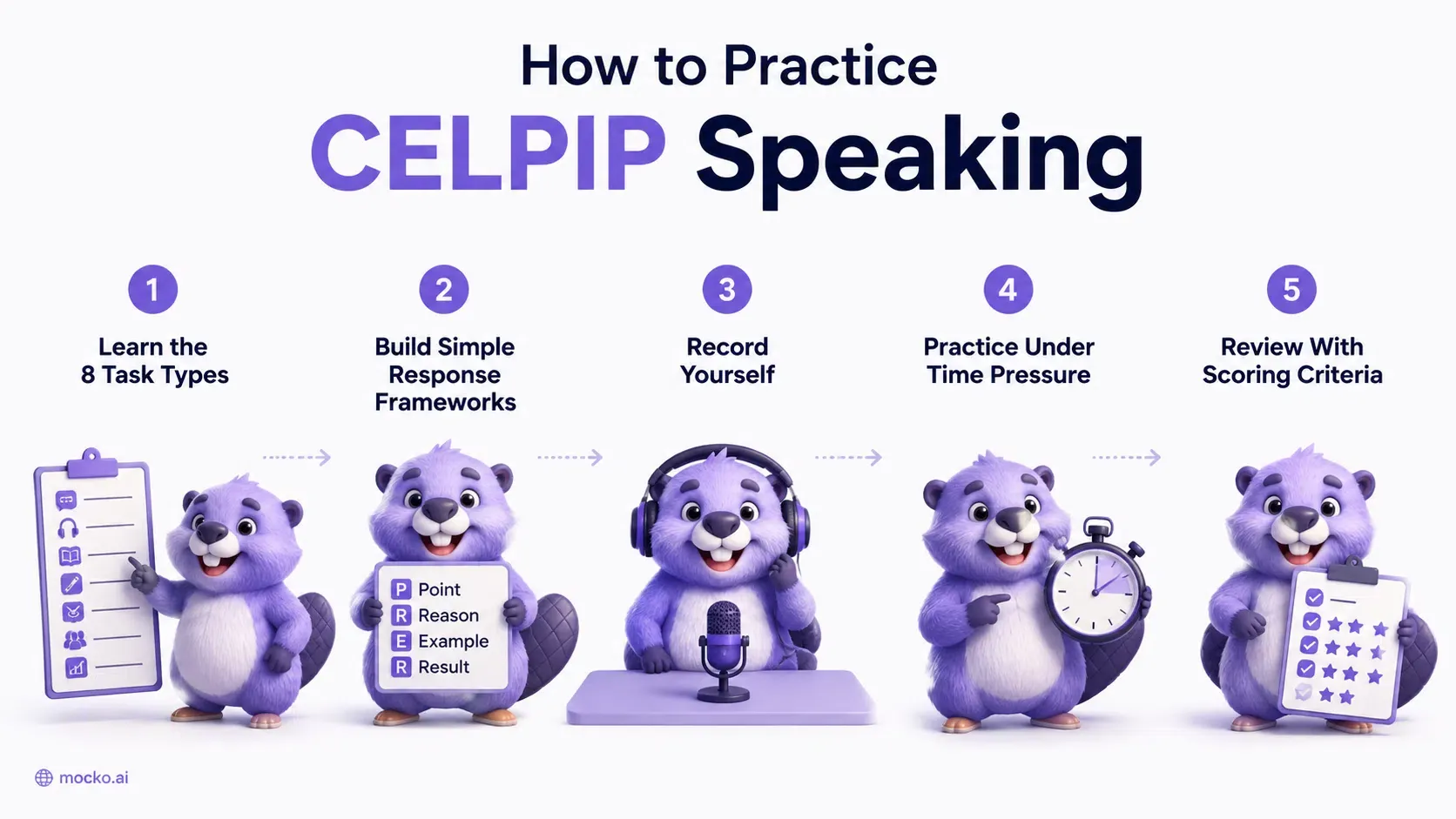
How to Practice CELPIP Speaking
Step 1: Learn the 8 Task Types
Do not start with random speaking practice. First, understand what each task is testing.
Step 2: Build Simple Response Frameworks
Use flexible structures, not memorized scripts.
Example:
- Main answer
- Reason
- Example
- Result
- Closing
Step 3: Record Yourself
Listening to your own answers helps you notice:
- Long pauses
- Repeated words
- Unclear pronunciation
- Weak endings
- Missing details
Step 4: Practice Under Time Pressure
CELPIP Speaking is timed. You need to train your brain to organize ideas quickly.
Step 5: Review With Scoring Criteria
After each answer, ask:
- Did I answer the question?
- Were my ideas organized?
- Was my vocabulary natural?
- Was I easy to understand?
- Did I finish properly?
7-Day CELPIP Speaking Practice Plan
Day | Focus | Practice Task |
|---|---|---|
Day 1 | Understand format | Review all 8 tasks |
Day 2 | Advice + experience | Practice Tasks 1 and 2 |
Day 3 | Description + prediction | Practice Tasks 3 and 4 |
Day 4 | Persuasion + difficult situation | Practice Tasks 5 and 6 |
Day 5 | Opinion + unusual situation | Practice Tasks 7 and 8 |
Day 6 | Full speaking simulation | Record complete test |
Day 7 | Review and improve | Fix weak task types |
Best CELPIP Speaking Tips
- Answer the exact question
- Use clear structure
- Speak naturally, not too fast
- Give examples
- Avoid long silence
- Use practical vocabulary
- Finish with a closing sentence
- Practice with a timer
- Record and review your answers
- Focus on clarity before complexity
Conclusion
The CELPIP Speaking Test is challenging, but it is highly trainable. You do not need perfect English to improve your score. You need clear structure, relevant ideas, natural vocabulary, and enough practice with the real task types.
If your goal is Canadian immigration, citizenship, or a higher CLB score, treat CELPIP Speaking as a practical communication test, not a memorization test.
Try a mock test on Mocko.ai to practice CELPIP Speaking under realistic timing and get more confident before test day.
FAQ
001Is CELPIP Speaking hard?
It can be hard if you are not used to timed speaking, but the task types are predictable.
002How long is CELPIP Speaking?
Usually about 15–20 minutes.
003Is CELPIP Speaking with a person?
No. You speak into a computer, and your responses are recorded.
004How many tasks are in CELPIP Speaking?
There is a practice task and 8 scored speaking tasks.
005What score do I need in CELPIP Speaking for immigration?
It depends on the program. For Express Entry, IRCC maps CELPIP scores to CLB levels.
006Can I use CELPIP General LS for PR?
No. For Express Entry/PR, IRCC says you must take CELPIP General.
007Can I use CELPIP LS for citizenship?
Yes, CELPIP General LS is accepted for Canadian citizenship listening and speaking proof.
Official Sources Referenced:
CELPIP official test format, CELPIP official results/scoring resources, IRCC Express Entry language test page, IRCC citizenship language proof page.
Rated 5.0 by the Product Hunt community
Real, public reviews from candidates who prepared with Mocko. Verify them on Product Hunt