
TEF Vocabulary Structure: How to Prepare For It?
Table of Contents10 sections
The TEF Vocabulary and Structure section is usually where learners feel the real challenge begins. It’s not just about understanding French; it’s about showing that you can think in the language.
Unlike listening or reading comprehension, this module doesn’t just measure what you understand; it evaluates how well you can choose the right word and apply the right grammar rule under pressure. In just 30 minutes, you’ll face 40 questions that challenge your command of French lexicon, syntax, and cohesion.
Success in this part of the exam doesn’t come from cramming word lists. It comes from spotting patterns, making quick choices, and proving you can handle French with ease and confidence.
Let’s take a detailed look at the TEF vocabulary structure and teach you how to come out successfully from this section.
A Quick Overview of The TEF Exam
As you may already know, the TEF is a computer-based French proficiency exam recognized worldwide. It is used for Canadian immigration, Québec immigration programs, French citizenship applications, and admission to certain universities and colleges.
The test is modular, which means you can choose the sections that match your goals. Here’s a quick look at the main parts:
- Listening (Compréhension Orale): 40 minutes, 60 questions. Everyday and professional French, with new short interviews and street surveys.
- Reading (Compréhension Écrite): 60 minutes, 50 questions. Real-life texts like articles, emails, and ads.
- Speaking (Expression Orale): 15 minutes, 2 tasks. Role-plays and debates to test interactive speaking.
- Writing (Expression Écrite): 60 minutes, 2 tasks. A short text (80–120 words) and a longer argumentative letter (200–295 words).
- Vocabulary & Structure (Lexique et Structure): 30 minutes, 40 questions. Focuses on vocabulary, grammar, and sentence flow, our main area of focus.
TEF Vocabulary Structure
Now let’s get to the main part. The Lexique et Structure module checks how well you can use French grammar and vocabulary in a real context.
In some versions, the test is computer-adaptive, meaning the difficulty changes based on how you respond.
In this section, the focus is on practical skills: word usage, syntax, and cohesion, all tested through everyday examples.
TEF Vocabulary Section Details
The Lexique et Structure module is short but intense: 30 minutes, 40 questions.
You'll encounter incomplete sentences or short paragraphs with missing words or structures. Select the best option from several choices to complete them correctly.
For example: "Malgré les obstacles, elle a décidé de _____ son rêve." (Options might include poursuivre, abandonner; correct: poursuivre). This tests contextual fit over isolated knowledge.
All tasks are multiple-choice, with incomplete sentences or short paragraphs where you pick the best option to fill the gap. There’s no writing or speaking here; it’s purely about selecting the right answer.
What’s Being Tested:
- Vocabulary: Choosing words in context, spotting synonyms and antonyms, understanding idioms, and recognizing thematic vocabulary.
- Grammar & Syntax: Applying verb tenses, agreement, prepositions, and pronouns, and keeping sentences cohesive.
- Overall Skill: Showing you can identify the correct forms in real-life situations, and use French with clarity and fluency.
How the TEF Vocabulary Questions Are Divided
The Lexique et Structure module has 40 questions total, split evenly between vocabulary and grammar/syntax. Each side uses two formats: sentence completions and short texts.
Vocabulary (20 questions)
This part checks if you can pick the right word for the situation.
- 14 sentence completions: You’ll see a single sentence with a blank space. Your job is to choose the word that fits best; it could be a synonym, a thematic term, or an idiomatic expression.
- 6 short texts: Instead of one sentence, you’ll get a short paragraph (2–4 sentences) with missing words. You need to fill the gaps with vocabulary that makes the passage accurate and natural.
Grammar & Syntax (20 questions)
This part tests how well you handle sentence structure and grammar rules.
- 14 sentence completions: You’ll see sentences with a grammar issue, maybe the wrong verb tense, a missing preposition, or incorrect agreement. You choose the option that fixes it.
- 6 short texts: Here, you’ll read a short passage and select the right connectors or structures to make the text flow smoothly. Think of things like linking clauses, using the right pronouns, or keeping verb forms consistent.
Overall, this part of the exam looks closely at the finer details of French usage. You’ll be tested on:
Nouns & Articles
Using definite and indefinite articles correctly, even with abstract ideas.
Pronouns
Handling complex forms, especially relative pronouns like lequel and dont.
Verbs
Applying a wide range of tenses (passé composé, imparfait, subjunctive, conditional), as well as passive voice and participles.
Sentence Structure
Building complex sentences with subordinate clauses, reported speech, and other advanced constructions.
Adjectives & Adverbs
Placing them accurately to create emphasis and precision.
Prepositions
Using advanced phrases such as à cause de and en raison de in the right context.
TEF Vocabulary and Structure Scoring
Each correct answer is worth one point, and there is no penalty for incorrect answers. While the number of correct responses matters, TEF results are ultimately converted into an official score aligned with the CEFR levels (A1–C2). As a general guideline, consistently scoring around 70% or higher on practice tests may indicate that you are approaching a B2-level performance.
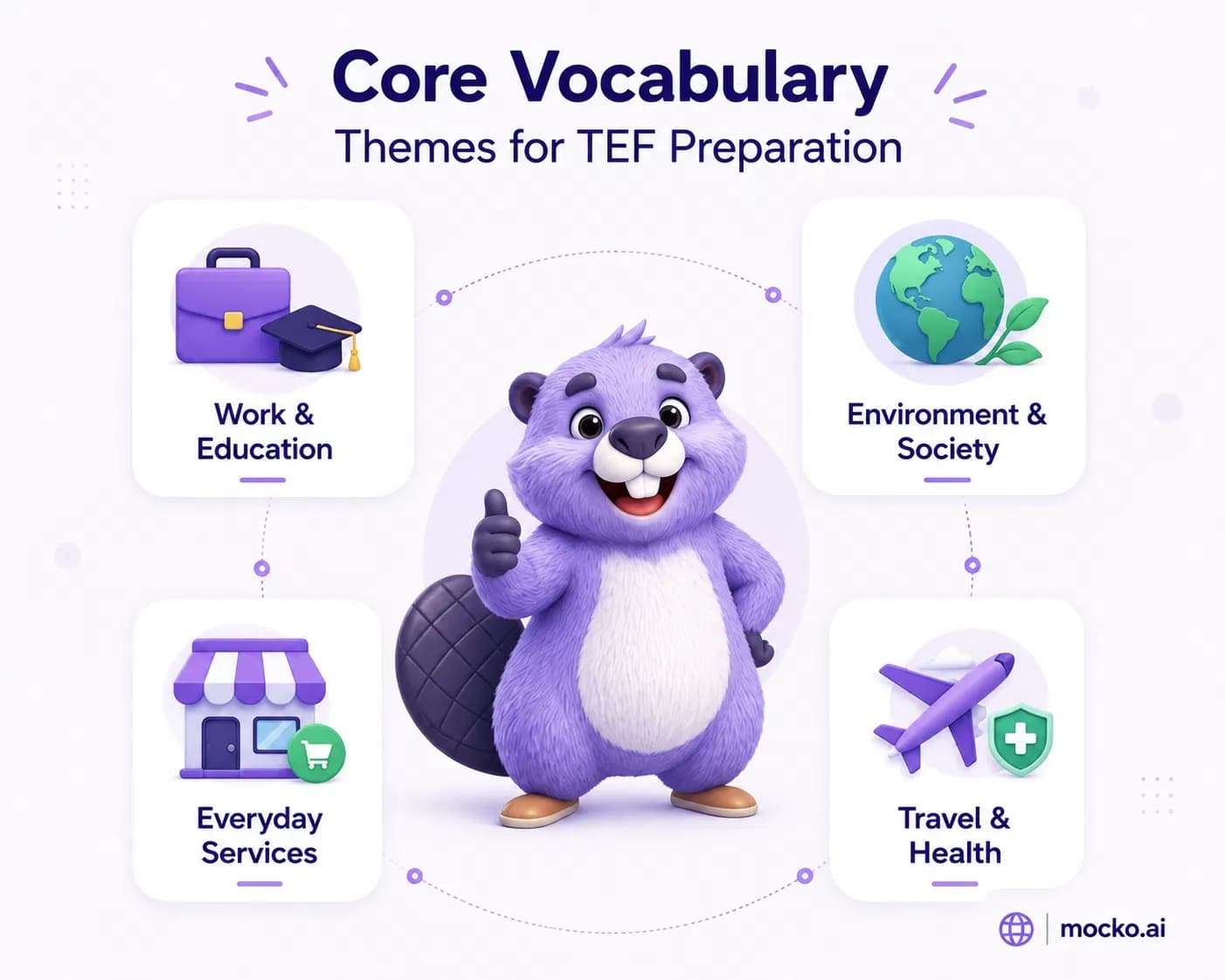
Core Vocabulary Themes for TEF Preparation
Rather than memorizing isolated words, organize your French vocabulary around thematic areas that frequently appear in TEF reading, listening, speaking, and writing tasks.
Work and Education
- Le recrutement (recruitment)
- Le télétravail (remote work)
- Les compétences (skills)
- La formation professionnelle (professional training)
- Le salaire (salary)
Environment and Society
- Le développement durable (sustainable development)
- Les énergies renouvelables (renewable energy)
- La pollution (pollution)
- Le recyclage (recycling)
- Le logement (housing)
Administration and Everyday Services
- Les démarches administratives (administrative procedures)
- L'assurance (insurance)
- Le contrat (contract)
- La banque (bank)
- Le rendez-vous (appointment)
Travel and Health
- Les transports en commun (public transportation)
- L'assurance voyage (travel insurance)
- Les soins médicaux (medical care)
- La consultation médicale (medical consultation)
- La santé (health)
Focus on learning each word together with common expressions and real-life contexts rather than memorizing isolated definitions. This approach is considerably more effective for TEF listening comprehension, oral expression, and written production tasks.
Essential Linking Words (Connectors)
Using linking words correctly helps candidates structure arguments, express nuance, and demonstrate a higher level of French proficiency in both Expression Écrite and Expression Orale.
Function | Connector | Example |
|---|---|---|
Addition | De plus | De plus, cette mesure est bénéfique pour l'environnement. |
Addition | Par ailleurs | Par ailleurs, elle permet de réduire les coûts. |
Opposition | Cependant | Cependant, certains experts ne sont pas d'accord. |
Opposition | En revanche | En revanche, cette option reste plus coûteuse. |
Cause | Puisque | Puisque les prix augmentent, les consommateurs changent leurs habitudes. |
Consequence | Par conséquent | Par conséquent, la demande a diminué. |
Illustration | Par exemple | Par exemple, plusieurs villes ont adopté cette politique. |
Concession | Bien que + subjonctif | Bien que cette solution soit imparfaite, elle demeure efficace. |
TEF Tip:
Rather than memorizing long lists of connectors, focus on mastering a small number of expressions for addition, opposition, cause, consequence, and concession. Examiners generally reward accuracy and natural usage more than the quantity of advanced vocabulary.
Common Challenges In The TEF Vocabulary
Many TEF candidates find this module tricky because it tests both speed and precision. Here are the main hurdles and how to tackle them:
1. Time Pressure: With 40 questions in 30 minutes, you have less than a minute per item. It’s easy to get stuck.
✅ Train with timed practice sets. Get used to moving quickly, skipping tough questions, and coming back later if time allows.
2. Similar Words (e.g., savoir vs. connaître): French often has pairs of words that look interchangeable but aren’t. These subtle differences can trip you up.
✅ Learn them in context, not isolation. For example, savoir is used for facts or skills (Je sais nager), while connaître is for familiarity with people or places (Je connais Paris). Practice with sentences so the distinction feels natural.
3. Subtle Grammar Rules (like subjunctive triggers): The subjunctive mood appears after certain expressions (il faut que, bien que, pour que), and missing it can cost points.
✅ Make a list of common triggers and practice short sentences. For example: Il faut que tu viennes (subjunctive) vs. Je pense que tu viens (indicative). Seeing them side by side helps cement the rule.
4. Over-Reliance on Memorization: Some learners try to memorize endless word lists or grammar charts, but the test measures how you apply knowledge in real sentences.
✅ Focus on usage. Read short French texts (emails, ads, articles) and pay attention to how words and structures appear naturally. Then practice filling in blanks with those same patterns.
Preparation Tips for Success
In the Lexique et Structure module, not only do you have to memorize grammar rules and vocabulary lists, but you also have to use French actively and accurately in context. Here are some helpful strategies:
1. Strengthen Your Core Skills
Start with grammar basics: review tenses, articles, and pronouns using trusted resources like Grammaire Progressive du Français.
For vocabulary, focus on learning words in context rather than isolation. Group them by themes such as immigration, environment, or daily life, and aim to add 50–100 new words to your repertoire each week.
2. Practice with Purpose
Target the formats you’ll see on the exam, sentence completions, and short texts. Work on connectors like cependant, donc, and par exemple to strengthen cohesion.
Don’t shy away from complex grammar rules either; practice the subjunctive and subordinate clauses in realistic scenarios, so they feel natural.
3. Use Reliable Resources
Official samples from France Éducation International or the TEF Canada portal are essential. Supplement them with TEF preparation books like Préparation au TEF or Le TEF: 500 exercices.
For a more interactive option, platforms like Mocko.ai stand out. Mocko is built for TEF and TCF exam preparation, giving learners realistic mock tests with clear feedback.
The platform mirrors the official exam setup and includes all modules, so your practice is authentic, professional, and targeted.
Why Mocko Is Useful for TEF Vocabulary
The Lexique et Structure module is about applying vocabulary and grammar in context, not rote memorization. Mocko.ai helps here by:
- Giving you sentence completion tasks and short text exercises identical to the exam format.
- Offering AI-powered feedback that suggests synonyms, clarifies usage, and strengthens contextual understanding.
- Allowing you to practice under real timing conditions (30 minutes for 40 questions), which builds speed and confidence.
- The system adjusts difficulty based on your responses, helping you progress steadily toward higher proficiency.
If you want to master the TEF vocabulary section, don’t forget to check out Mocko!
4. Simulate Test Conditions
Time yourself for 30 minutes when practicing. Train your eye to skim quickly, eliminate wrong options, and keep pace with the exam’s rhythm. Again, specialized TEF platforms like Mocko are great options for this purpose.
5. Make French Part of Your Day
Read French media like Le Monde or listen to RFI for exposure to authentic vocabulary. Podcasts such as Coffee Break French are great for idioms and spoken flow. Keep a short journal in French and use tools like BonPatron to check your writing for errors.
7. Target Weak Spots
If verbs are your weak point, drill them until they feel automatic. Use thematic vocabulary banks, especially those relevant to TEF Canada, like immigration terms, to strengthen areas that matter most.
Conclusion
The Lexique et Structure section of the TEF is a gateway to proving fluent, accurate French usage through contextual vocabulary and grammar.
If you get to know how the test works, keep up steady practice, and use fresh resources, you’ll get better at each part of the test and take real steps toward your goals, whether that’s immigration, citizenship, or studying abroad. Bonne chance!
FAQs
You don’t need to know every word in French, but aiming for 50–100 new words per week (grouped by themes like immigration, environment, or daily life) helps build a strong base.