

TCF Online Test - Free Sample Test
Table of Contents9 sections
Searching for a reliable TCF online test? You’ve come to the right place. At Mocko, we provide a comprehensive TCF online test environment that accurately mirrors the official 2026 exam standards.
Whether you are aiming for TCF Canada immigration or academic admission in France, practicing with our TCF online test is the key to mastering time management and reducing exam-day anxiety
Before we dive into the specific features of our TCF online test and the strategies to boost your score, let’s review the essential details you need to know about the exam structure:
Why You Should Practice with a TCF Online Test?
The Test de Connaissance du Français (TCF) is an official French language test for people who are not native speakers. It is run by France Éducation international, which is part of the French Ministry of National Education.
The test checks your overall French skills in four modules: TCF Listening, TCF writing, TCF reading, and TCF speaking.
The TCF is modular, meaning you can choose which parts of the test you want to take depending on your goals. It is recognized worldwide by universities, employers, immigration authorities (like in France, Canada, and Quebec), and professional organizations.
The test includes:
Listening Comprehension
Understanding everyday and academic spoken French.
Reading Comprehension
Interpreting articles, instructions, and texts.
Grammar and Vocabulary
Assessing accuracy and usage.
Speaking (Optional module)
Oral expression through interviews and tasks.
Writing (Optional module)
Structured written responses.
Also, a high TCF score makes it easier to get visas, win scholarships, and find better job opportunities. The certificate stays valid for 2 years from the day you receive your results.
Why is the TCF Important?
The TCF is highly valued because it serves multiple purposes:
Immigration
Required for Canadian and Québec residency or citizenship applications.
Education
Accepted by universities and academic programs in French-speaking countries.
Employment
Recognized by companies and institutions worldwide.
Language benchmarking
Provides an official evaluation of your French level.
Also, a high TCF score makes it easier to get visas, win scholarships, and find better job opportunities. The certificate stays valid for 2 years from the day you receive your results.
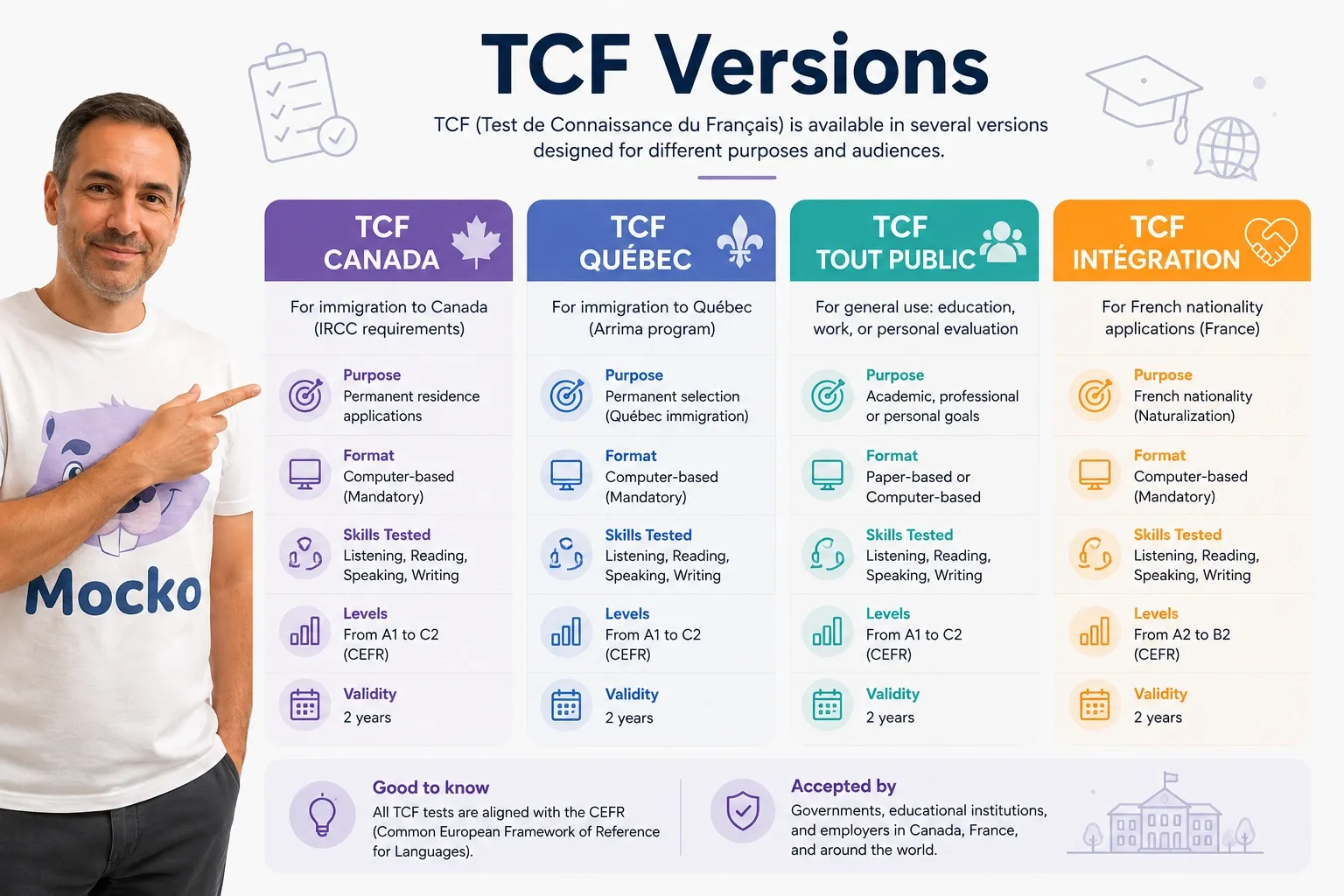
TCF Versions: Which One Do You Need?
Here’s a comprehensive table comparing different types of TCF tests:
Version | Purpose | Mandatory Sections | Key Notes | Validity |
General certification (academic, professional, personal) | Listening (29 Qs), Language Structures (18 Qs), Reading (29 Qs). Writing is optional but often required for DAP | Full CEFR A1–C2; about 80+ MCQs total; ideal for students and learners | 2 years | |
TCF DAP | Admission to French universities (1st year) or architecture schools | Same as Tout Public + mandatory Writing | Includes a written expression test; details via Campus France | 2 years |
Immigration to Canada (Express Entry, Federal Skilled Worker) | All four skills: Listening, Reading, Speaking, Writing | Scores match Canadian Language Benchmarks (CLB 4–10); partnership with IRCC renewed through 2029 | 2 years | |
Immigration to Quebec (Skilled Worker Program) | Listening, Reading, Speaking, Writing | Tailored to Quebec’s immigration standards, B2+ is often required | 2 years | |
TCF IRN | French residency, integration, or nationality | Listening (20 Qs), Reading (20 Qs), Speaking (12 min) | Focuses up to B1 level; no Writing; certificate includes photo; updates in May 2025 simplify to A1–B1 | 2 years |
TCF ANF | Access to French nationality | Listening, Reading, Speaking | Similar to IRN but specifically for citizenship; requires at least B1 level | 2 years |
TCF Exam Structure and Format
Unlike many other language tests like TEF Canada or TEF Quebec, the TCF exam includes optional sections that you can choose based on your goals.
For example, in the TCF exam, the writing and speaking sections are optional, so you can decide whether or not to take them.
Moreover, the exam itself is adaptive, meaning the questions get harder as you move forward.
Also, the total time is about 1.5 to 2.5 hours (not counting the optional parts).
Related Article: TEF vs TCF: Key Differences and How to Choose the Best↗️
Most of the TCF test uses multiple-choice questions, which makes scoring clear and unbiased. For the speaking part, your answers are recorded and checked by official graders to keep the results fair.
Take a look at these tables reviewing the TCF exam sections:
TCF Mandatory Sections (for TCF Tout Public, Canada, Québec)
Section | Format | Duration | Details |
Listening Comprehension | 29 MCQs (4 options, 1 correct) | 25 min | Audio starts simple (everyday conversations) and gets harder (debates, news). Digital version: 91 items, 15 unscored. |
Language Structures | 18 MCQs (4 options) | 15 min | TCF Grammar and TCF vocabulary tasks: fill-in-the-blanks, sentence corrections (levels A1–C2). |
Reading Comprehension | 29 MCQs (4 options) | 45 min | Texts range from ads and menus (simple) to articles and literary excerpts (advanced). |
TCF Optional Sections
Section | Format | Duration | Details |
Writing (Expression Écrite) | 3 tasks (60–180 words each) | 60 min | Task 1: Message/email (60–120 words). Task 2: Summary/article (120–150 words). Task 3: Argumentative comparison (120–180 words). Graded on coherence, vocabulary, grammar. |
Speaking (Expression Orale) | 3 tasks (face-to-face interview, recorded) | 12 min (2 min prep) | Task 1: Self-introduction (2 min). Task 2: Role-play interaction (5.5 min). Task 3: Opinion monologue (4.5 min). Assessed on fluency, pronunciation, and argumentation. |
TCF Exam Scoring and Levels
Each section of the TCF exam is scored between 100 and 699 points, with results linked to the CEFR levels (A1–C2) that describe your French ability.
Your overall level is calculated as the average of your section scores, and there is no pass or fail; the exam simply measures your proficiency.
Results are typically available within 4 to 6 weeks, or in about 15 working days for the IRN version, and certificates are collected directly from your exam center. Here are the TCF exam scoring levels:
- A1 (Beginner): 100–199
- A2 (Elementary): 200–299
- B1 (Intermediate): 300–399
- B2 (Upper Intermediate): 400–499
- C1 (Advanced): 500–599
- C2 (Mastery): 600–699
Related Article: Top 20 TCF Mistakes That Lower Your Score ↗️
TCF Test Registration, Dates, and Costs
The TCF exam runs all year, but each center sets its own schedule (weekly or monthly). You can check the nearest center using the official France Éducation international map (france-education-international.fr).
TCF Exam Sign Up Process
Below is a clear, easy‑to‑follow version of your registration guide. All original information is preserved, just organized with a smoother flow and natural tone. Your required terms are included exactly as written.
1. Choose an Approved Test Center
Registration for the TCF is done only through officially accredited centers authorized by France Éducation international. These include Alliance Française branches, universities, language schools, and other certified institutions worldwide.
You can find the nearest center using the official interactive map:
france-education-international.fr/centres-d-examen/carte?type-centre=tcf
2. Select the Correct TCF Version for Your Goal
Make sure you register for the right variant:
- TCF Tout Public
- TCF Canada
- TCF Québec
- TCF DAP
- TCF IRN
- TCF ANF
Your choice depends on your purpose:
immigration (Canada or certificat de sélection du Québec), university admission, residency, citizenship, employment, or general certification.
Always verify requirements with the relevant authority (IRCC, Ministère de l’Immigration du Québec, Campus France, prefecture, etc.).
You are responsible for choosing the correct test.
3. Check Availability and Session Dates
Each center sets its own calendar. Sessions run throughout the year, but frequency varies.
Check the center’s website, email them, or call to confirm upcoming exam date options.
High‑demand periods, especially before immigration deadlines or university cycles, fill up quickly.
4. Book Early (Recommended Timeline)
To secure a spot, register 4–6 weeks in advance. For 2026, booking 2–3 months ahead is strongly recommended due to:
- increased demand
- limited seating
- backlogs caused by immigration policy changes
- seasonal peaks
This applies whether you’re planning an in-person private class beforehand or preparing independently.
5. Complete the Registration Form
Most centers now offer an online registration form, while some still use paper forms or require email/in‑person submission.
You’ll need to provide:
- Full name (exactly as on your ID)
- Date and place of birth
- Nationality
- Contact information (email + phone)
- A recent passport-style photo (digital or printed)
- A copy/scan of a valid official ID (passport, national ID card, residence permit, etc.)
- The specific TCF version and modules you want
- Your intended purpose (e.g., Express Entry, Quebec Skilled Worker, French nationality, DAP admission, permanent visa applications)
Make sure all instructions and details are followed carefully to avoid delays.
6. Pay the Registration Fee
TCF Fees vary by country, center, and TCF version, usually €100–€250 or the local equivalent.
Full tests (mandatory + optional modules) cost more than partial versions.
Payment methods depend on the center:
- credit/debit card
- bank transfer
- cash or on‑site payment (some locations)
Once payment is made, registration is generally non‑refundable, though policies differ slightly by center.
7. Receive Your Registration Confirmation
After submitting your form and payment, you’ll receive an official invitation or registration confirmation by email, usually within a few days to two weeks.
This message includes:
- Your exam date
- Time
- Exact location
- Test format (paper or computer-based)
- Any center-specific instructions and details
Check your spam folder if it doesn’t arrive.
8. Prepare for Exam Day
- Bring the same valid ID you used during registration.
- Arrive early. Some centers take a new photo on-site for your certificate.
- Follow all center rules, including restrictions on personal items and arrival windows.
- Review the terms and conditions provided by your test center so there are no surprises.
How to Prepare for The TCF Exam?
To prepare for the TCF exam, you have to enhance your skills in reading, writing, speaking, and listening. To do this, it’s best to hire a tutor and get the official TCF exam preparation books.
However, just reading books and memorizing vocabulary won’t be enough to achieve a good TCF score. The key to reaching a high score is practice through tests. You can only discover your true level when you challenge yourself under exam conditions.
By now, you have probably guessed that the most effective way to get ready is to take mock exams. They let you experience the real test format, manage your time under pressure, and identify your weak points before exam day.
Related Article: 6-Month TCF Study Plan for Canada PR ↗️
That’s where Mocko.ai comes in, the best French mock test platform designed to simulate the TCF exam.
How Can Mocko Help You With Your TCF Exam?
Mocko isn’t just another study tool, it’s built to mirror the real TCF experience and give you the practice that truly matters. Here’s how its features help you prepare:

- Real Exam Simulation: You can practice with full-length mock tests that follow the exact TCF format, timing, and difficulty. This helps you get used to the adaptive structure and manage your time effectively.
- Adaptive Questioning: Additionally, the questions get harder as you progress, just like in the official exam. This trains you to handle increasing complexity and prepares you for the real exam flow.
- Instant Feedback & Scoring: Moreover, you’ll see your results right away, mapped to CEFR levels (A1–C2). This makes it easy to know exactly where you stand and which skills need more work.
- Section-by-Section Practice: Also, you can focus on Listening, Reading, Writing, or Speaking individually. Perfect if you want to strengthen weak areas before tackling the full exam.
- Speaking & Writing Evaluation: There’s more: you can record your speaking responses and submit writing tasks for feedback, building confidence in the two sections most learners struggle with.
- Progress Tracking: In addition, you can monitor your improvement over time. Seeing how your scores evolve keeps you motivated to push toward your target level.
- Flexible Access: Finally, practice anytime, anywhere. Doesn't matter that you’re preparing for immigration, studies, or citizenship, Mocko adapts to your schedule!
Conclusion
The TCF is a straightforward exam once you know its essentials: it’s adaptive, it covers listening, reading, speaking, and writing, and your score depends entirely on how well you perform on test day, not on accumulated coursework or past grades.
Each section has its own format, timing, and expectations, and being familiar with these details makes a noticeable difference in your results. Most candidates who score well do so because they practice with tasks that match the real exam and focus on the specific skills the TCF evaluates.
With consistent, targeted practice, especially using tools like Mocko that mirror the test structure and give you feedback, you can build the accuracy, speed, and confidence needed to ace the TCF.
FAQs
Results are usually available in 4–6 weeks; faster (about 15 working days) for TCF IRN.
Rated 5.0 by the Product Hunt community
Real, public reviews from candidates who prepared with Mocko. Verify them on Product Hunt
I’ve tried several apps to prepare for the TCF exam. While many of them are suitable for general French learning, they aren’t specifically designed for exam preparation. I think this app is great, not only for people preparing for the TCF test but also for anyone looking to build a solid foundation in French.
Unlike regular practice materials, it really simulates the exam experience — from the style of listening tests to the structure of reading and writing tasks. Covers all four skills in a clear, structured way.
The section by section approach is magnificent. It makes studying manageable and less overwhelming. Moreover, the questions are incredibly realistic and well-targeted. This is such a smart use of AI for personalized learning.