
TFI exam - Get Prepared for Your TFI Test
Table of Contents14 sections
Learning French for work, education, or professional development often leads candidates to one important assessment: the TFI Exam. Whether you are applying for a job in an international company, demonstrating workplace French proficiency, or simply measuring your language skills, understanding how the TFI Exam works is the first step toward achieving a strong score.
Unlike academic French tests that evaluate speaking and writing, the TFI Exam focuses on practical language comprehension in professional and everyday workplace situations. As a result, many employers and institutions use it to assess whether candidates can understand French effectively in real-world environments.
This guide explains the structure of the TFI Exam, how scoring works, what constitutes a good score, and how to build an effective TFI Preparation strategy using realistic study methods and TFI practice resources.
For learners looking to strengthen their French skills before test day, platforms such as Mocko.ai can provide structured preparation opportunities and realistic exam-style practice.
What Is the TFI Exam?
The TFI Exam (Test de Français International) is a standardized French-language proficiency test designed to evaluate listening and reading comprehension skills in professional and international contexts.
Developed by ETS, the organization behind several well-known language assessments, the TFI Exam measures how effectively a candidate understands spoken and written French in workplace-related situations.
The test is commonly used by:
- International companies
- Human resources departments
- Universities
- Government agencies
- Professional certification programs
Unlike exams that focus on academic French, the TFI Exam emphasizes practical communication scenarios such as meetings, emails, reports, announcements, and workplace conversations.
The TFI Exam is a French-language proficiency assessment that measures listening and reading comprehension in professional and workplace environments. It is widely used by employers, educational institutions, and organizations to evaluate practical French communication skills.
Who Should Take the TFI Exam?
The TFI Exam is suitable for a wide range of learners and professionals.
You may benefit from taking the TFI Exam if you:
- Need proof of French proficiency for employment
- Work in an international business environment
- Plan to study in a French-speaking setting
- Want an objective measurement of your French level
- Need a benchmark for career advancement
Because the exam focuses heavily on workplace communication, it is particularly valuable for professionals who use French in business contexts.
TFI Exam Format
The TFI Exam contains two primary sections:
- Listening Comprehension
- Reading Comprehension
The total test includes 180 multiple-choice questions and typically takes approximately two hours to complete.
Section | Questions | Purpose |
|---|---|---|
Listening | 90 | Evaluate spoken French comprehension |
Reading | 90 | Evaluate written French comprehension |
Listening Section
The listening portion of the TFI Exam assesses your ability to understand spoken French in realistic situations.
Candidates encounter:
- Conversations
- Telephone messages
- Workplace discussions
- Public announcements
- Short talks
Audio recordings are presented only once, making concentration essential.
Strong listening performance often depends on familiarity with natural French speech patterns rather than advanced grammar knowledge.
Reading Section
The reading component measures how effectively candidates understand written French.
Question types may include:
- Emails
- Business correspondence
- Advertisements
- Reports
- Articles
- Notices
Success in this section requires both vocabulary knowledge and efficient reading speed.
The TFI Exam consists of two sections: Listening and Reading. Candidates answer 180 multiple-choice questions that assess practical French comprehension skills commonly used in workplace and professional environments.
TFI Exam Scoring System
One reason many organizations prefer the TFI Exam is its straightforward scoring system.
Each section receives an individual score.
The scores are then combined to produce a total score ranging from 10 to 990.
Score Range | General Interpretation |
10–250 | Beginner |
255–400 | Elementary |
405–600 | Intermediate |
605–780 | Upper Intermediate |
785–990 | Advanced |
The TFI Exam does not use a pass-or-fail system.
Instead, organizations determine their own score requirements based on their needs.
What Is a Good TFI Score?
A good TFI Exam score depends on your goals.
Generally:
- 600+ demonstrates functional workplace French.
- 750+ reflects strong professional proficiency.
- 850+ indicates advanced comprehension skills.
- 900+ is often considered excellent.
For many corporate positions, scores above 700 are viewed favorably because they indicate the ability to understand complex workplace communication with relatively little difficulty.
TFI Exam vs Other French Proficiency Tests
Many French learners confuse the TFI Exam with other well-known French assessments. While all of these tests measure language proficiency, they serve different purposes.
Exam | Main Purpose | Skills Tested | Typical Use |
|---|---|---|---|
TFI Exam | Workplace French | Listening, Reading | Employment, corporate assessment |
TEF | General French proficiency | Reading, Listening, Speaking, Writing | Immigration, citizenship, studies |
TCF | General French proficiency | Reading, Listening, Speaking, Writing | Immigration, academic applications |
DELF/DALF | Official French certification | Four language skills | Education and long-term certification |
The biggest difference is that the TFI Exam focuses on comprehension rather than productive skills such as speaking and writing.
If your goal is Canadian immigration, tests such as TEF or TCF are generally more relevant. If your goal is proving workplace French proficiency, the TFI Exam is often a better fit.
Learners preparing for multiple French exams can also benefit from dedicated TCF practice resources, since many foundational language skills overlap across exams.
The TFI Exam differs from TEF and TCF because it focuses only on listening and reading comprehension in professional settings. TEF and TCF evaluate all four language skills and are commonly used for immigration and academic purposes.
How Difficult Is the TFI Exam?
The difficulty of the TFI Exam depends largely on your current level of French and your familiarity with professional vocabulary.
Candidates often find that:
- Basic questions are accessible to intermediate learners.
- Advanced questions contain workplace-specific language.
- Listening passages become progressively more challenging.
- Time management affects performance significantly.
A common misconception is that grammar alone determines success. In reality, comprehension speed plays a major role.
For example, a learner with strong grammar knowledge may still struggle if they cannot quickly process spoken French during the listening section.
The exam rewards practical understanding rather than memorized rules.
How to Prepare for the TFI Exam
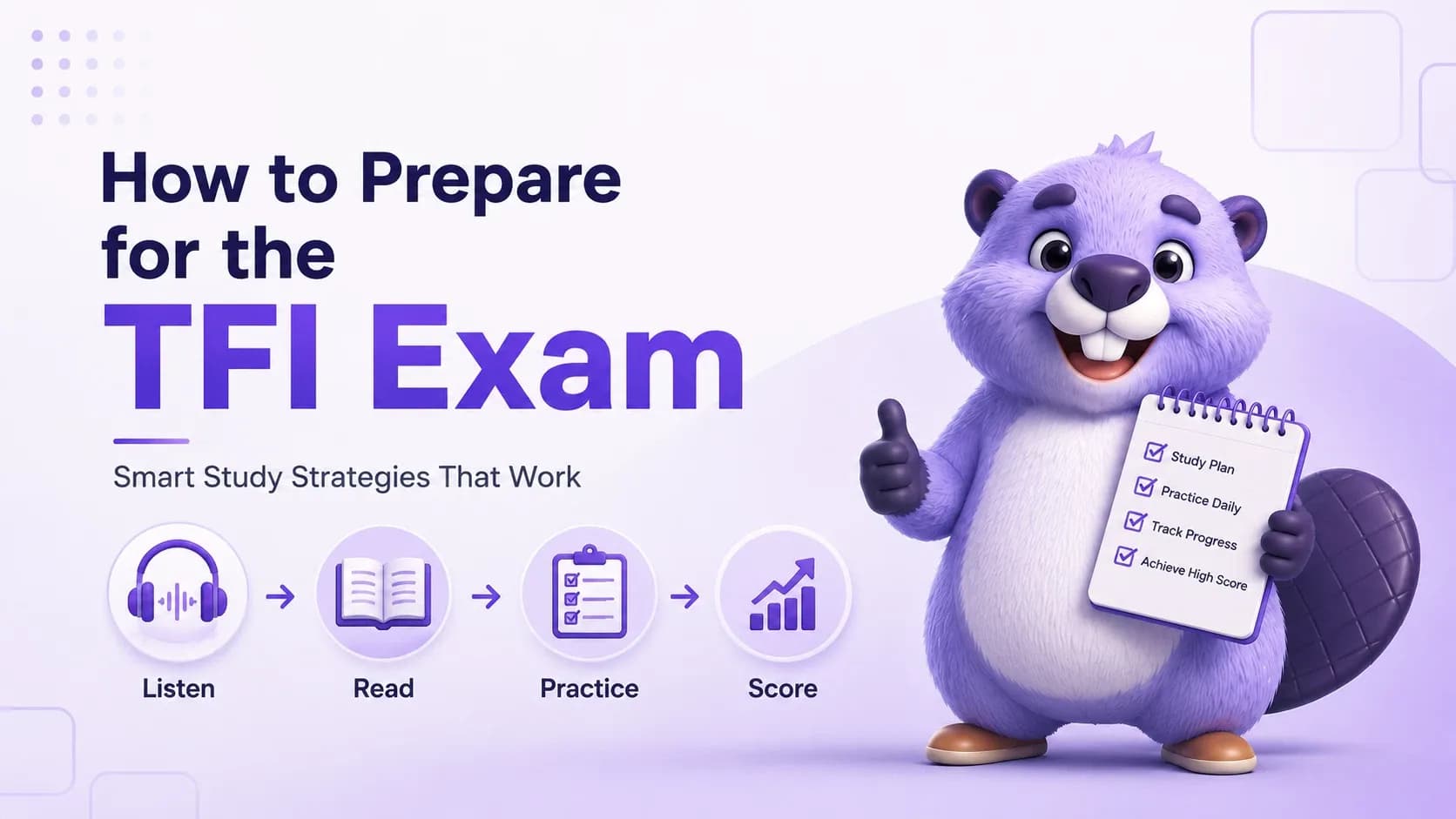
An effective TFI Preparation plan should focus on the skills actually tested on the exam.
Many learners spend excessive time reviewing grammar while neglecting listening and reading comprehension. A balanced preparation strategy is usually more effective.
Build Vocabulary Strategically
The TFI Exam frequently includes vocabulary related to:
- Business communication
- Human resources
- Customer service
- Administration
- Travel
- Workplace procedures
Instead of memorizing isolated word lists, learn vocabulary in context.
Reading French emails, company announcements, and business articles can help reinforce practical language usage.
Improve Listening Skills
Listening is often the most challenging section for candidates.
Effective preparation methods include:
- French podcasts
- Business-related audio content
- News broadcasts
- Workplace dialogue recordings
Regular exposure to authentic speech helps train your brain to process French more efficiently.
Many learners also benefit from structured French listening exercises that mirror exam-style content.
Develop Reading Speed
Reading comprehension requires both accuracy and efficiency.
Practice:
- Skimming for key information
- Identifying main ideas
- Understanding context clues
- Managing time under pressure
The goal is not simply understanding the text but understanding it quickly enough to answer questions within the allotted time.
Take Regular TFI Practice Tests
One of the most effective preparation techniques is completing realistic TFI practice sessions.
Practice tests help you:
- Identify weaknesses
- Improve timing
- Become familiar with question patterns
- Build confidence
Candidates who consistently complete TFI practice exams often perform better because fewer surprises occur on test day.
Best Resources for TFI Preparation
Not all study materials provide equal value.
The most useful preparation resources include:
Official Preparation Materials
These provide the closest representation of actual exam content and question styles.
French News Sources
Reading authentic French content develops both vocabulary and reading speed.
Examples include:
- Business news
- Technology articles
- Workplace publications
Audio-Based Learning Resources
Listening to authentic French speakers helps improve comprehension of different accents and speaking speeds.
Online Practice Platforms
Interactive learning environments can help learners simulate testing conditions and monitor progress.
Many candidates use Mocko.ai to strengthen French comprehension skills and gain additional exam-style practice opportunities before taking the TFI Exam.
Common Mistakes to Avoid
Many candidates lose valuable points because of avoidable preparation mistakes.
Focusing Only on Grammar
Grammar matters, but comprehension matters more. The TFI Exam measures how well you understand French, not how many grammar rules you can recite.
Ignoring Time Pressure
Some learners study extensively but never practice under timed conditions. This creates problems on test day when reading passages must be completed quickly.
Avoiding Listening Practice
Listening improvement requires consistent exposure. Studying vocabulary alone rarely leads to major gains in listening scores.
Taking Too Few Mock Tests
Candidates who complete only a handful of practice tests often underestimate the pace of the exam. Regular TFI practice sessions help build familiarity and confidence.
How Long Does It Take to Prepare?
Preparation time varies depending on your starting level.
Current Level | Estimated Preparation Time |
|---|---|
Beginner | 6–12 months |
Elementary | 4–8 months |
Intermediate | 2–4 months |
Upper Intermediate | 1–3 months |
Advanced | Several weeks |
These estimates assume consistent study habits.
A learner studying three to five hours per week may require more time than someone studying daily.
Expert Insight
Many candidates reach a plateau because they repeatedly study familiar material.
To continue improving, gradually increase the difficulty of your listening and reading resources. Consistent exposure to slightly more challenging content often produces stronger score gains than repeatedly reviewing comfortable materials.
Why Taking a TFI Free Test Matters
A TFI free test can provide valuable insight into your readiness before taking the official exam.
Benefits include:
- Establishing a baseline score
- Identifying strengths and weaknesses
- Practicing time management
- Building familiarity with question formats
Many candidates discover that their perceived weaknesses differ from their actual weaknesses. A diagnostic TFI free test helps direct study efforts toward the areas that will generate the greatest improvement.
Conclusion
The TFI Exam is one of the most widely recognized assessments of workplace French comprehension. Understanding the exam format, scoring system, and preparation process can help you approach test day with confidence.
If you want to evaluate your current level and strengthen your French skills through realistic practice, explore the learning resources available at Mocko.ai and begin preparing with exam-style exercises today.
TFI exam FAQ
The TFI Exam measures French listening and reading comprehension skills in professional and workplace contexts.