CELPIP vs IELTS: Which Test Is Better for Canada?
Table of Contents16 sections
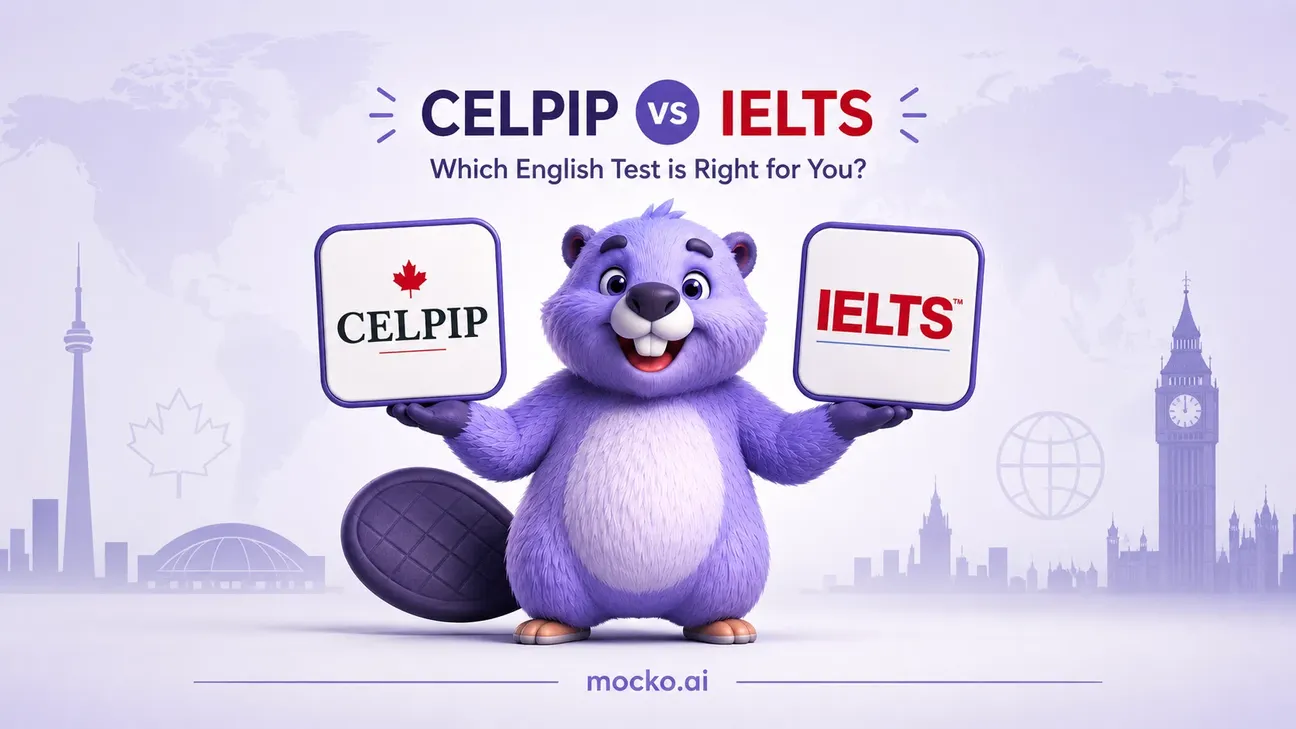
If you are comparing CELPIP vs IELTS, you are probably trying to choose the right English test for Canadian immigration, PR, Express Entry, or future study plans. The direct answer is this: both tests can work for Canada, but the better choice depends on your goal, test style, speaking comfort, typing speed, and target CLB score.
CELPIP is often more convenient for Canada-focused applicants because it is fully computer-based and uses everyday Canadian English. IELTS may be better if you want wider global recognition or need IELTS Academic for university admission.
For Canadian immigration, choose CELPIP-General if you prefer a computer-based test, recorded speaking, Canadian-style English, and one sitting.
Choose IELTS General Training if you prefer broader international recognition, are comfortable with IELTS-style tasks, or may use the result outside Canada.
For university admission, CELPIP is usually not the main choice. IELTS Academic is more commonly required by universities.
CELPIP vs IELTS: Quick Comparison
Feature | CELPIP | IELTS |
|---|---|---|
Best for | Canadian immigration | Immigration, study, global use |
Accepted by IRCC | Yes, CELPIP-General | Yes, IELTS General Training |
Academic version | No direct equivalent to IELTS Academic | IELTS Academic available |
Speaking test | Recorded on computer | Usually with examiner |
Format | Fully computer-based | Computer or paper depending on location |
English style | Canadian everyday English | International English |
Scoring | 1–12 | 0–9 bands |
Best fit | Canada PR applicants | Canada + global applicants |
What Is CELPIP?
CELPIP stands for Canadian English Language Proficiency Index Program. It measures English ability in four skills: Listening, Reading, Writing, and Speaking.
For Canadian immigration, the relevant version is usually CELPIP-General, not CELPIP-General LS.
CELPIP-General LS only tests Listening and Speaking and is mainly used for Canadian citizenship, not most PR pathways.
CELPIP is fully computer-delivered. You type your writing answers and record your speaking answers into a microphone. This is helpful for candidates who dislike face-to-face speaking interviews.
What Is IELTS?
IELTS stands for International English Language Testing System. It has two main versions:
IELTS Academic is mainly for university and higher education admission.
IELTS General Training is mainly for immigration, work, and practical English contexts.
For Canadian Express Entry, applicants normally need IELTS General Training, not IELTS Academic.
CELPIP and IELTS are English proficiency tests accepted for Canadian immigration. CELPIP is fully computer-based and designed around everyday Canadian English. IELTS is an international English test with Academic and General Training versions. For Canadian immigration, applicants usually choose between CELPIP-General and IELTS General Training.
Are CELPIP and IELTS Both Accepted for Canada Immigration?
Yes. For Canadian immigration, both CELPIP-General and IELTS General Training are accepted English language tests.
This is where many applicants make their first mistake: they ask, “Is IELTS accepted?” but they do not check which version. IELTS Academic and IELTS General Training are not the same for immigration.
If your goal is Express Entry, PR, CEC, FSWP, FSTP, or many PNP streams, check the exact language test accepted for your program before booking.
CELPIP vs IELTS Scores: How They Connect to CLB
Canada uses CLB, or Canadian Language Benchmarks, to interpret language ability. Your exam score is converted into a CLB level.
For CELPIP, the score is easier to understand because CELPIP levels usually match CLB levels directly. For example, CELPIP 9 usually means CLB 9.
IELTS is less direct. For example, CLB 9 in IELTS General Training usually requires:
Skill | IELTS General Training Score for CLB 9 |
|---|---|
Listening | 8.0 |
Reading | 7.0 |
Writing | 7.0 |
Speaking | 7.0 |
This is one reason many immigration applicants compare CELPIP vs IELTS carefully. The exam is not only about “passing.” It is about reaching the CLB level that supports your immigration score.
Which Is Easier: CELPIP or IELTS?
There is no universal answer. CELPIP is easier for some candidates, while IELTS is easier for others.
CELPIP may feel easier if you:
- Type faster than you write by hand
- Prefer speaking to a computer
- Understand Canadian accents and everyday situations
- Want one computer-based test experience
- Are preparing mainly for Canadian immigration
IELTS may feel easier if you:
- Prefer speaking to a real person
- Are already familiar with IELTS materials
- Need a test accepted globally
- Want IELTS Academic for study
- Feel more confident with traditional exam formats
The best question is not “Which test is easier?” The better question is: Which test gives you the highest chance of reaching your target CLB score?
Decision-Making Framework: Which Test Should You Take?
Use this simple framework.
Choose CELPIP if your answer is “yes” to most of these:
Question | Why It Matters |
|---|---|
Is your main goal Canadian immigration? | CELPIP is Canada-focused |
Are you comfortable typing? | Writing is typed |
Do you prefer speaking to a computer? | Speaking is recorded |
Do you understand Canadian English well? | Listening may feel more familiar |
Do you want a one-sitting test? | CELPIP is designed that way |
Choose IELTS if your answer is “yes” to most of these:
Question | Why It Matters |
|---|---|
Do you need the test for university admission? | IELTS Academic may be required |
Do you want global recognition? | IELTS is widely accepted worldwide |
Do you prefer human interaction in speaking? | IELTS speaking involves an examiner |
Have you already prepared for IELTS? | Switching may waste time |
Is IELTS more available in your city? | Test access matters |
Expert Insight:
Many candidates choose the exam based on what friends say is “easier.” That is risky. A test that feels easy for one person may be harder for another because scoring depends on skill profile.
A candidate with strong casual speaking but weak structure may struggle in CELPIP Speaking because tasks are timed and recorded. A candidate who gets nervous with examiners may perform better in CELPIP than IELTS.
The smartest strategy is to compare your performance, not other people’s opinions.
Advanced Explanation Competitors Often Miss
The biggest difference between CELPIP and IELTS is not only the format. It is the performance environment.
In IELTS Speaking, you interact with a person. This can help candidates who use natural conversation skills, facial cues, and real-time correction.
In CELPIP Speaking, you respond to a prompt on a screen. This can help candidates who prefer privacy, but it can hurt candidates who need human feedback to speak naturally.
So the speaking section is not simply “computer vs human.” It changes how you think, organize, and perform under pressure.
Common Mistakes When Choosing CELPIP or IELTS
Taking IELTS Academic for immigration
For Canadian immigration, IELTS General Training is usually required. IELTS Academic is mainly for study.
Choosing based only on price
Price matters, but a cheaper test is not cheaper if you need to retake it.
Ignoring CLB targets
For immigration, your goal is not just an exam score. Your goal is the CLB level needed for your program or CRS strategy.
Assuming CELPIP is automatically easier
CELPIP can feel easier because it uses everyday English, but its timing and recorded speaking format can surprise candidates.
Not taking a mock test first
A mock test shows whether the test format matches your strengths. Do this before booking.
CELPIP vs IELTS for Speaking
CELPIP Speaking is recorded on a computer. You speak into a microphone and answer timed prompts.
IELTS Speaking is usually a live interview with an examiner. Some candidates find this more natural. Others find it stressful.
Choose CELPIP if you prefer structured, private responses. Choose IELTS if you communicate better with a real person.
CELPIP vs IELTS for Writing
CELPIP Writing is typed. This is helpful if you type quickly and can edit on screen.
IELTS Writing may be computer-based or paper-based depending on the test option and location. IELTS writing tasks are highly standardized and require strong task response, organization, grammar, and vocabulary.
For both exams, memorized templates are risky. Examiners and scoring systems reward clear, relevant, natural answers.
CELPIP vs IELTS for Listening
CELPIP Listening often uses everyday Canadian contexts. IELTS Listening uses a wider range of accents and situations.
If you are already living in Canada or watching Canadian content, CELPIP Listening may feel familiar. If you are used to international English accents, IELTS may feel more predictable.
CELPIP vs IELTS for Reading
Both exams test comprehension, detail recognition, inference, and time management.
CELPIP Reading is computer-based and often practical in style. IELTS Reading can feel more academic or text-heavy depending on the version.
For immigration candidates, the real challenge is not only understanding the text. It is answering accurately under time pressure.
Preparation Tips
Start with your target CLB. Then take a diagnostic test. Do not prepare blindly.
For CELPIP:
- Practice timed speaking responses
- Improve typing speed
- Learn Canadian everyday vocabulary
- Practice functional writing, such as emails and responses
- Record yourself and review clarity
For IELTS:
- Learn band descriptors
- Practice essay structure
- Improve paraphrasing
- Train with different accents
- Practice speaking with follow-up questions
Related Article:
- PTE vs. CELPIP: Which Is Better for Canada Immigration?
- PTE vs IELTS: Which English Test Should You Take?
Final Recommendation
Choose CELPIP if your goal is Canadian immigration and you prefer a fully computer-based test.
Choose IELTS if you need broader recognition, may apply for study, or feel more comfortable with IELTS-style tasks.
The best test is the one that helps you reach your required CLB score with the least friction.
Before booking, take a mock test and compare your results. You can try a mock test on Mocko.ai to understand your current level and choose the right preparation path.
FAQ
001Is CELPIP easier than IELTS?
Not always. CELPIP may be easier for candidates who prefer computers, typing, and recorded speaking. IELTS may be easier for candidates who prefer speaking with a person.
002Is CELPIP accepted for Canada PR?
Yes, CELPIP-General is accepted for many Canadian immigration pathways.
003Is IELTS accepted for Canada PR?
Yes, IELTS General Training is accepted. IELTS Academic is usually not the correct version for immigration.
004Which is better for Express Entry?
Both can work. CELPIP may be better for Canada-only applicants. IELTS may be better if you want wider international use.
005What CELPIP score equals CLB 9?
CELPIP 9 in each skill generally corresponds to CLB 9.
006What IELTS score equals CLB 9?
For IELTS General Training, CLB 9 usually requires Listening 8.0, Reading 7.0, Writing 7.0, and Speaking 7.0.
007Should I take CELPIP or IELTS for university?
IELTS Academic is more commonly used for university admission. Always check the university’s official requirement.
Official Sources Referenced:
- IRCC language test requirements
- Official CELPIP test overview
- Official IELTS/IDP Canada comparison information