PTE vs. CELPIP: Which Is Better for Canada Immigration?
Table of Contents7 sections
For years, candidates applying for Canadian permanent residency through Express Entry had limited choices when it came to proving their English proficiency. Today, the landscape has completely changed. With Immigration, Refugees and Citizenship Canada (IRCC) officially accepting both the PTE Core and the CELPIP test, applicants now face a critical decision: which exam offers the clearest path to a high Comprehensive Ranking System (CRS) score?
From what we see in learner performance data, choosing the wrong test format can cost candidates precious points not because their English is weak, but because the exam structure doesn't align with their natural test-taking style.
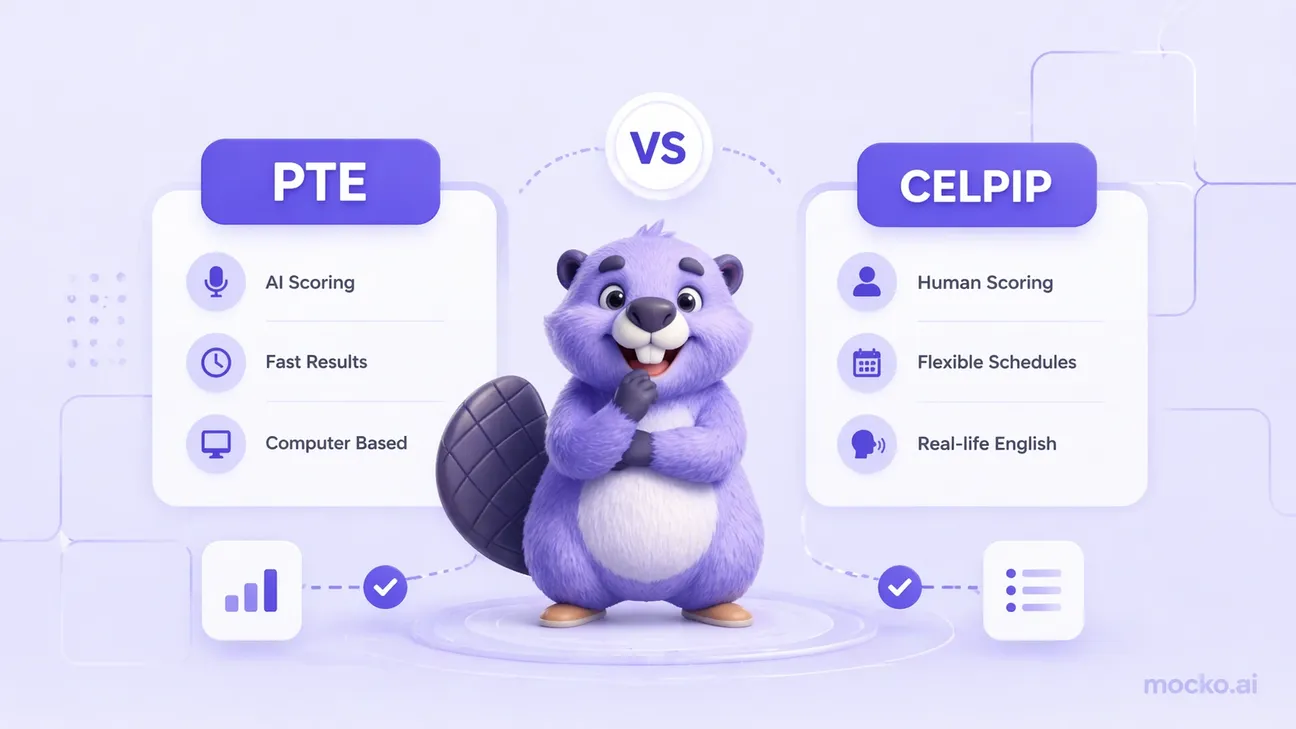
While both exams evaluate the same four core skills; speaking, listening, reading, and writing, they are built on entirely different philosophies. One relies heavily on artificial intelligence and speed, while the other emphasizes everyday Canadian scenarios and human evaluation. This guide breaks down the critical differences between PTE Core and CELPIP so you can choose the test that maximizes your Canadian Language Benchmark (CLB) score.
Understanding the Two Exams
Before comparing the difficulty of specific sections, it helps to understand the fundamental design of each test.
- PTE Core is a fully computer-based, AI-scored exam developed by Pearson. It is designed to measure general, everyday English skills in a fast-paced, integrated format. This means that a single task might test both your reading and speaking skills simultaneously. The exam takes approximately two hours to complete in a single sitting.
- CELPIP General (Canadian English Language Proficiency Index Program) was created specifically for Canadian immigration by Paragon Testing Enterprises. It focuses heavily on Canadian vocabulary, accents, and workplace scenarios. The test takes about three hours to complete, and unlike PTE Core, it keeps the four skill sections completely separate.
Format and Structure Comparison
The way questions are presented can significantly impact your performance. If you are someone who struggles with long reading passages, a test with shorter, rapid-fire questions might be your best option.
The PTE Core Experience
PTE Core moves quickly. The interface is highly automated, and the AI evaluates your responses instantly. The speaking and writing sections are combined, followed by reading and listening. Tasks include reading short texts aloud, repeating sentences, describing images, and writing brief emails.
Because the test is integrated, your performance in one area directly impacts your score in another. For candidates who have already researched PTE vs. IELTS, this integrated scoring model is often the biggest adjustment they have to make.
The CELPIP Experience
CELPIP feels more like a traditional exam, but modernized for a computer. The reading passages are longer and more complex, often requiring you to synthesize information from multiple paragraphs. The speaking section involves responding to on-screen prompts by talking into a microphone, but your responses are later evaluated by human raters rather than an algorithm.

Scoring and CLB Equivalency
For Canadian immigration, your raw test score doesn't matter as much as your CLB level. Express Entry awards points based on your CLB score in each of the four language skills.
CELPIP makes this incredibly straightforward: your CELPIP score is your CLB score. If you score a 9 in Listening on the CELPIP, you have achieved a CLB 9 in Listening.
PTE Core requires a conversion table. Because the exam is scored out of 90, you must cross-reference your results to find your CLB equivalent. For example, to achieve the highly coveted CLB 9 (which maximizes Express Entry points), you need a PTE Core score of 82–88 in Listening, 78–87 in Reading, 84–88 in Speaking, and 88–89 in Writing.
✅Read more: What CELPIP Score Do I Need for Express Entry?
Which Test Is Actually Easier?
"Easier" is subjective, but examining how each test evaluates candidates reveals distinct advantages depending on your strengths.
The Writing Section
For many learners, the harder part is the writing section. CELPIP requires two tasks: writing an email (about 150-200 words) and responding to a survey question with a short essay. PTE Core also requires an email, but its second task is simply summarizing a written text in a single sentence.
In one public learner story we reviewed on an immigration forum, a test-taker described scoring high in three CELPIP sections but repeatedly falling short in writing; they actively considered switching to PTE Core because the AI-driven email format felt less demanding under time pressure.
The Speaking Section
This is where the two exams diverge most sharply. PTE Core speaking is evaluated entirely by an algorithm. The AI is incredibly strict about hesitations, false starts, and pronunciation clarity. If you pause to think, the microphone may cut off.
CELPIP speaking is evaluated by human raters. While you still speak into a microphone, humans are generally more forgiving of natural pauses, self-corrections, and minor accent variations, provided your overall message is clear and coherent.
Cost, Availability, and Results
Practical logistics should also factor into your decision, especially if you are facing a tight Express Entry draw deadline.
- Cost: In Canada, CELPIP generally costs around CAD $295. PTE Core is slightly more expensive, averaging around CAD $330, depending on the specific test center.
- Availability: PTE Core has a massive global footprint, making it highly accessible if you are applying from outside Canada. While CELPIP has expanded internationally, its test centers are still predominantly located within Canada. Similar to the dynamic seen when comparing PTE vs. TOEFL, PTE's global network offers significant scheduling flexibility.
- Results Turnaround: PTE Core is the undisputed winner here. Because it is fully automated, results are typically delivered within 24 to 48 hours. CELPIP results generally take 4 to 5 business days.

What About Quebec Immigration?
It is crucial to note that neither PTE Core nor CELPIP will help you if your goal is to settle in the province of Quebec. Programs like the Quebec Skilled Worker Program operate under a completely different framework that heavily prioritizes French language proficiency. If Quebec is your destination, you must take an approved French exam, such as the TEF or TCF.
Action Plan: Making Your Decision
Choosing between PTE Core and CELPIP shouldn't be a guessing game. Follow these steps to make an informed decision:
- Assess Your Typing Speed: If you type quickly and accurately, PTE Core's fast-paced, integrated format will likely play to your strengths.
- Evaluate Your Speaking Style: If you tend to hesitate or self-correct while speaking, CELPIP's human raters will be more forgiving than PTE Core's strict AI algorithm.
- Take a Diagnostic Test: The only way to truly know which format suits you is to try them both under timed conditions.
Don't leave your CRS score to chance. Visit the Mocko.ai today to take a realistic, AI-scored mock test. Our detailed feedback will help you benchmark your current CLB level and determine exactly which exam format aligns with your natural abilities.
Frequently Asked Questions (FAQs)
Yes, IRCC accepts both PTE Core and CELPIP General as valid proof of English language proficiency for Canadian citizenship applications.