PTE vs IELTS: Which English Test Should You Take?
Table of Contents10 sections
Choosing between PTE and IELTS can feel paralyzing when a visa application or university offer is riding on your score. Both tests measure English proficiency, but they work very differently and the wrong choice can cost you time and money.
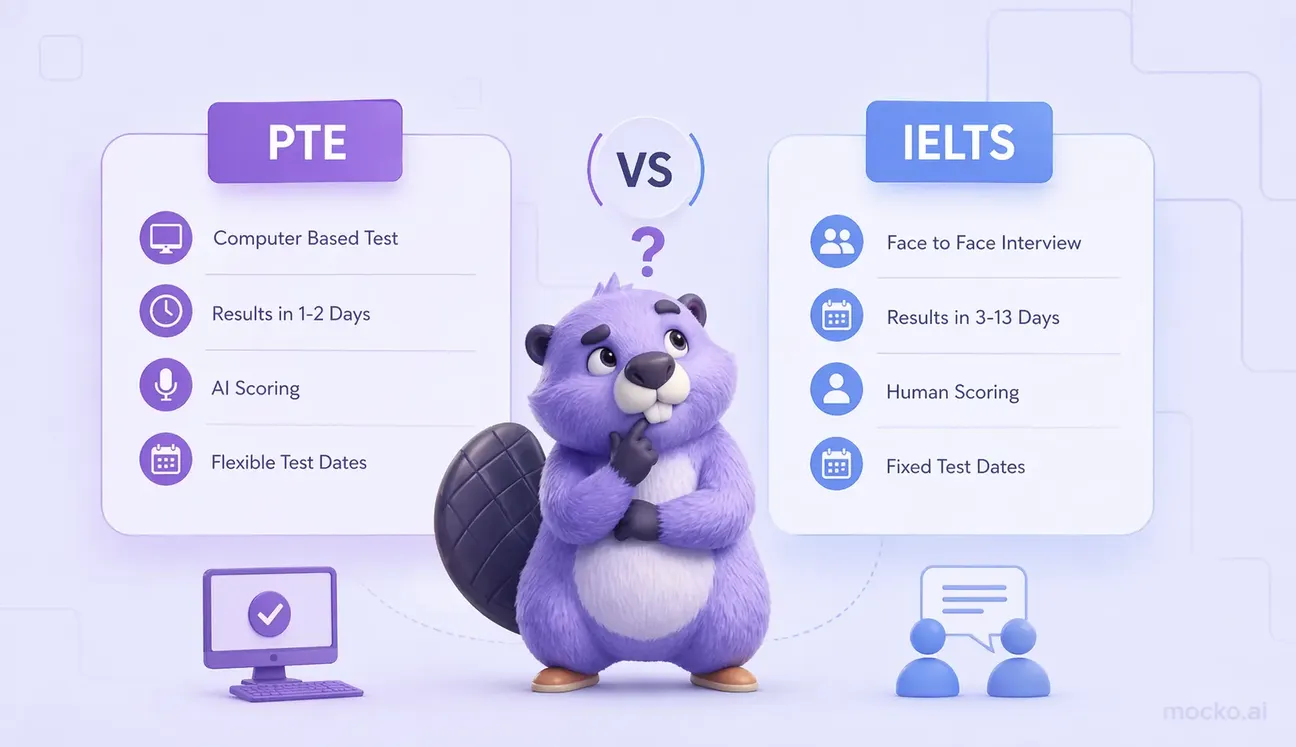
PTE is computer-graded and returns results in as little as 48 hours; IELTS involves human examiners and typically takes 3–13 days. Read on for a clear, section-by-section breakdown so you can make the call with confidence.
What Are PTE and IELTS?
PTE (Pearson Test of English Academic) is a computer-based English proficiency exam developed by Pearson. It tests Reading, Writing, Listening, and Speaking, all in a single three-hour session, all assessed by AI scoring algorithms.
IELTS (International English Language Testing System) is jointly owned by the British Council, IDP, and Cambridge Assessment English. It comes in two formats: Academic and General Training. The Speaking section is conducted face-to-face with a certified examiner, which some candidates find reassuring and others find nerve-wracking.
Both are widely accepted for immigration to Australia, Canada, the UK, and New Zealand, as well as by thousands of universities worldwide.
Format Comparison
Feature | PTE Academic | IELTS Academic / General |
|---|---|---|
Test delivery | Computer-based only | Paper-based or computer-based |
Total duration | ~3 hours | ~2 hours 45 minutes |
Speaking format | Recorded responses (AI-scored) | Live interview with examiner |
Results timeline | 48 hours (often faster) | 3–13 days |
Score validity | 2 years | 2 years |
Sections | Reading, Writing, Listening, Speaking | Listening, Reading, Writing, Speaking |
One key structural difference worth understanding is that PTE integrates skills across tasks. A single item may assess multiple skills simultaneously, such as reading and speaking together. In contrast, IELTS keeps the four sections more clearly separated, with each skill tested independently.
Scoring Systems
PTE uses a 10–90 point scale. Each skill area receives its own score, and institutions set their own minimum thresholds. for example, Australia's skilled visa stream typically requires an overall PTE score of 65 (equivalent to IELTS 6.0) or higher depending on the occupation.
IELTS uses a 0–9 band scale in 0.5 increments. A band 6.5 overall with no band below 6.0 is a common university requirement. The scoring feels more intuitive to many candidates because it mirrors how teachers grade, but that human element also introduces variability.
What surprises many candidates is how AI scoring in PTE removes examiner bias entirely. Your accent, nervousness, or the examiner's mood on a given morning simply don't factor in. For some test-takers, that's a significant advantage.
Cost and Availability
PTE Academic costs approximately USD $200–$210 depending on the country, with test centers available in over 50 countries. Rescheduling is flexible — you can book as little as 24 hours before the exam if a slot is open.
IELTS fees range from USD $215–$245 depending on the country and test center. Test dates are set in advance (typically 4 times per month), and rescheduling within 5 weeks of the test date incurs a fee.
If flexibility and fast results are priorities, especially for time-sensitive Express Entry draws or visa deadlines, PTE holds a practical edge.
Acceptance: Immigration and Universities
For Canadian immigration, both PTE Core (the newer Canadian-focused version) and IELTS General Training are accepted under Express Entry. If you're comparing these two specifically for PR pathways, the detailed breakdown in this PTE vs IELTS comparison guide is worth reading before you register.
For Australian immigration, PTE Academic is recognized by the Department of Home Affairs and is often preferred by applicants because results are faster — useful when visa processing times are tight.
For university admissions, IELTS currently has broader recognition among UK and European institutions. Most North American and Australian universities accept both, but it's always worth confirming with your specific institution before booking.
If you're also weighing other test options for Canada, this comparison of PTE Core vs CELPIP for Canadian immigration lays out the tradeoffs clearly.
Which Test Suits Which Candidate?
There's no universally superior exam, the right choice depends on your profile.
Choose PTE if you:
- Type faster than you write by hand
- Prefer objective, AI-based scoring without examiner variability
- Need results quickly for a visa deadline
- Are comfortable with technology-driven environments
- Struggle with test anxiety in face-to-face interviews
Choose IELTS if you:
- Prefer a live conversation for the Speaking section
- Are applying to institutions in the UK or Europe where IELTS acceptance is near-universal
- Find it easier to write by hand than to type
- Have more preparation time and want access to a larger pool of practice materials
A pattern we often see is that candidates who are strong, confident speakers tend to do well in IELTS Speaking because they can adapt their delivery to the examiner's follow-up questions. On the other hand, candidates who freeze under observation consistently perform better when speaking into a microphone on their own schedule.
Leila, a test-taker who shared her experience on an IELTS preparation forum, found that switching from IELTS to PTE after two unsuccessful attempts removed the speaking anxiety that had been pulling her score below the required band her third attempt, this time with PTE, resulted in the score she needed.
Preparation Strategy
PTE preparation is heavily pattern-based. The AI scoring system rewards specific micro-skills: fluency over filler words, proper oral punctuation in dictation tasks, and consistent keyboarding accuracy in writing. Learning the format is as important as improving your English.
IELTS preparation rewards genuine language development alongside test strategy. The writing tasks — especially Task 2 for Academic — benefit from deep practice with argument structure and cohesion.
For PTE, consistent timed practice under realistic conditions is essential. At Mocko.ai, full-length mock tests are built to mirror actual exam conditions so candidates can identify weak sections before test day rather than during it.
If you're also considering a French-language test alongside your English exam for Canadian immigration, the PTE Core vs TEF Canada comparison explains how bilingual applicants can strategically use both results to maximize their CRS score.
A Quick Decision Framework
- Check acceptance first. Confirm your target institution or visa stream accepts PTE, IELTS, or both.
- Consider your timeline. If you need scores within days, PTE is the faster option.
- Assess your strengths. Strong typist and tech-comfortable? PTE may suit you better. Expressive speaker? IELTS might play to your strengths.
- Review prep resources. Both exams have extensive materials, but PTE practice content is more format-specific.
- Factor in cost and flexibility. PTE's open scheduling and faster rebooking can reduce pressure significantly.
Conclusion
PTE and IELTS are both credible, internationally respected exams, the difference lies in format, speed, and how well each test aligns with your learning style and immigration or study goals.
If you're still undecided after reading this, the most practical next step is to sit a realistic practice test for each and see which environment feels more natural. You can start with a free mock test at Mocko.ai to gauge where you stand before committing to a test date.
Frequently Asked Questions
001Is PTE harder than IELTS?
Neither test is objectively harder, but they feel different. PTE's AI scoring rewards precision and pattern recognition. IELTS rewards communicative fluency and writing depth. Your prior test experience and study habits will determine which feels more manageable.
002Is PTE accepted for Canada PR?
Yes. PTE Core is accepted under Canada's Express Entry system. It maps directly to the Canadian Language Benchmark (CLB) levels used to calculate CRS points.
003Can I use PTE for UK visa applications?
PTE Academic is accepted by UK Visas and Immigration (UKVI) for most visa categories. Always verify the specific visa route you're applying for, as requirements can vary.
004How long are PTE scores valid?
PTE scores are valid for two years from the test date, the same validity period as IELTS.
005What PTE score is equivalent to IELTS 7.0?
A PTE score of 65 is broadly equivalent to IELTS 7.0, though exact equivalency tables vary slightly by institution. Always check the score requirements published by your specific institution or immigration program.
006How many times can I take PTE?
There is no official limit on how many times you can take the PTE exam. You can rebook as soon as a test slot is available, which gives you more flexibility than some other exams.