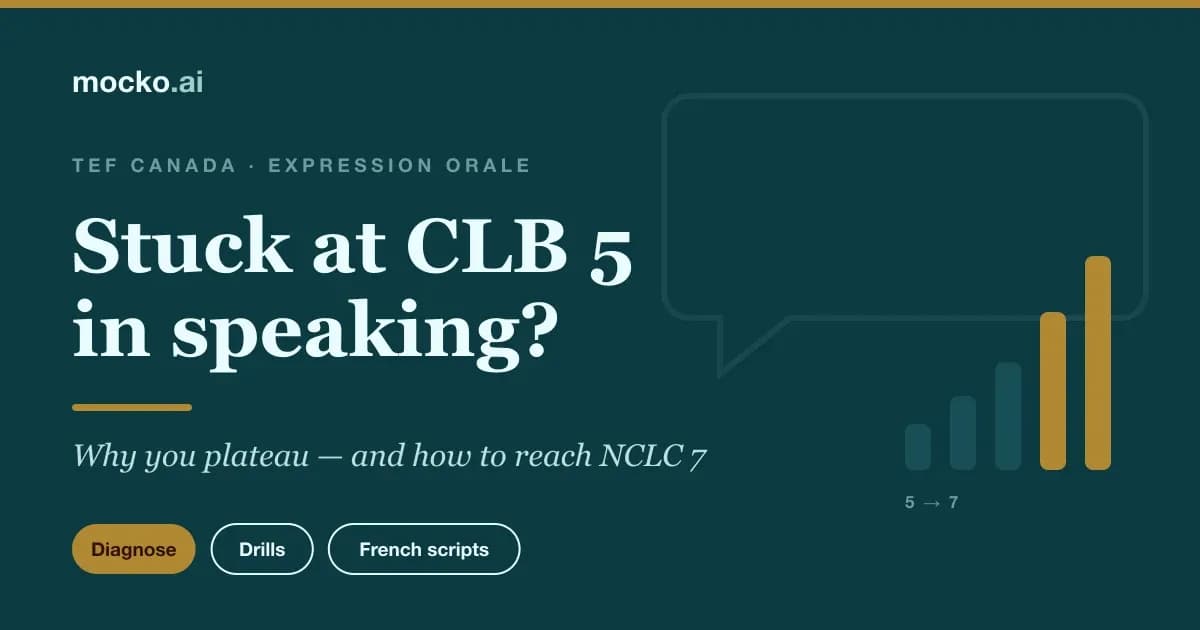
Stuck at CLB 5 in TEF Speaking? How to Reach CLB 7
Table of Contents10 sections
"I'm stuck at CLB 5 in speaking and I don't know what to do." If you have sat the TEF Canada twice and watched your Expression orale score land in almost the same place both times, you are in one of the most frustrating positions in the whole Canadian immigration process. Your reading is fine. Your listening is fine. One fifteen-minute conversation is holding up your entire profile.
This guide is a diagnosis, not a pep talk. We will start by making sure you are even reading the right number off your certificate — a surprising number of candidates are not — then work through what the examiner is actually marking, the specific behaviours that cap people at NCLC 5, and the French you need to fix each one.
Before anything else: are you reading the right score?
This comes first because it is the most common expensive mistake in TEF Canada, and it has nothing to do with your French.
Your attestation de résultats shows your result for each skill in two different places: a column marked « Score / 699 », and a column marked « Équivalence ancien score ». They are different numbers for the same performance. And for Express Entry, IRCC accepts only one of them.
Its instructions are blunt: enter only the scores from the « Équivalence ancien score » column, because "if you don't enter the correct scores, we may refuse your application." The Score / 699 figures, IRCC says, are not compatible with its system at this time and should not go into your profile at all.
So although CCI Paris Île-de-France, which runs the test, headlines the 0–699 score on your certificate, the number that decides your Express Entry profile is the ancien score — and for Expression orale that scale runs to 450.
This is why you will find two completely different sets of "NCLC 7" figures online, both correct in their own context. If you are working towards Express Entry, this is your table:
NCLC level | Speaking (expression orale) | Listening (compréhension de l'oral) | Reading (compréhension de l'écrit) | Writing (expression écrite) |
|---|---|---|---|---|
NCLC 10 | 393–450 | 316–360 | 263–300 | 393–450 |
NCLC 9 | 371–392 | 298–315 | 248–262 | 371–392 |
NCLC 8 | 349–370 | 280–297 | 233–247 | 349–370 |
NCLC 7 | 310–348 | 249–279 | 207–232 | 310–348 |
NCLC 6 | 271–309 | 217–248 | 181–206 | 271–309 |
NCLC 5 | 226–270 | 181–216 | 151–180 | 226–270 |
NCLC 4 | 181–225 | 145–180 | 121–150 | 181–225 |
Source: IRCC, Express Entry: Language test results (page last modified 22 June 2026).
If you have seen a chart saying NCLC 7 in Expression orale is 456–493, that is not wrong — it is the provider's 0–699 correspondence chart for tests taken from 11 December 2023, and some other immigration programs do use it. But it is not the column Express Entry reads. Check which programme you are applying under before you decide how far you have to go, and if you want the arithmetic done for you, our CLB converter works on the Express Entry scale.
Now the encouraging part. The top of NCLC 5 is 270. The bottom of NCLC 7 is 310. You are 40 points away on a 450-point scale — about 9%.
One more thing that table quietly tells you, and it is worth its own sentence: the NCLC 7 threshold sits at roughly the same proportion of the scale in every skill — 310/450 in speaking, 249/360 in listening, 207/300 in reading, all about 69%. Speaking is not marked more harshly than the other skills. If speaking is your outlier, that is information about your speaking, not about the test being unfair.
Be honest about the size of the jump
You will find plenty of pages promising NCLC 5 to NCLC 7 in a fixed number of weeks. Here is the more honest version.
The Centre for Canadian Language Benchmarks commissioned its own alignment of the CLB/NCLC to the Common European Framework. For speaking specifically, that study places NCLC 5 at the very bottom of B1 and NCLC 7 at around B1+, with elements of B2. So 5 to 7 is a genuine jump of roughly two CEFR sub-levels. It is not a formatting trick.
But — and this is the whole point of this article — candidates stuck at exactly NCLC 5 are usually not held back by the whole of that gap. They are held back by a handful of specific, gradeable behaviours that are much cheaper to fix than a full level of French. The plan later in this article targets that layer first, because it is where the fastest points live. If you are genuinely a long way below the band, no amount of technique will substitute for more French, and you should plan for months rather than weeks.
Why NCLC 7 is worth so much
NCLC 5 in one skill is not "a slightly lower score." It is often the difference between having a profile and not having one.
- Program eligibility. For the Federal Skilled Worker Program, your first official language must be NCLC 7 in all four abilities. One skill at 5 makes you ineligible, and the other three do not compensate.
- The French bonus in the CRS. IRCC's wording is precise: score NCLC 7 or higher on all four French skills and you get 25 additional points if your English is CLB 4 or lower (or you took no English test), or 50 additional points if your English is CLB 5 or higher across all four skills. Note "all four." Speaking at NCLC 5 makes that bonus zero, not smaller.
- The knock-on effects. Because several parts of the CRS gate on your lowest first-language ability, one skill at 5 also costs you core language points and can shut down the skill-transferability points for education and foreign work experience. Added up, one stuck skill routinely costs well over 60 CRS points. Our CRS calculator will show you your own number both ways.
- French-category draws. French-language proficiency is one of IRCC's category-based selection categories, it requires NCLC 7 in all four abilities, and it is the one category with no occupation requirement. Through 2026 its cut-offs have sat far below the general and Canadian Experience Class rounds. You can check the current picture in our Express Entry draw history.
One caveat worth knowing, as of July 2026: IRCC has opened a consultation that raises the possibility of removing or changing the additional points for French, on the reasoning that category-based draws now do that job. Nothing has changed in law, and the French category is not part of that consultation — but if the 25 or 50 points are part of your plan, that is an argument for acting sooner rather than later.
What actually happens in those fifteen minutes
You cannot fix a test you have not modelled precisely. Expression orale is a face-to-face role-play with an examiner, 15 minutes, in two sections that test different things — and it is systematically recorded, then marked by two assessors: the examiner in the room, and a second assessor working only from the recording.
That second assessor cannot see you. Every point you earn has to be audible.
Section A — 5 minutes — obtain information. You are given an everyday advertisement: a job offer, a service, a rental, a leisure activity. You are telephoning about it. The official instruction is to ask about ten questions — « Posez une dizaine de questions » — while the examiner plays the person on the other end. You are talking to a stranger in a commercial situation, so this section is vous, and CCI describes the skill being tested as holding a formal conversation.
Section B — 10 minutes — present and persuade. You are given a second document, you present it to the examiner, and you try to convince them to take part. Here the examiner plays a friend who is reluctant and will push back, so this section is tu, and CCI describes it as holding an informal conversation.
Read those two paragraphs again and notice what the test is built to do: it makes you switch register halfway through. That is not incidental. It is one of the clearest differences between NCLC 5 and NCLC 7, and most candidates run a single register for the full fifteen minutes.
One warning, because it wrecks people's preparation: several prep sites describe Section A as a spontaneous chat where you answer questions about yourself. That is the opposite of the task. Work from CCI's own sample subjects so your mental model is right, and see our TEF oral expression breakdown for practice tasks in the real format.
What the examiners are actually asked
CCI publishes the questions its assessors work from. There are two families.
The quality and effectiveness of your discourse — in Section A, getting information and making answers more precise; in Section B, presenting a situation and developing your ideas. The assessors are asked: Is the discourse suited to the situation? Is it clear, or confused and incoherent? Are the points sketchy, vague, precise, detailed? Are the reactions to the examiner's interventions appropriate, spontaneous, natural?
The richness and control of your spoken French — vocabulary, syntax, pronunciation. The assessors are asked: Are the sentences simple, complex, well controlled? Are tenses and moods used correctly? Is the vocabulary accurate, precise, appropriate? Is the pronunciation clear and natural?
Two things follow directly. "Sketchy and vague" versus "precise and detailed" is a scored distinction, so short safe answers cost you. And nothing there rewards rare vocabulary or a native accent — the words are accurate, precise, appropriate and clear, natural.
If you want to know precisely what the levels themselves require, the NCLC descriptors are published in the Niveaux de compétence linguistique canadiens framework. Here is the 5-versus-7 comparison for speaking, which is the most useful diagnostic on this page:
NCLC 5 | NCLC 7 | |
|---|---|---|
Overall | Takes part with some effort in everyday conversations on familiar, concrete topics | Takes part with ease, developing ideas, in detailed conversations on concrete and sometimes abstract topics |
Pace | Slow to normal, with frequent pauses and hesitations | Slow to normal, but often reformulates and self-corrects |
Who runs the conversation | May need occasional help from the other person | Uses several strategies to manage the conversation — holding the floor, resuming after interruption, changing topic, asking questions |
Vocabulary | Everyday vocabulary | Precise vocabulary |
Sentences | Simple structures, a few complex ones, sometimes simplified | Varied structures including complex sentences; moods and tenses for possibility and probability |
Prosody | not mentioned at this level | Adapts prosody — intonation, voice, pace |
Connectors | et, mais, ensuite, parce que | A variety of connectors, used appropriately, ideas in logical order |
Register | Some cultural references, a limited range of idiom | Adapts style and register to different situations and audiences |
Look at the "Pace" row, because it settles an argument. The expected delivery is slow to normal at both levels. Speed is not the variable. What changes is what you do when you get stuck, and who is doing the work of keeping the conversation alive.
The ten reasons candidates freeze at NCLC 5
Most people stuck at 5 will recognise three or four of these.
1. In Section A, you answer instead of ask
The single most common cause. The examiner says almost nothing, the silence pulls you in, and you start talking about the advertisement — "Ah oui, cet appartement est intéressant, j'aime bien le quartier…" — instead of interrogating it. You produce plenty of French and still score badly, because you did not do the task.
The fix: treat Section A as a shopping list, not a conversation. Decide in advance on eight to ten things you need to know — price, availability, location, duration, conditions, what is included, next step — and ask about them one at a time. Count your questions out loud in practice until ten in five minutes feels normal.
2. Your "questions" are statements with a question mark
"Le loyer c'est combien ?" and "L'appartement est disponible quand ?" are comprehensible, and marked as low-register spoken French. Ten of those shows the assessor exactly one structure.
The fix: rotate deliberately through three machines. Est-ce que is your workhorse, inversion is your polish, and indirect questions buy you register:
- Est-ce que le loyer comprend les charges ?
- Le logement est-il disponible dès le mois de septembre ?
- Quels sont les horaires exactement ?
- Pourriez-vous me préciser le montant du dépôt de garantie ?
- J'aimerais savoir quelles sont les conditions pour réserver.
Then check your coverage of question words across the ten: qui, que, quand, où, comment, combien, pourquoi, quel, à partir de quand, pendant combien de temps.
3. You run one register for fifteen minutes
You say tu to the letting agent, or you keep vous with the friend in Section B, or you open with vous and drift into tu by minute four.
The fix: treat the register switch as the structural feature it is. Rehearse both openings as fixed rituals until they are reflexes:
Section A (vous): « Bonjour madame, je vous appelle au sujet de votre annonce pour le poste d'auxiliaire de vie. Auriez-vous quelques minutes pour me renseigner ? »
>
Section B (tu): « Écoute, je viens de tomber sur une annonce qui devrait vraiment t'intéresser. »
Say the first sentence of each section out loud before anything else, and never mix s'il vous plaît with tu.
4. You give opinions instead of arguments
Asked to convince, a candidate at 5 says: "Je pense que c'est une bonne idée. C'est bien pour la santé. Et c'est moins cher." Three opinions, nothing developed, nothing addressed to the person being persuaded — which lands squarely on "sketchy and vague."
The fix: one four-move structure, every time, until it is muscle memory.
- Position — Franchement, je pense que c'est exactement ce qu'il te faut.
- Reason — …parce que cela te permettrait de…
- Concrete example — Tiens, l'année dernière, tu as passé des semaines à organiser ton voyage.
- Concede, then push back — Je comprends ton hésitation, et c'est vrai que le vol n'est pas inclus. Cela dit, si tu réserves tôt, tu trouveras un billet correct sans problème.
Move four is what separates 5 from 7. Answering the objection is the clearest evidence of interactive competence there is, and almost nobody stuck at 5 does it.
5. You let the examiner run the conversation
At NCLC 5 you "may need occasional help from the other person." At NCLC 7 you are managing the exchange yourself. If the examiner is doing the work of keeping things moving, the descriptor already has you at 5.
The fix: bank a handful of relances and use one every twenty to thirty seconds:
- D'accord, et concrètement, cela représente combien d'heures par jour ?
- Excusez-moi, je n'ai pas bien saisi : vous avez dit trois cents dollars par personne ou pour le groupe ?
- Si j'ai bien compris, il faut être disponible le week-end aussi, c'est bien ça ?
- Une dernière chose, si vous permettez : …
6. Your connectors stop at et, mais and parce que
Those four words are literally the NCLC 5 examples in the framework. NCLC 7 asks for variety used appropriately. This is the cheapest fix on the list.
The fix: learn twelve connectors by function rather than fifty in a list, and force one contrast and one concession into every Section B answer:
- Adding: de plus, par ailleurs, d'ailleurs
- Contrast: en revanche, cela dit, pourtant
- Concession: certes… mais, il est vrai que… mais, bien que + subjunctive
- Consequence: donc, du coup, par conséquent
- Reformulating: autrement dit, c'est-à-dire, bref
- Sequencing: tout d'abord, ensuite, enfin
Our guide to French connectors was written for the written test, but the inventory works out loud.
7. You go silent, or you hesitate in English
Silence is the most expensive thing you can do in a fifteen-minute test, and "um" is audibly not French. Remember that the second assessor has only the audio.
The fix: the framework rewards reformulating and self-correcting, so do it out loud, in French:
- Alors, laissez-moi réfléchir un instant…
- C'est une bonne question. Je dirais que…
- Comment dire… ce que je veux exprimer, c'est que…
- Si je comprends bien, vous me demandez si…
And correct yourself audibly rather than hoping it slipped past: « …il a allé — pardon, il est allé. » That is a scored behaviour, not an admission of weakness. Swap um for euh and ben.
8. You stop dead when you don't know a word
You need un dépôt de garantie, you do not have it, and you stop. The assessors cannot reward vocabulary you never produce — but working around it is itself a competence.
The fix: practise defining your way out.
- Je ne connais pas le mot exact, mais c'est l'argent qu'on verse au début et qu'on récupère à la fin.
- C'est une sorte de… disons, un document officiel qui prouve que…
- Comment on dit… la personne qui s'occupe des personnes âgées à domicile ?
Never switch to English. Paraphrase reads as competence; a switch reads as breakdown.
9. You live in the present tense
NCLC 7 explicitly wants moods and tenses that express possibility and probability. Plenty of candidates stay in the present for fifteen straight minutes.
The fix: plant variety on purpose — one of each, per section:
- J'ai vu votre annonce hier soir. (passé composé)
- Je pensais plutôt à un poste à temps partiel. (imparfait)
- Je serais disponible dès lundi. (conditionnel)
- Il faut que je vérifie mon emploi du temps. / Bien que ce soit un peu loin, ça vaut le coup. (subjonctif)
- Si j'étais toi, je n'hésiterais pas. (hypothetical)
10. You are reciting
A memorised answer cannot satisfy "are the reactions to the examiner's interventions appropriate, spontaneous, natural?" — and the examiner is specifically briefed to interrupt and disagree. Scripts also collapse the moment the advert is not the one you rehearsed.
The fix: memorise functions, not sentences. An opener, a clarification move, a concession move, a closer. Everything between them is improvised. And prepare one or two counter-arguments before Section B, because the friend will never simply agree.
A four-week block to fix the technique layer
This will not manufacture a level of French. What it will do is remove the behaviours above, which is where the fastest points are if you are already at the top of NCLC 5 or in NCLC 6.
Week | Focus | Daily work (30–45 min) | How you know it worked |
|---|---|---|---|
1 | Questions & register | Ten Section A questions a day from a real advert, rotating est-ce que / inversion / indirect, all in vous | You can generate ten varied questions about any advert in 90 seconds |
2 | Argument structure | One Section B prompt a day, aloud, with the four-move structure and always a concession | Every argument ends with "I understand X, but Y" |
3 | Interaction & prosody | Shadow five minutes of French audio; re-record Week 2 answers adding a relance every 20–30 seconds | No silence over three seconds; questions audibly rise |
4 | Full simulations | Two timed 15-minute mocks, reviewed against the criteria above | You finish both sections without running out of things to say |
Two rules matter more than the schedule. Record every session — you cannot hear your own hesitation, flat intonation or tu/vous slips in real time, but they are obvious on playback, and playback is exactly what your second assessor will hear. And get one round of outside feedback, because the specific thing capping your score is usually invisible from the inside. Mocko's TEF speaking practice runs timed Section A and Section B tasks with feedback on these criteria, and our TEF mock tests cover the full sitting.
Retaking, appealing, and switching test
This is where candidates waste the most money, so it is worth being precise.
You cannot retake only the speaking section. For a federal immigration application, CCI requires you to register for all four skills in a single session, and « toutes les épreuves doivent être passées le même jour pour que votre attestation soit reconnue par les autorités canadiennes » — all sections on the same day for the certificate to be recognised. There is no TEF equivalent of a single-skill retake. A retake means sitting all four again.
There is a minimum gap of 20 days between two attempts at the same épreuve, across all TEF versions, and breaking that rule gets your registration cancelled. There is no limit on how many times you may take it overall.
You cannot ask for your speaking score to be re-marked. This is the most misunderstood point in TEF. CCI does have an appeal procedure — free, within 30 days — but it exists for a serious anomaly or malfunction during the session, which has to be reported to the invigilator on the day. The remedy is a free retake of the affected section, not a re-score, and once the procedure completes your original scores are cancelled whatever the new ones say. You also cannot listen to your own recording. If you are hoping a second look will nudge 305 up to 310, that route does not exist.
This is the one genuine argument for switching to TCF Canada. TCF does offer a re-correction of the speaking and writing tests on request within 30 days of results. Its speaking test is also structured differently: three tasks in about twelve minutes, opening with a short warm-up about yourself and giving you a couple of minutes of preparation for the interaction task, where TEF opens cold into a five-minute role-play. If your problem is specifically freezing in the first minute, that difference is real. Set against it, TCF speaking is marked out of 20, so each band is a single-mark cliff — NCLC 7 is 10 or 11 — which cuts both ways. Cost is about the same, roughly CAD $390 for the four modules at Canadian centres for either test. Our TEF vs TCF comparison goes through the rest. What no source supports is the idea that TCF examiners simply score more generously.
Watch your validity dates. IRCC requires results less than two years old at two separate moments: when you complete your Express Entry profile, and when you submit your PR application. A profile that was valid on the day you created it does not protect a late submission. Results come back in roughly one to ten business days, so build that into any deadline. If you need to move a booking, see our guide to rebooking or cancelling a TEF or TCF exam.
And book the retake after the fix, not before. Four weeks of targeted work then a test beats a test every month with nothing changed in between — the 20-day rule almost seems designed to make that point.
Three myths worth dropping
"I need to speak faster to sound fluent." No. The NCLC descriptors put expected delivery at slow to normal at NCLC 5 and NCLC 7. Rushing strips out the intonation that makes French questions sound like questions and blurs your endings. Slow down slightly and put the energy into rhythm, intonation and eliminating silence.
"My accent is holding me back." The published criterion is whether pronunciation is clear and natural — not native. A strong accent with clear rhythm and real question intonation scores well. Chasing a native accent is the least efficient possible use of four weeks.
"The examiner was biased." Partly answerable. The test is recorded, marked by two independent assessors — one of whom works only from the recording and sees only your candidate number. That design limits individual bias. It is also true that research on TEF examiner judgement finds real variation in how assessors interpret descriptors, and that the ambiguity is worst exactly at the B1/B2 boundary where NCLC 5 to 7 sits. So: if you are a few points under a band, variance is a plausible part of the story. If you are forty points under, it is not. And if the anxiety itself is part of the problem, that is separate and solvable — see managing French exam anxiety.
The bottom line
Check you are reading the « Équivalence ancien score » column, so you know your real distance from 310. Then identify which of the ten causes are yours, honestly, from a recording — not from memory of how it felt.
Spend a week on questions and register, a week on argument structure with concessions, a week on interaction and prosody, and a week on full simulations. Record everything. Get one round of real feedback. Then rebook.
The candidates who break through are rarely the ones who studied the most French. They are the ones who worked out which specific behaviour was capping their score, and changed it.
001Why am I stuck at CLB 5 in TEF speaking?
Most candidates plateau at NCLC 5 for task reasons rather than pure language reasons. The most common causes are answering instead of asking questions in Section A, giving opinions instead of structured arguments in Section B, relying on a single question form, running one register for the whole test, letting the examiner manage the conversation, staying in the present tense, and filling hesitation with silence or English. Each of those is graded, and each is fixable.
002What TEF score do I need for CLB 7 in speaking?
For Express Entry you need 310 to 348 in Expression orale, read from the "Équivalence ancien score" column of your certificate. NCLC 5 is 226 to 270 and NCLC 6 is 271 to 309, so the distance from the top of NCLC 5 to the bottom of NCLC 7 is 40 points on a 450-point scale.
003Should I use the Score /699 or the Équivalence ancien score column?
For Express Entry, the "Équivalence ancien score" column. IRCC states that you should only enter the scores from that column, that the Score /699 results are not compatible with its system at this time, and that entering the wrong scores may lead to your application being refused. Some other immigration programs do use the 0 to 699 chart, so check the requirements of the specific program you are applying under.
004Can I retake only the speaking section of the TEF?
No. For a federal immigration application you must register for all four skills in a single session, and all sections must be taken on the same day for your certificate to be recognised by the Canadian authorities. A retake means sitting the whole test again.
005Can I ask for my TEF speaking score to be re-evaluated?
Not in the sense most candidates mean. CCI's appeal procedure is free and open for 30 days, but it applies to a serious anomaly or malfunction during the session, which must be reported to the invigilator on the day, and the remedy is a free retake rather than a re-score. Your original scores are cancelled once the procedure completes. TCF Canada, by contrast, does offer a re-correction of the speaking and writing tests on request.
006How long do I have to wait to retake the TEF?
There is a minimum gap of 20 days between two attempts at the same section, across all versions of the TEF, and breaking that rule results in your registration being cancelled. There is no cap on the total number of attempts.
007Does a strong accent lower my TEF speaking score?
No. Assessors are asked whether your pronunciation is clear and natural, not whether it is native-like. Clear rhythm and rising intonation on questions matter far more than accent reduction, particularly because a second assessor marks your performance from the audio recording alone.
008How long are TEF Canada results valid for immigration?
Two years. IRCC requires results that are less than two years old both when you complete your Express Entry profile and when you submit your application for permanent residence, so a profile that was valid when you created it does not protect a late submission.
009Is CLB 5 in speaking enough for Canadian PR?
Not for the Federal Skilled Worker Program, where your first official language must be NCLC 7 in all four abilities. It also means you receive none of the additional CRS points for French, which are 25 points, or 50 points if your English is CLB 5 or higher, and it keeps you out of French-language category-based draws. Some other streams accept lower levels, so check the requirements of your specific program.
0010What happens in the TEF Canada Expression orale test?
It lasts 15 minutes and has two sections. In Section A, five minutes, you are given an everyday advertisement and must telephone about it, asking around ten questions while the examiner plays the other person, using formal register. In Section B, ten minutes, you present a second document to the examiner, who plays a reluctant friend, and try to convince them to take part, using informal register. The whole test is recorded and marked by two assessors.