Component-Based Scoring in PTE (Tips to Succeed Faster)
Table of Contents6 sections
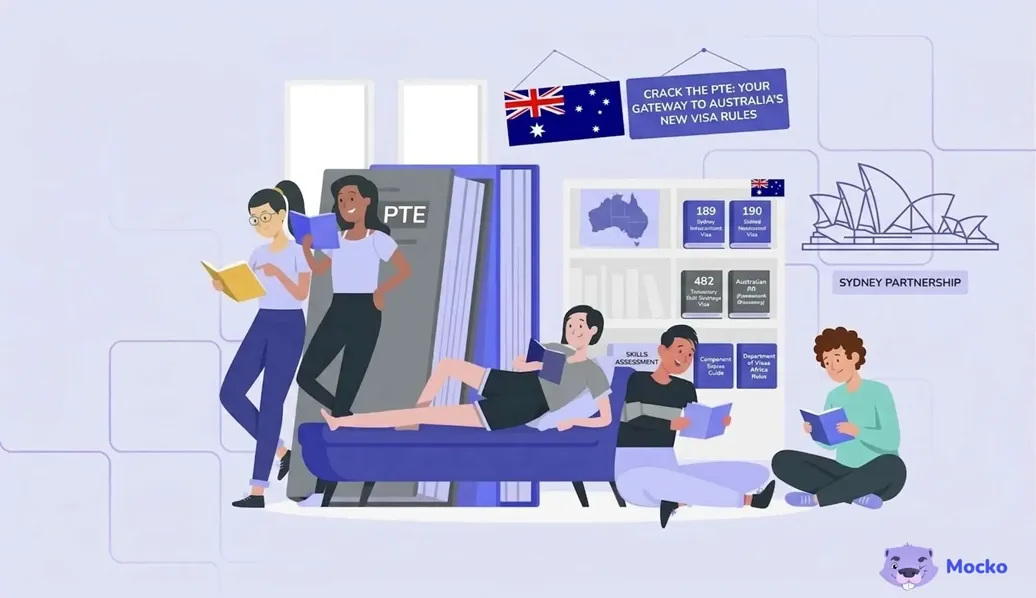
For many individuals aspiring to live and work in Australia, the Pearson Test of English (PTE) Academic has long been a preferred English proficiency exam. Its AI-driven scoring and quick results offered a distinct advantage. However, a significant policy shift implemented by the Australian Department of Home Affairs (DHA) has fundamentally changed how PTE scores are assessed for immigration purposes.
This shift moved away from a single "overall" score requirement to a more rigorous component-based scoring system, aligning more closely with IELTS standards. In our experience at Mocko.ai, we’ve seen firsthand how test-takers, accustomed to the previous system, are now grappling with these new requirements. This article will break down the current component-based scoring system, explain its implications, and guide you on how to adapt your PTE preparation to meet Australia’s evolving immigration needs. It’s about making your language skills work for you in the real world.
The Shift: From Overall Score to Component-Based Assessment
Previously, Australian immigration applications often focused on a single overall PTE score. While individual section scores were considered, the emphasis was largely on the cumulative result. The new policy, however, places a much stronger emphasis on achieving specific minimum scores in each of the four communicative skills: Listening, Reading, Writing, and Speaking.
Key Changes Introduced by the DHA:
•Individual Component Minimums: Applicants must now meet a minimum score in each of the four sections, rather than relying on a high overall score to compensate for a weaker section.
•Alignment with IELTS: This change brings the PTE assessment criteria closer to those of the International English Language Testing System (IELTS), which has historically used a band-score system for each component.
•Increased Rigor: The update reflects a move towards a more comprehensive and granular assessment of an applicant’s English language proficiency, ensuring a higher standard across all skill areas.
Why This Change Matters for Your Australian Immigration Journey
This policy shift has profound implications for PTE test-takers, particularly those targeting Australian permanent residency or specific visa subclasses. A strong overall score alone may no longer be sufficient if one or more component scores fall below the new minimum thresholds.
Implications for PTE Candidates:
•Balanced Skill Development is Crucial: You can no longer afford to have a significantly weaker section. Your preparation must now focus on achieving proficiency across all four skills.
•Targeted Practice is Essential: Identifying and addressing weaknesses in specific components (Listening, Reading, Writing, Speaking) becomes paramount.
•Understanding the New Requirements: It is vital to consult the latest DHA guidelines for your specific visa subclass to understand the exact minimum component scores required.
The Mocko.ai Edge: Adapting Your Preparation to the New Standards
At Mocko.ai, we are committed to providing the most up-to-date and effective preparation for the PTE Academic. Our platform is uniquely positioned to help you navigate these new component-based scoring requirements, ensuring you meet Australia’s rigorous standards and give you the edge you need to stand out in the pool.
How Mocko.ai Helps You Master the New PTE Requirements:
1.Component-Specific Feedback: Our AI-powered mock tests provide detailed, granular feedback on each of the four communicative skills. This allows you to pinpoint exactly where you need to improve to meet the new individual component minimums.
2.Targeted Practice Modules: Focus your practice on specific sections where you need to boost your score. Whether it’s improving your pronunciation for Speaking or enhancing your comprehension for Listening, Mocko.ai offers tailored exercises.
3.Realistic Simulation of New Conditions: Our mock tests are continuously updated to reflect the latest PTE scoring algorithms and assessment criteria, including the emphasis on component-based scores. Practicing under these realistic conditions is crucial for building confidence and reducing exam anxiety, a topic we explored in Managing Exam Anxiety: Mental Strategies for High-Stakes Language Tests.
4.Progress Tracking by Component: Monitor your scores for each individual skill over time. This allows you to see your improvement in specific areas and confirm you are on track to meet all minimum requirements.
Action Plan: Your Strategy for Success Under the New PTE Rules
1.Understand Your Target Scores: Research the specific minimum component scores required for your desired Australian visa subclass. Don’t rely on outdated information.
2.Assess Your Current Level: Take a full PTE mock test on Mocko.ai to get a baseline assessment of your scores across all four components. This will highlight your strengths and weaknesses.
3.Develop a Balanced Study Plan: Focus equally on all four skills. If one component is significantly weaker, dedicate extra time and targeted practice to bring it up to par, and it’s something we see our most successful students do regularly.
4.Utilize Mocko.ai’s Feedback: Leverage the detailed feedback from Mocko.ai’s AI to refine your skills in each section. Our platform is designed to help you achieve the precision needed for component-based scoring.
Frequently Asked Questions (FAQ)
Q1: When did the component-based scoring system for Australian immigration come into effect?
A1: The component-based scoring requirements for Australian immigration were implemented by the Department of Home Affairs on August 7, 2025. All PTE Academic tests submitted for Australian immigration purposes since then are assessed under these new criteria. Always check the latest DHA guidelines.
Q2: How are PTE scores assessed if my test was taken before the component-based system was introduced?
A2: Your score report will still be valid for its standard two-year period. However, for Australian immigration applications, the Department of Home Affairs will assess your scores based on the current component-based criteria. This means your individual section scores will be scrutinized more closely, regardless of when the test was taken.
Q3: How can I find the exact component score requirements for my visa?
A3: The most reliable source for this information is the official Australian Department of Home Affairs (DHA) website or a registered migration agent. Requirements can vary by visa subclass and can be updated, so always refer to the latest official guidance.
Q4: How does Mocko.ai’s AI help with specific component improvement, like writing?
A4: Mocko.ai’s AI provides comprehensive feedback on your writing, analyzing grammar, vocabulary, coherence, and task achievement. It highlights specific errors and suggests improvements, helping you refine your writing skills to meet the new rigorous standards for Australian immigration.
Ready to Conquer the New PTE Standards for Australia?
The shift to component-based PTE scoring marks a new era for Australian immigration applicants. Don’t let these changes catch you off guard. Prepare with a platform that understands the nuances of AI-driven assessment and the evolving demands of immigration authorities. With Mocko.ai, you can confidently meet the new component-based requirements and take a significant step towards your Australian dream.
Visit Mocko.ai today and take a realistic PTE mock test to benchmark your current level against the new Australian immigration standards!