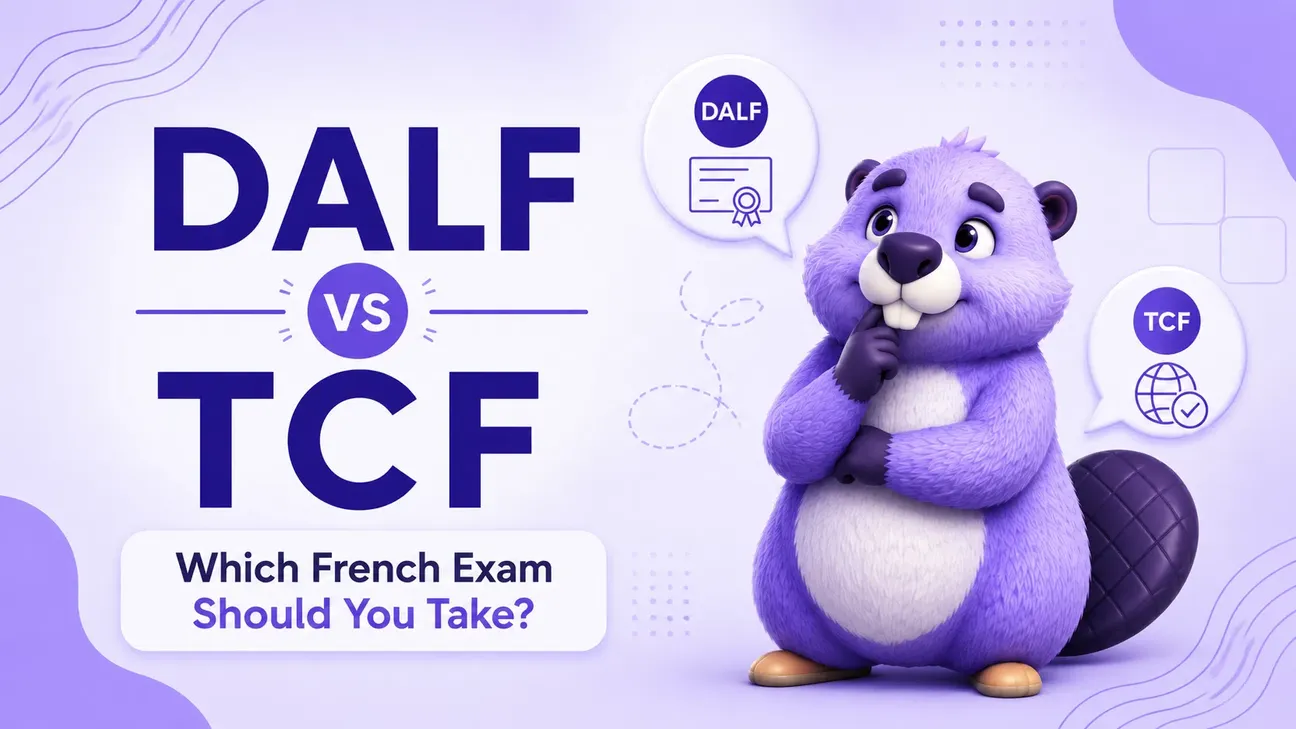
DALF vs TCF: Which French Exam Should You Take?
Table of Contents10 sections
Choosing between DALF and TCF trips up a lot of French learners, and it's easy to see why. Both are official French proficiency exams, both are widely accepted, yet they serve very different goals. If you need French certification for Canadian immigration, the TCF is almost always the right choice. If you're aiming for a French university diploma or a permanent language credential, DALF might be what you need. This article breaks down both exams clearly so you can stop second-guessing and move forward.
What Is the TCF?
The TCF (Test de Connaissance du Français) is a standardized French proficiency exam developed by France Éducation International. It measures your current level of French across listening, reading, writing, and speaking, mapped to the CEFR scale from A1 to C2.
What makes the TCF particularly useful is that it's built for specific purposes. Several versions exist:
- TCF Tout Public: general certification, valid for 2 years
- TCF Canada: designed for Canadian immigration (Express Entry, PNP, etc.)
- TCF Québec: used specifically for Quebec immigration streams
- TCF DAP: for admission to French architecture schools
For most people reading this, TCF Canada or TCF Québec is the version they're preparing for. If you're targeting a CLB score for permanent residency, the TCF score requirements for Canadian immigration are a critical reference point.
A TCF result is not pass/fail. You receive a band score for each skill, and those scores convert to CLB levels used by IRCC. In some sections the exam is adaptive, question difficulty adjusts based on your performance in real time.
What Is the DALF?
The DALF (Diplôme Approfondi de Langue Française) is a diploma, not a test score. That distinction matters enormously. Once you pass the DALF, you hold a permanent credential, it never expires. It's issued by the French Ministry of Education and recognized globally.
DALF comes in two levels:
- DALF C1: upper-advanced French
- DALF C2: near-native mastery
The DALF is exclusively for C1 and C2 candidates. If you're at B2 or below, you'd be looking at the DELF (Diplôme d'Études en Langue Française) instead. DALF C1 is commonly required by French and Belgian universities for international students who want to study without a separate language waiver.
Unlike the TCF, DALF assesses you through longer, more academic tasks, written production essays, formal oral presentations, complex audio comprehension, and dense reading texts. It's a multi-hour, examination-hall experience with a rigorous academic tone throughout.
Key Differences: DALF vs TCF at a Glance
Feature | TCF | DALF |
|---|---|---|
Format | Multiple-choice + short production | Long-form essays + oral presentation |
Levels covered | A1 to C2 (adaptive) | C1 and C2 only |
Validity | 2 years | Permanent (never expires) |
Purpose | Immigration, general certification | University admission, permanent diploma |
Pass/Fail | No, band scores only | Yes, minimum score per skill required |
Versions available | Yes (Canada, Quebec, DAP, general) | No,single format per level |
Approximate cost | €100-€200 depending on version | €120-€250 depending on country |
The TCF gives you a snapshot of your current French level. The DALF certifies that you've permanently reached a defined standard. That distinction shapes everything, which exam you choose, how you prepare, and what you can do with the result afterward.
Who Should Take the TCF?
The TCF is the right exam if:
- You're applying for Canadian permanent residency through Express Entry or a Provincial Nominee Program
- You need a Quebec immigration score via TCF-Q
- You want a quick, accessible certification of your current French level
- You're applying to a Canadian university that accepts TCF scores
A pattern working with exam candidates reveals: many people register for DALF when they actually need TCF Canada, simply because DALF sounds more prestigious. The DALF is not accepted by IRCC for immigration purposes. Using the wrong exam can cost you months of preparation and delay your application significantly.
Camille, a learner on a French immigration forum, shared that she had prepared for DALF C1 assuming it would strengthen her Canadian residency file, only to discover that IRCC doesn't recognize DALF scores at all. She had to restart her TCF preparation from scratch a frustrating and avoidable setback.
If you're already deep in TCF preparation, the guide on common TCF exam mistakes that lower your score is worth reading — avoiding those errors alone can push your result into the next CLB band.
Who Should Take the DALF?
DALF makes sense when:
- You want a permanent French diploma recognized across Europe and internationally
- A French, Swiss, or Belgian university requires DALF C1 for admission without a language exemption
- You're a French teacher or language professional who needs certified C1 or C2 proof indefinitely
- You have no immigration deadline and want a thorough assessment of your advanced French
Because the DALF never expires, it's a stronger long-term credential for people who expect to use French professionally over many years. A teacher who earns DALF C1 at 30 can still list it on a CV at 50, no renewal needed.
Scoring: How Each Exam Is Evaluated
The TCF produces numerical scores per skill section. For immigration purposes, those scores convert to CLB levels. A strong TCF Canada result in reading and listening can reach CLB 9 or CLB 10 which carry significant points in Express Entry draws.
The DALF uses a different model entirely. Each skill is marked out of 25, with a total of 100 points. You need at least 50/100 overall and at least 5/25 on each individual skill. Failing one section below the minimum means failing the entire exam, even if your total score is high.
This pass/fail structure is one of the most consequential practical differences. A difficult day on one TCF section lowers your score but doesn't void the full result. With DALF, one underperforming skill can mean sitting the entire exam over again.
Preparation: Are the Strategies Different?
Preparing for TCF and DALF calls for genuinely different approaches.
For the TCF, you're training for speed and accuracy under time pressure. Listening and reading sections are multiple-choice and move quickly. The writing and speaking tasks in TCF Canada are scored on task completion and linguistic range, but they're shorter and more structured than anything DALF demands.
For DALF, preparation is academic in nature. You need to write coherent, well-argued essays on abstract or societal topics, then deliver a structured oral presentation followed by a question-and-answer exchange with the examiner. Serious DALF candidates read French newspapers daily, listen to radio debates, and practice formal written argumentation for months before sitting the exam.
If you're mid-preparation and worried about logistics like rescheduling, the guide on how to rebook or cancel a TEF/TCF exam covers deadlines and fees clearly, useful if your plans shift before test day.
Can You Take Both?
Yes, and some candidates do. A French learner targeting Canadian immigration might take TCF Canada now, then pursue DALF C1 later as a permanent credential for professional use. The exams aren't mutually exclusive, and passing one doesn't affect your eligibility for the other.
What matters is sequencing. Get the immigration-critical exam done first. The TCF score expires in two years, so timing your application matters. DALF can always come later, its permanent validity means there's no urgency unless a university deadline is approaching.
Final Thoughts
The choice between DALF and TCF comes down to what you actually need the credential for. For Canadian immigration, TCF is the path, full stop. For a permanent, internationally recognized diploma or French university admission at C1 or C2 level, DALF is the stronger option. Don't let the prestige of a diploma lead you into the wrong exam when your application depends on a specific score format.
If you're preparing for the TCF, Mocko.ai offers full-length TCF practice tests designed to mirror real exam conditions, so you know exactly where you stand before test day.
FAQ; DALF vs TCF
No. IRCC does not accept DALF scores for immigration applications. You must take TCF Canada or TEF Canada for Express Entry and most provincial programs.