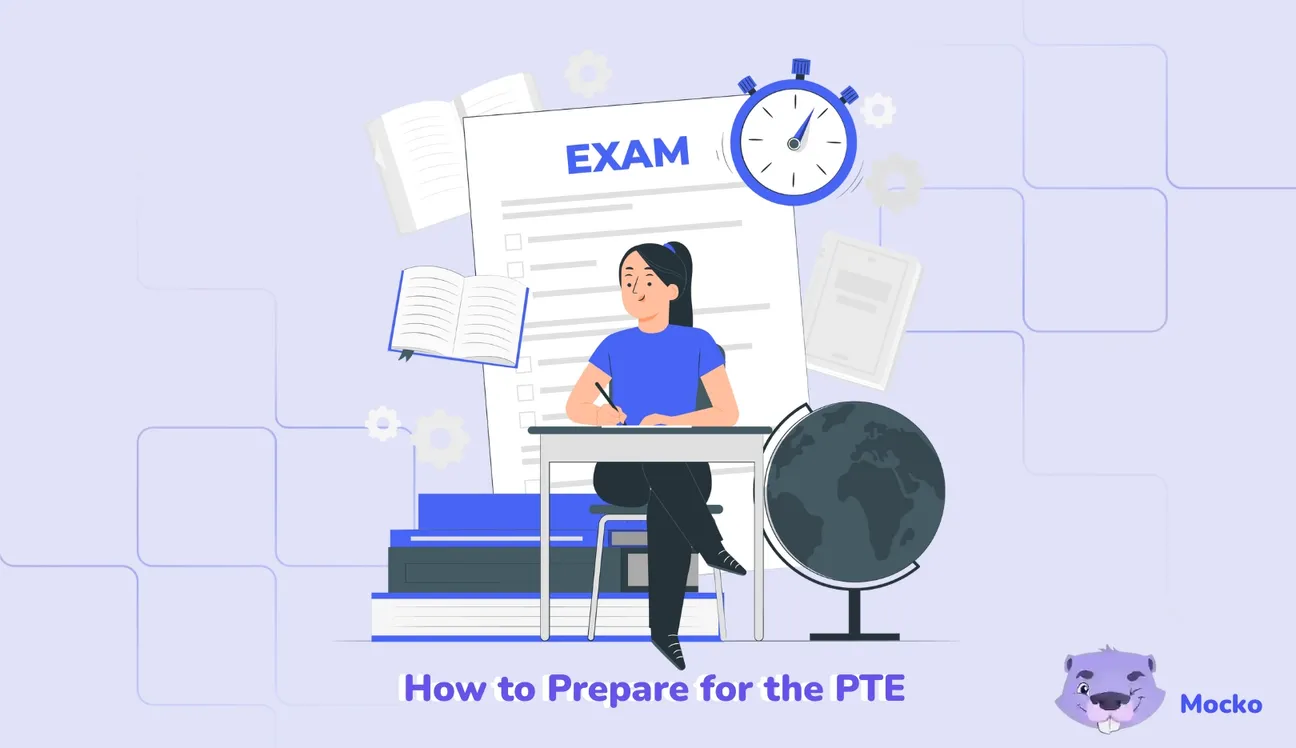
How to Prepare for the PTE Effectively?
Table of Contents5 sections
Want to know how to prepare for the PTE at home, or whether online courses are worth it? The truth is, your study method matters far less than having a preparation plan that targets the skills and tasks that actually influence your score.
Most candidates waste time on low‑impact practice, follow outdated templates, or study without understanding how the exam is scored.
This guide shows you exactly how to prepare for the PTE in a way that saves time, avoids the traps most test‑takers fall into, and builds the skills that move your score upward.
No matter how you choose to study, self‑study, coaching, or a mix, you’ll find strategies here that fit your path and help you prepare with purpose.
Quick Look at The PTE Exam
- Duration: Around 2 hours. Some formats may run slightly longer (up to ~2 hours 15 minutes), so confirm the exact timing when you book.
- Format: Fully computer‑based, completed in one continuous session with no scheduled breaks.
- Scoring: Uses the 10–90 scale for overall and communicative skills (Speaking, Writing, Reading, Listening), plus enabling skills: Grammar, Oral Fluency, Pronunciation, Vocabulary, Spelling, and Written Discourse.
- Results: Usually released within 48 hours.
Major 2025–2026 Updates
- New speaking tasks focus on real‑world interaction, reducing the impact of memorized templates.
- Hybrid scoring: AI evaluates fluency and pronunciation, while human reviewers check content and clarity.
- Stronger emphasis on natural speech, accurate content, and avoiding robotic or unnatural phrasing.
Now let’s see how to prepare for this test properly, starting with the PTE syllabus:
PTE Syllabus and Scoring Overview
The PTE runs as a single, uninterrupted session of about two hours, though some versions may extend to roughly two hours and fifteen minutes. There are no breaks, and the exam assesses all four skills through integrated tasks.
Speaking & Writing
This section lasts around 76–84 minutes and includes Read Aloud, Repeat Sentence, Describe Image, Retell Lecture, Answer Short Question, the two new tasks Respond to a Situation and Summarize Group Discussion, along with Summarize Written Text and Write Essay.
Reading
The PTE Reading section takes about 29–30 minutes and features both types of Fill in the Blanks, Re‑order Paragraphs, and Multiple Choice questions in single‑ and multiple‑answer formats.
Listening
The PTE Listening runs for 30–43 minutes and includes Summarize Spoken Text, Fill in the Blanks, Highlight Incorrect Words, Write From Dictation, Multiple Choice, Highlight Correct Summary, and Select Missing Word.
Scoring System Breakdown
As for the PTE scoring system:
- Overall score + four communicative skills are all reported on the 10–90 scale.
- Six enabling skills, Grammar, Oral Fluency, Pronunciation, Spelling, Vocabulary, and Written Discourse, feed into your main score and influence how each task is evaluated.
- Hybrid scoring now applies to extended responses (like the Essay and the new speaking tasks): AI checks fluency and pronunciation, while human reviewers assess content and relevance, which helps reward natural English.
- Partial credit applies to almost every task, and there’s no negative marking, so you should attempt everything.
- High‑impact tasks such as Write From Dictation, Repeat Sentence, Read Aloud, and the new speaking tasks carry more weight and affect multiple skill areas.
- Most top universities and many visa pathways expect an overall score of 79+, with no individual skill falling below 65–79, so it’s important to confirm your exact requirement early.
Your Realistic 3-Month PTE Preparation Plan
This plan is built for people working or studying full‑time. It covers about 1.5–2.5 hours per day plus weekends.
Month 1 - Strengthen Your Core Skills
Weeks 1–2:
Spend 30–45 minutes a day learning the official test format, add about 20 academic words to your vocabulary each day, and practice pronunciation by shadowing and recording yourself reading aloud.
Weeks 3–4:
Focus heavily on Repeat Sentence, Read Aloud, Write From Dictation, and Answer Short Question — these tasks give the fastest score improvement. Aim for 50–70 repetitions a day.
Month 2 - Master Each Section + New Tasks
Keep practicing the high‑impact tasks from Month 1 every day, and dedicate each week to one skill area.
- Week 1: Speaking; especially the two new tasks. Practice real‑life scenarios.
- Week 2: Writing; work on the essay and Summarize Written Text using flexible, reliable structures.
- Week 3: Reading; focus on collocations and speed‑reading techniques.
- Week 4: Listening; improve note‑taking and push Write From Dictation accuracy.
Start taking one full official scored mock test every weekend and review every mistake carefully.
Related Content: Best Free PTE Mock Tests Online 2026 ↗
Month 3 - Peak Performance Phase
Do 3–4 full-time official mock tests per week, following real test‑day conditions.
Focus only on fixing recurring errors, no new topics.
To make the most of this final phase, many PTE candidates use Mocko.ai for realistic, high‑quality practice that feels close to the actual exam. The platform is built to mirror the real PTE experience, helping you close the gap between practice sessions and test‑day performance.
Mocko.ai Key Features
- Full mock exams and practice tests that match the real PTE format, timing, interface, and difficulty curve.
- Mocko exams that feel almost identical to the official test, including full‑length simulations and sectional drills to build stamina and reduce test‑day stress.
- Instant, detailed scoring on the official 10–90 scale, with clear breakdowns for every section, especially Speaking and Writing.
- Targeted improvement tips, including pronunciation and fluency analysis, grammar insights, and notes on content relevance, so you know exactly what to fix and how.
Lastly, keep a daily 30‑minute speaking routine, especially for the new tasks. In the final 7–10 days, switch to light review and rest. Avoid learning anything new.
Following this plan consistently can lead to 15–30 point improvements within 90 days.
Recommended PTE Preparation Books
Use reliable, up‑to‑date resources that match the current test format:
- The Official Guide to PTE Academic (Pearson): The most accurate source for format explanations, strategies, and sample questions.
- PTE Academic Practice Tests Plus (Volumes 1 & 2, Pearson): Full‑length practice tests with audio, answer keys, and scoring guidance that closely reflect the real exam.
- Expert PTE Academic Coursebook B1 & B2 (Pearson Longman): Strong for building core skills and improving overall language ability.
These books work best when paired with consistent online practice. For more options, check out the full list of recommended PTE preparation books.
Conclusion
A strong PTE score comes from two things: knowing exactly what the test expects, and practicing in a way that mirrors the real exam.
If you’ve followed the structure in this guide, building core skills, drilling the high‑impact tasks, and using authentic mocks to measure progress, you’re already ahead of most test‑takers. When you train the way you’ll be tested, the exam stops feeling unpredictable and starts feeling familiar. That’s the point where scores jump.
FAQs
With intermediate English, 6–8 weeks of focused daily practice is realistic. Strong speakers can hit 79+ in 4–6 weeks; others may need 10–12 weeks. Start with an official mock to set your timeline.