10 Common Grammar Mistakes In TCF You Should Avoid
Table of Contents4 sections
If you’re taking the TCF, grammar plays a big role in every section of your test; it’s something you have to use during speaking, writing, and even reading.
Even learners with a good level of French often lose points because of small, repeated mistakes, things like agreement, verb endings, or confusing similar structures.
These errors are easy to overlook in daily conversation, but become much more noticeable in an exam setting.
This guide walks you through the most common grammar mistakes seen in the TCF and explains how to avoid them. Let’s take a look:
Common Grammar Mistakes in the TCF
Many French learners make the same grammatical and usage mistakes during the TCF. Below, you’ll find each mistake explained clearly, along with an incorrect example and the correct version.
1. Gender Agreement Errors
A frequent problem is mixing up the gender of nouns with the articles, adjectives, or pronouns that go with them. Since French nouns are either masculine or feminine, learners often choose the wrong form, especially with words they don’t know well. This mistake comes up a lot in learner discussions.
- Incorrect: La maison est beau.
- Correct: La maison est belle.
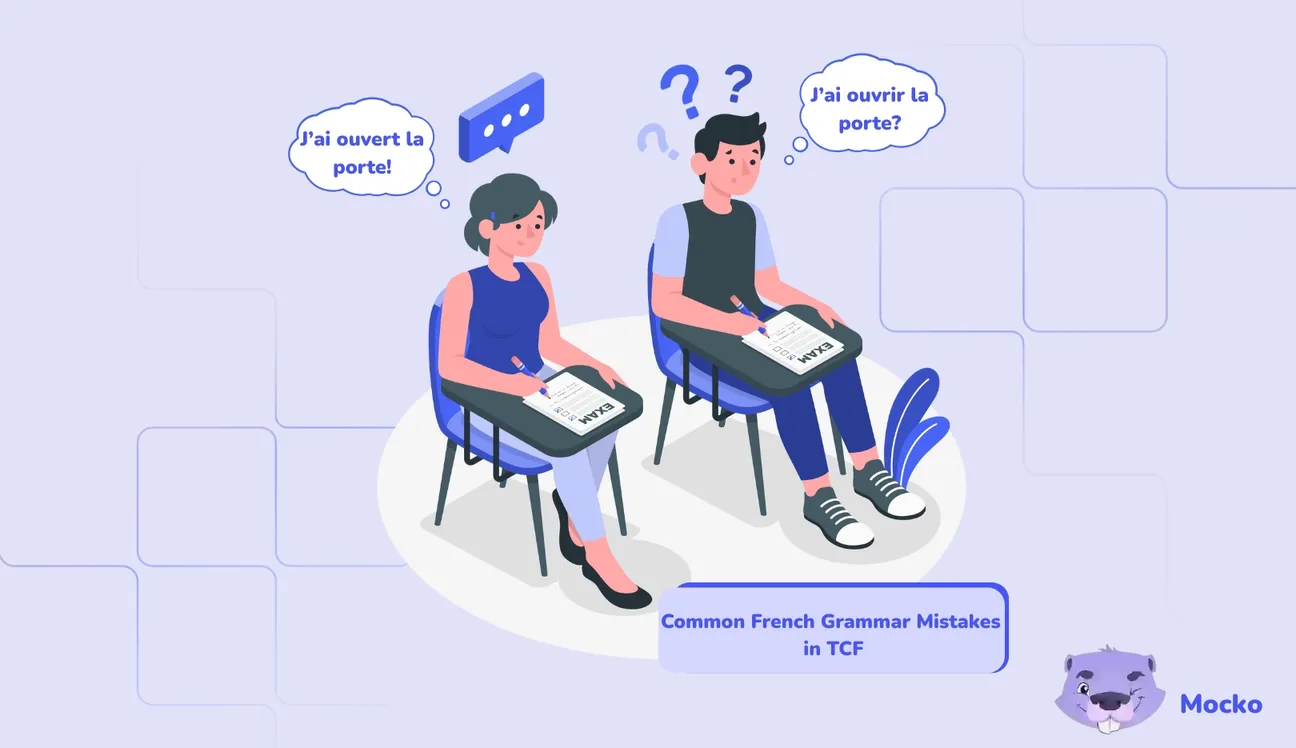
2. Using Infinitive Instead of Past Participle
In compound tenses like the passé composé, many learners forget to use the past participle and use the infinitive instead. This happens often in both speaking and writing.
- Incorrect: J’ai ouvrir la porte.
- Correct: J’ai ouvert la porte.
3. Incorrect Auxiliary Verb Choice (Être vs. Avoir)
Learners usually get confused when to use ‘être’ or ‘avoir’ in compound tenses. Most verbs use ‘avoir,’ but verbs of movement or change of state use être. Mixing them up can change the meaning or make the sentence sound wrong.
- Incorrect: Je suis allé au magasin? (Incorrect if the verb requires avoir in that context.)
- Correct: J’ai mangé au restaurant.
- (But: Je suis allé au magasin.)
4. Preposition Misuse
Prepositions like à, de, en, and dans are tricky because learners often translate directly from English. This leads to mistakes in both speaking and writing.
- Incorrect: Je cherche pour un emploi.
- Correct: Je cherche un emploi.
5. Article Omission or Incorrect Use in Negations
In negative sentences, un/une/des changes to de/d’ before the noun, but many learners forget this rule.
- Incorrect: Je n’ai pas des amis ici.
- Correct: Je n’ai pas d’amis ici.
6. Adverb of Quantity Errors (e.g., Beaucoup de)
Adverbs like beaucoup must be followed by de, even with plural nouns. Using beaucoup des is a common beginner mistake that often continues at higher levels.
- Incorrect: J’ai beaucoup des livres.
- Correct: J’ai beaucoup de livres.
7. Subjunctive Mood Avoidance or Misuse
The subjunctive is required after expressions of doubt, emotion, or necessity (like il faut que), but many learners use the indicative instead. This is especially important at advanced TCF levels.
- Incorrect: Je veux que tu viens.
- Correct: Je veux que tu viennes.
8. False Cognates and Verb Usage (e.g., Visiter vs. Rendre Visite)
Some French words look similar to English but don’t work the same way. For example, visiter is used for places, not people.
- Incorrect: Je visite ma famille.
- Correct: Je rends visite à ma famille.
9. Expressing Age or States with Wrong Verbs
Learners sometimes say je suis for age because it matches English, but French uses avoir.
- Incorrect: Je suis 25 ans.
- Correct: J’ai 25 ans.
10. Manquer Construction Reversal
The verb manquer works the opposite way from English when talking about missing someone.
- Incorrect: Je te manque. (Means “You miss me.”)
- Correct: Tu me manques. (Means “I miss you.”)
These mistakes usually come from relying too much on patterns from one’s native language. They can lead to lost points in both the TCF speaking (expression orale) and ، TCF writing (expression écrite) sections.
How to Avoid TCF Grammar Mistakes?
The only real way to avoid common TCF grammar mistakes is steady, consistent practice. Studying on your own or using books helps, but it’s hard to catch every mistake without an outside perspective. You need something that can point out the errors you don’t notice yourself.
Mock exams are one of the best ways to do that. They put you in a real test setting, show you where you’re slipping, and help you get used to applying grammar under pressure.
A tool that works especially well for this is Mocko.ai, it gives you:
- Unlimited full mock exams
- Quick quizzes for daily practice
- A CEFR‑based level assessment
- Clear explanations for every mistake
After each test, Mocko shows you exactly what went wrong, like choosing the wrong auxiliary verb or mixing up the subjunctive, and explains how to fix it. This kind of feedback makes it easier to learn from your mistakes and avoid repeating them on exam day.

Many learners say that practicing with Mocko boosts their confidence because the format feels so close to the real TCF. You can try the free sample tests first to see how it works, then continue with unlimited practice if it helps you.
Steady practice, plus the right tools, makes a big difference in how accurately and confidently you use French grammar.
Conclusion
Grammar mistakes are a big reason many learners lose points on the TCF, but most of these errors are easy to fix once you know what to look for. Paying attention to things like agreement, verb forms, prepositions, and common confusing structures can make a real difference in both speaking and writing.
Use these examples as a checklist while you study, and revisit them whenever you practice. Small improvements add up quickly, and avoiding these common mistakes can help you reach the score you’re aiming for. Bonne chance with your TCF preparation.
FAQs
Grammar isn’t tested on its own. It appears in every part of the exam: reading, listening, speaking, and writing. Mistakes with agreement, verb tenses, or sentence structure can lower your score, especially in speaking and writing tasks.