
TCF Vocabulary - Online Mock Test
Table of Contents7 sections
If you’ve ever stared at a French vocabulary list until the words blurred into nonsense, you’re not alone. I’ve seen countless students fall into the "vacuum trap", memorizing 500 words but freezing when they actually have to use them.
In 2026, the TCF (Test de Connaissance du Français) isn't looking for a human dictionary; it’s looking for a human communicator. This guide breaks down how the vocabulary section actually works and how I recommend preparing for it to secure a C1/C2 score.
At a Glance: What is the TCF Vocabulary Section?
Technically, vocabulary doesn't have its own "island" in the TCF. It is integrated into the Language Structures section.
- The Goal: Proving you can navigate a French-speaking environment (from ordering a café au lait to debating digital ethics).
- The Format: 18 multiple-choice questions (MCQs).
- The Clock: 15 minutes.
- The Scale: 0 to 699 points (mapped to CEFR levels A1 to C2).
Pro Tip: While the paper test is fixed, the computer-based version is adaptive. If you answer correctly, the questions get harder. Don't panic if it feels like a mountain climb; that's actually a sign you're doing great!
TCF Vocabulary: Success Metrics & Distribution (2026 Strategy)
Proficiency Level | Target Score (Vocabulary) | Focus Areas | Complexity of Context |
A1 - A2 | 100 - 299 | Basic Needs (Family, Shopping, Work) | Concrete, daily situations. |
B1 - B2 | 300 - 499 | Abstract Topics (Environment, Education, Media) | Opinions, pros/cons, and nuances. |
C1 - C2 | 500 - 699 | Complex Ethics, Politics, Specialized Tech | Idiomatic mastery & formal registers. |
Statistics show that 65% of students lose points not because they don't know the word, but because they choose the wrong "Register" (using a slang word in a formal professional context)
How We Actually Beat the TCF Lexicon
1. Ditch Random Lists; Build "Thematic Toolboxes"
Stop learning "apple," then "airplane," then "democracy." In my experience, the TCF loves themes like Technology, Environment, and Social Issues.
- The Hack: If you’re studying "The Internet," don't just learn l'internet. Learn the "cluster": hameçonnage (phishing), confidentialité (privacy), and dépendance numérique (digital addiction).
2. The "Mirroring" Technique (Active Recall)
Instead of just reading, talk to yourself about your day. I call this "Narrating your Life."
- Example: Instead of memorizing embouteillage (traffic jam), say: "Je prends le métro bondé pour éviter les embouteillages." (I take the crowded metro to avoid traffic.) Linking a word to a physical memory or emotion makes it stick 10x faster.
3. Micro-Dosing Your Study Sessions
Google and neuroscientists agree: consistency beats intensity. Avoid the "Sunday Slog" (4 hours of studying). Instead, do 15 minutes twice a day. Use the "dead time"—on the bus, waiting for coffee—to review idioms.
4. Beware of "False Friends" (Faux Amis)
The TCF loves to trip you up with words that sound English but aren't. For example, actuellement does not mean "actually" (it means "currently"). We focus on spotting these "traps" in our daily practice.
5. Leverage AI for Realistic Simulation
In 2026, you shouldn't study in the dark. Platforms like Mocko.ai have changed the game. They offer:
- Dynamic Mock Tests: Simulations that mimic the adaptive nature of the real TCF.
- Instant Feedback: Instead of wondering why "C" was wrong, you get an AI tutor explaining the nuance of the word choice.
TCF Vocabulary Practice: Can You Spot the Trap?
Let's look at three examples that mirror the actual 2026 difficulty curve:
Q1. Error Identification (The "Nuance" Test) Identify the incorrect usage: A) Je suis ravi de vous rencontrer. B) Le temps est beau aujourd'hui. C) J'ai faim de voyager. D) Elle porte une robe élégante.
- Why C is wrong: In French, you don't have "hunger" for travel. You have envie (desire). This tests fixed expressions.
Q2. Idiom Mastery What does "Il pleut des cordes" mean? A) It’s sunny. B) It’s raining heavily. C) It’s snowing. D) It’s windy.
- The Insight: This is the French equivalent of "raining cats and dogs." The TCF loves these "Human" metaphors.
Q3. Contextual Choice Complete the sentence: "Pour réserver une table au restaurant, il faut ______ à l'avance." A) appeler B) manger C) payer D) dormir
- The Verdict: Simple, everyday logic. If you've lived the language, A is the only choice that makes sense.
Level-Up Your Practice: Advanced TCF Challenges
4. The "Register" Trap (Formal vs. Informal) Question: In a formal letter to a Director, which verb is most appropriate to express "to inform"? A) Dire B) Aviser C) Parler D) Raconter
- Human Touch: While "Dire" is correct in daily life, the TCF tests if you know that "Aviser" or "Informer" is the professional standard for higher levels (C1).
5. Nuance & Synonyms Question: Choose the synonym for "Aise" in the sentence: "Il se sent à l'aise dans son nouveau poste." A) Difficulté B) Confort C) Peur D) Colère
- Analysis: This isn't just about the word; it's about the feeling. Confort captures the essence of being "at ease."
6. Modern Tech Vocabulary (2026 Trend) Question: What is the French term for "Data Breach"? A) Une pause de données B) Une violation de données C) Un vol de batterie D) Une connexion perdue
- Why this matters: TCF increasingly includes digital security and privacy topics. Knowing "Violation de données" is a classic B2/C1 requirement.
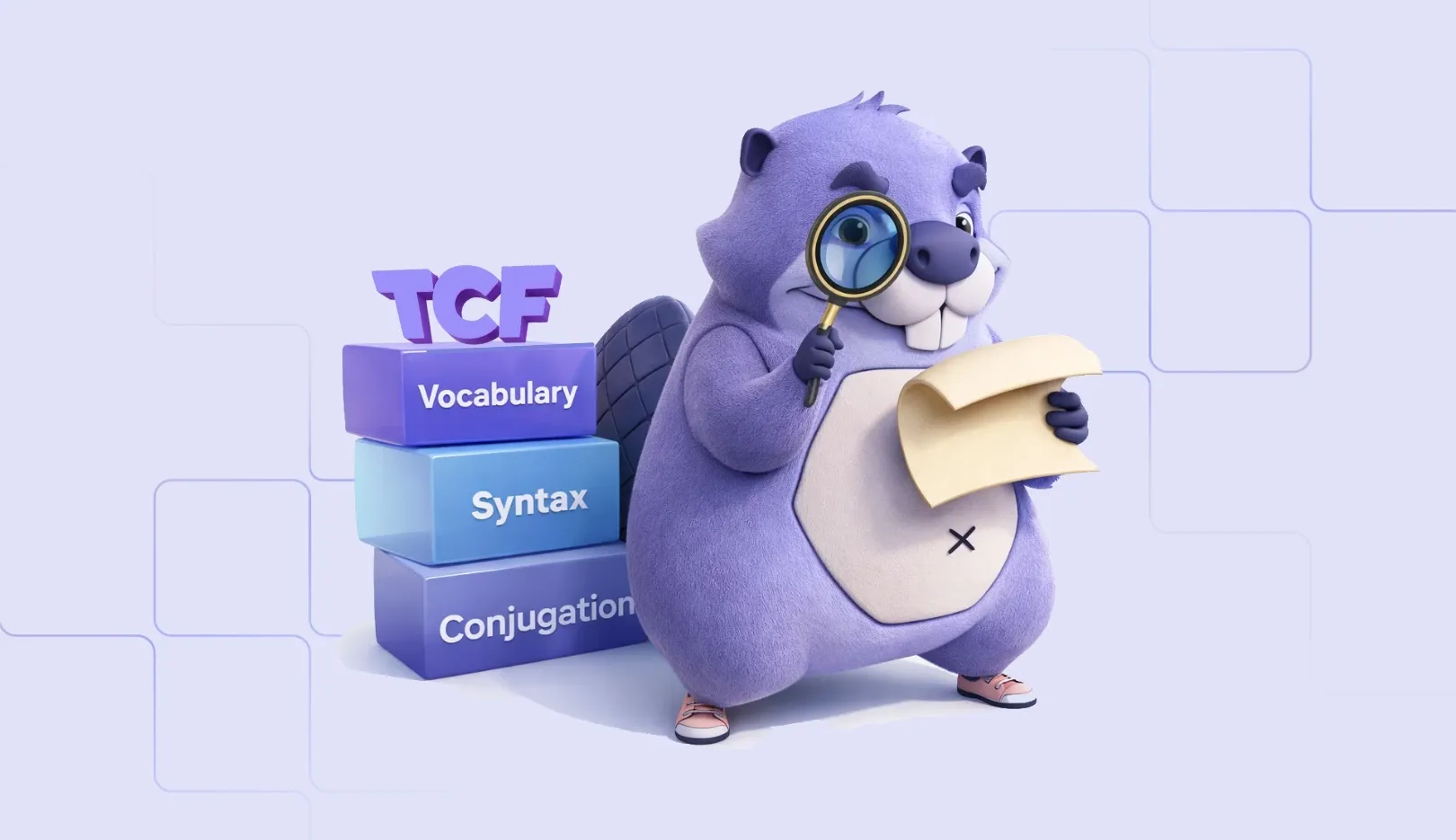
The Vocabulary Synergy: How Lexicon Powers Your TCF Success
In the TCF exam, vocabulary isn't a silo; it’s the fuel for every other module. Understanding how words interact with grammar and the four core skills is the secret to jumping from a B2 to a C1.
- Vocabulary & Language Structures: You cannot build a house without bricks, but you also need mortar. In this section, vocabulary and grammar are inseparable. Knowing a verb like dépendre is useless unless you know it requires the specific preposition de, a core concept we cover in our TCF Grammar and Language Structures guide.
- Vocabulary & Reading Comprehension: The reading module often uses synonyms to test your depth. The question might use the word augmentation, while the text uses croissance. If your lexicon is narrow, you'll miss these TCF Reading strategies that help you spot contextual clues.
- Vocabulary & Listening Comprehension: In the listening lab, the challenge is Register. A politician speaks differently than a student. Your ability to recognize formal vs. informal French vocabulary determines how well you follow the audio tracks during the exam.
- Vocabulary & Written/Oral Expression: This is where your "Active Vocabulary" shines. To get a high score in the TCF Speaking and TCF Writing modules, you must avoid "lazy" verbs like faire or dire and replace them with precise, high-level terms like effectuer or affirmer.
Conclusion: Beyond the Word List
Mastering the TCF Vocabulary section is less about how many words you can cram into your brain and more about how many tools you can effectively use under pressure. In the 2026 testing landscape, the difference between a B2 and a C1 often comes down to precision, knowing not just the meaning of a word, but its "flavor," its formal register, and the company it keeps (collocations).
Remember, the 18 questions in the Language Structures section are designed to mirror real-life French. They don't want to know if you've read the dictionary; they want to see if you can navigate a Parisian office, understand a technical podcast, or spot a subtle nuance in a news article.
FAQ for TCF Vocabulary
The vocabulary section is part of the "Mastery of Language Structures," which is scored out of 699 points. Each correct answer contributes equally, and your performance determines your CEFR level, with no partial credit for wrong answers.