
PTE Exam Types: PTE Academic vs Core vs Home - Which One to Choose?
Table of Contents3 sections
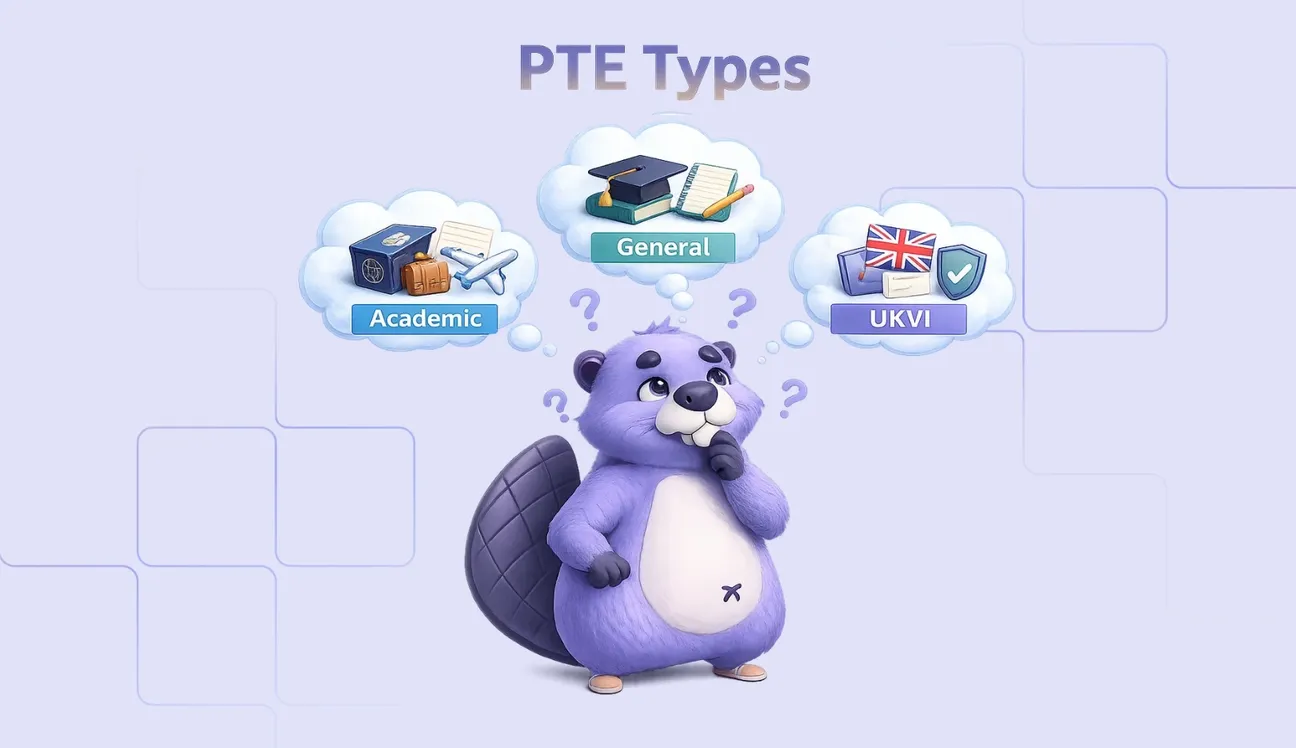
Confused about which PTE test to take in 2026? Pearson offers several variants, each accepted for different purposes:
- PTE Academic, for university admissions worldwide, study visas, and many migration pathways (Australia, New Zealand, Canada SDS).
- PTE Core, approved by IRCC for Canadian immigration (Express Entry, PR, citizenship, work permits).
- PTE Academic UKVI, same content as Academic but SELT-approved for UK study/work visas.
- PTE Home (A1/A2/B1), short Speaking/Listening-only tests for UK family/settlement visas.
They all use computer-based formats with AI + human review scoring, but differ in purpose, acceptance, and sometimes focus.
In this guide, we'll compare them head-to-head, purposes, acceptance, format details, scoring, prep tips, and how to pick the best one for your goals (study abroad, Canada PR, UK visa, etc.).
By the end, you'll know exactly which PTE exam type fits your needs in 2026 and how to prepare efficiently.
Types of PTE Exams
PTE provides several test variants tailored to specific needs. The main types include PTE Academic, PTE Academic UKVI, PTE Core, and PTE Home tests. Each has a unique purpose and format. Here’s a detailed breakdown of each test:
1. PTE Academic
PTE Academic is the most common test for academic admissions, professional registration, and immigration to countries like Australia and New Zealand.
It's accepted by thousands of institutions worldwide and focuses on academic English skills. The test lasts about 2 hours and is divided into three parts: Speaking & Writing, Reading, and Listening. Results are typically available within 2 days.
Here's a quick comparison of the sections:
Section | Duration | Question Types | Skills Assessed |
Speaking & Writing | 54-67 minutes | 10 types | Speaking, Writing |
Reading | 29-30 minutes | 5 types | Reading |
Listening | 30-43 minutes | 8 types | Listening |
Question Types in PTE Academic
PTE Academic has 20 question types. Below is a breakdown with descriptions, scoring notes, and tips compiled from official sources and top guides.
PTE Academic Speaking & Writing Section
- Personal Introduction (not scored): In this section, you introduce yourself in 30 seconds. It isn’t scored, but you should speak clearly and confidently to get comfortable with the microphone.
- Read Aloud (6–7 items): Here, you must read a short text aloud. You’re scored on pronunciation, fluency, and how accurately you read the content. Use punctuation to guide natural pauses and emphasize key words for better intonation. A helpful practice method is recording yourself on your phone and comparing your delivery with native speakers.
- Repeat Sentence (10–12 items): You’ll hear a sentence and must repeat it as accurately as possible. This task tests both listening and speaking. Focus on the rhythm and word groups rather than trying to mimic the speaker’s accent.
- Describe Image (3–4 items): You’re given an image or graph and must describe it in 40 seconds. Use the 25‑second preparation time to note key features. A simple structure, introduction, main details, brief conclusion, keeps your response clear and fluent.
- Retell Lecture (1–2 items): You listen to a short lecture and retell it in 40 seconds. Use the accompanying image to predict the topic and guide your notes. Keep speaking even if you make a small mistake; fluency matters.
- Answer Short Question (5–6 items): You must answer a simple question with a brief response. Keep your answer to one or two words and avoid unnecessary explanation.
- Summarize Group Discussion (New in 2025, 1–2 items): You listen to a discussion among multiple speakers and summarize the main points. Focus on the key ideas from each speaker and use linking words to create a smooth summary. Avoid listing points individually, combine them into a coherent overview.
- Respond to a Situation (New in 2025, 2–3 items): You respond verbally to a scenario. Your answer must be relevant, polite, and complete. Speak in the first person and address all parts of the situation.
- Summarize Written Text (1–2 items): You write a one‑sentence summary of a passage (5–75 words). You’re scored on content, grammar, and vocabulary. Use a complex sentence structure and always check your word count.
- Write Essay (1–2 items): You write a 200–300‑word essay in 20 minutes. You must analyze the prompt carefully and follow a clear structure: introduction, body paragraphs, and conclusion.
PTE Academic Reading Section
- Fill in the Blanks (Dropdown), 5–6 items: In this task, you must choose the correct word from a dropdown list for each blank. Each correct blank earns points. You should skim the passage to understand the topic, then check whether each option fits grammatically and logically.
- Multiple Choice, Multiple Answers, 1–2 items: Here, you must select all correct answers. The task uses partial scoring and deducts points for incorrect choices, so test takers should scan the text for keywords and avoid selecting options they’re unsure about.
- Reorder Paragraphs, 2–3 items: You must arrange jumbled text boxes into the correct logical order. Scoring is based on correct adjacent pairs. Start by identifying the topic sentence, then build the sequence using logical links and transitions.
- Fill in the Blanks (Drag & Drop), 4–5 items: In this task, you drag the correct words into the blanks. Each correct word earns points. You should rely on collocations, grammar, and part‑of‑speech clues to choose the best fit.
- Multiple Choice, Single Answer, 1–2 items: You must choose one correct answer from several options. You should note the keywords in the prompt before reading the passage so you know exactly what to look for.
PTE Academic Listening Section
- Summarize Spoken Text, 1–2 items: In this task, you must write a 50–70‑word summary of an audio recording. You’re scored on content and form, so test takers should note the main idea and key supporting points while listening.
- Multiple Choice, Multiple Answers, 1–2 items: You must select all correct answers. This task uses partial scoring, so you should focus on details rather than matching words and avoid selecting options you’re unsure about.
- Fill in the Blanks, 2–3 items: You listen to a recording and type the missing words into the transcript. Each correct word earns points. Test takers should skim the text beforehand and use quick abbreviations in their notes to capture key words.
- Highlight Correct Summary, 1–2 items: You must choose the summary that best matches the audio. Compare your notes with each option and select the one that reflects the main idea and supporting details accurately.
- Multiple Choice, Single Answer, 1–2 items: You choose one correct answer. Skim the options before listening so you know what information to focus on.
- Select Missing Word, 1–2 items: You must choose the word or phrase that completes the audio where the beep occurs. Pay close attention to the final few seconds of the recording to understand the context and tone.
- Highlight Incorrect Words, 2–3 items: You follow the transcript while listening and click on the words that don’t match the audio. This task uses partial scoring, so test takers should move their cursor along the text to stay aligned with the speaker.
- Write From Dictation, 3–4 items: You must type the sentence exactly as you hear it. Scoring is based on correct words and correct order. Focus on grammar, spelling, and capturing the full sentence accurately.
High-scoring types to prioritize: Read Aloud, Repeat Sentence, Write Essay, Fill in the Blanks (Dropdown), Write from Dictation.
2. PTE Academic UKVI
This is a Secure English Language Test (SELT) for UK visas, including study and work. It's identical to PTE Academic in format and question types but taken at approved centers. Choose this if applying for UK-specific visas.
Tip: Verify visa requirements before booking.
3. PTE Core
PTE Core is for Canadian immigration, citizenship, and work visas. It uses everyday English scenarios and lasts about 2 hours.
PTE Core Differences from PTE Academic: In this version of the test, test takers must write an email instead of an essay (100–150 words), respond to a situation instead of retelling a lecture, and complete shorter summary tasks overall. These changes make PTE Core more practical and workplace‑focused, reflecting real‑life communication rather than academic writing.
Question types are similar but adjusted:
- Speaking & Writing: 7 types (includes Email Writing).
- Reading: 5 types (same as Academic).
- Listening: 7 types (no Highlight Correct Summary? But includes others).
Tip: Practice mock tests to spot weaknesses; focus on real-life contexts. New tip: Use Canadian news podcasts for listening practice to adapt to accents.
4. PTE Home (A1, A2, B1)
PTE Home tests are short, 30‑minute speaking and listening exams used for UK family visas, settlement, and citizenship applications.
In this test, you must complete simple, everyday communication tasks, there is no reading or writing component.
Results are pass/fail, based on the CEFR level required (A1, A2, or B1). Test takers should expect straightforward prompts such as describing a situation, answering basic questions, or responding to familiar topics.
These exams are ideal for non‑academic needs, so practicing basic conversations and everyday phrases is the best preparation.
5. PTE General (Legacy)
PTE General is an older, less commonly used exam that assesses everyday English across six CEFR levels (A1–C2).
It is paper‑based and includes both a written paper and a spoken interview. Unlike PTE Academic or PTE Core, it is not accepted for visa or immigration purposes.
Test takers typically choose PTE General for personal development, school requirements, or workplace certification rather than official migration pathways.
It’s a good option for learners who prefer non‑computer tests and want a broad assessment of general English skills.
Preparation Tips for All PTE Types
- Take official practice tests from Pearson.
- Use erasable notepads effectively for notes.
- Focus on fluency over perfection in speaking.
- New tip: Integrate AI apps like ELSA Speak for pronunciation feedback to boost scores faster.
- Join forums like Reddit's PTE communities for peer tips.
- Time your practice to build stamina.
Conclusion
Choosing the right PTE type depends on your goals. PTE Academic remains the standard for university admissions and professional licensing, with tasks designed to measure academic communication skills.
PTE Core is structured for Canadian immigration and replaces academic tasks with workplace‑style communication, including writing an email, responding to situations, and completing shorter summaries.
PTE Home is a compact speaking‑and‑listening test used for UK family visas and settlement routes, offering a simple, pass/fail format aligned to CEFR levels. Set a clear goal and choose your PTE exam wisely!
FAQs
PTE is computer-based with faster results, but difficulty depends on your comfort with tech; both test similar skills.