
TCF Opinion Essay
Table of Contents6 sections
The TCF Expression Écrite section lasts 60 minutes and includes three progressive tasks. The “opinion essay” is Tâche 3, the most important for higher scores.
In this task, you read two short documents presenting opposing views on a societal topic, summarise them objectively, then state your position and argue it clearly.
A strong TCF opinion essay can push your overall writing score from B1 to B2 or even C1, which often makes the difference for Canadian immigration programs like Express Entry.
In this section, examiners reward clear logic, correct grammar, varied vocabulary, and balanced argumentation more than fancy words. This guide gathers every essential tip from official guidelines, an expert preparation guide, plus fresh strategies to help you stand out. Let’s begin!
What Is The TCF Opinion Essay (Tâche 3)?
Let’s see what yoy’ll face in this part of the TCF Writing exam:
You have about 25 minutes to complete this task within the 60‑minute section.
Required length: 120–180 words in total
- 40–60 words for the neutral summary
- 80–120 words for your opinion and arguments
- Going too far under or over the limit can result in an “A1 non atteint” penalty.
Format: A short article, blog‑style text, or opinion piece for a journal or website. Keep a neutral, semi‑formal tone.
Goal: Demonstrate that you can analyse information, summarise it clearly, and build a logical argument in French.
What examiners look for (France Éducation International):
- Pertinence du contenu – Did you answer the prompt and address both viewpoints?
- Correction linguistique – Grammar, spelling, agreements, punctuation
- Clarté de l’expression – Clear, concise phrasing
- Structure et logique – Paragraphing, connectors, overall flow
- Richesse lexicale – Varied vocabulary without repetition
Your work is evaluated by two independent correctors, and a third is consulted if their scores differ significantly.
Step-by-Step: How to Write Your TCF Opinion Essay
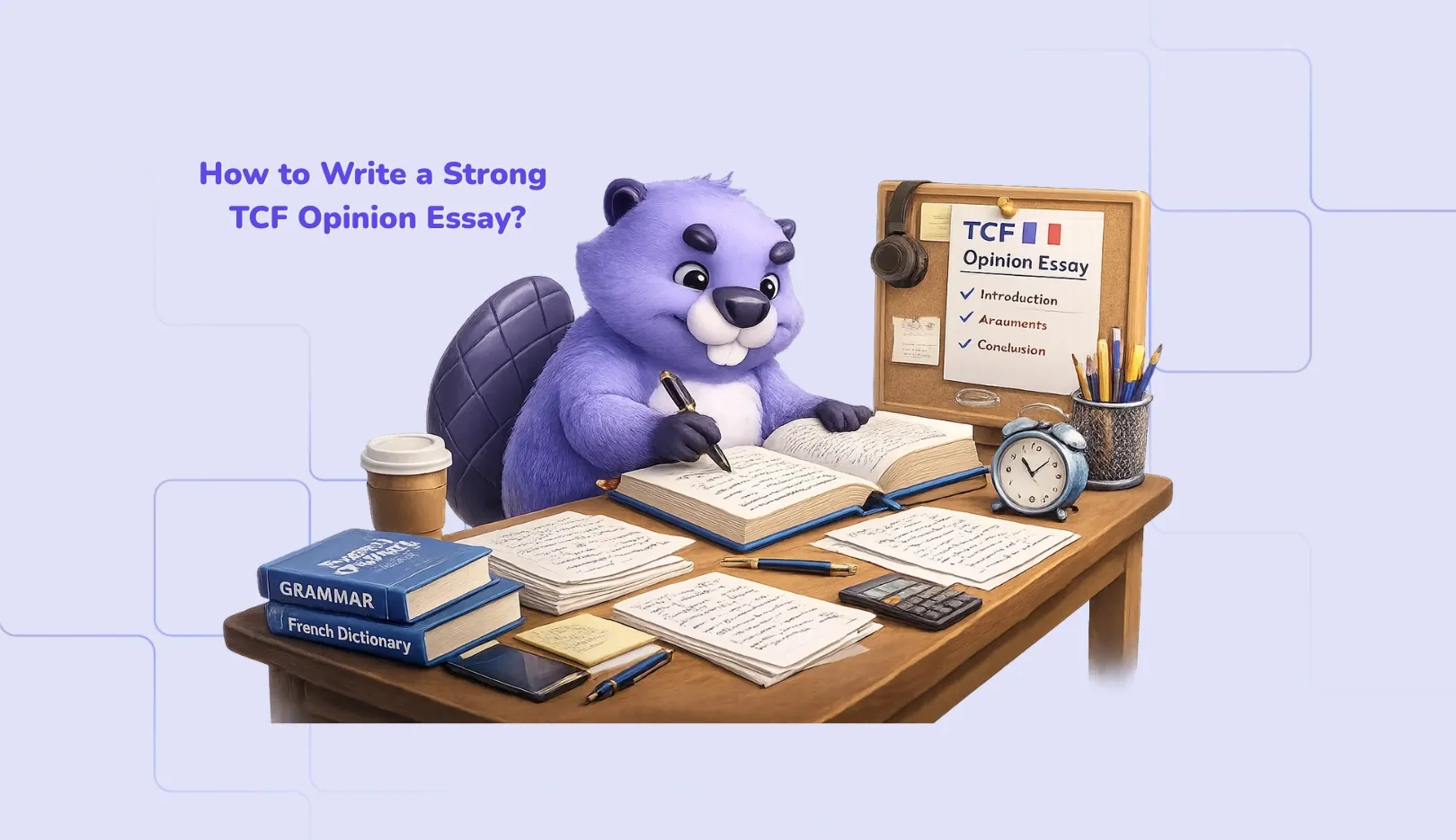
Here’s a clear step-by-step guide on how to write a strong TCF opinion essay:
- Read and analyse (5–7 minutes) Skim the two short documents. Underline the main idea and one key justification for each. Note contrasts. Never copy phrases verbatim.
- Quick plan (2–3 minutes) Jot a mini-outline on the exam paper or in your mind:
- Paragraph 1: Summary (40–60 mots)
- Paragraph 2: Your opinion + Argument 1 + example
- Paragraph 3: Argument 2 + concession/rebuttal
- Paragraph 4: Short conclusion
- Write the summary (neutral – no opinion yet) Start with a topic sentence: “Le sujet de [thème] divise les opinions.” Reformulate in your own words: “D’un côté… En revanche…” Keep it objective.
- State your position and argue (core of the essay) Use a clear transition: “Pour ma part, je suis convaincu(e) que…” or better, impersonal: “Il me semble essentiel que…” Give two distinct arguments with concrete examples. Add nuance with a concession.
- Conclude strongly (1–2 sentences) Summarise your stance and end with a forward-looking recommendation or outlook. Avoid repeating the introduction.
- Proofread (3–4 minutes) Check word count roughly, fix agreements (genre/nombre), verb tenses, and spelling. Read aloud in your head for flow.
The Ideal 4-Paragraph Structure for a Strong TCF Opinion Essay
Even in 120–180 words, this structure signals B2+ maturity and earns top marks for logic.
Paragraph 1 – Summary (40–60 mots)
Introduce the theme and present both views objectively.
Example opener: “De nos jours, la question de [sujet] suscite des débats. Selon le premier document, … Par contre, le second document souligne que…”
Paragraph 2 – Opinion + First Argument
Clearly state your position, then develop one strong reason with an example.
Use connectors: “D’abord”, “En effet”, “Par exemple”.
Paragraph 3 – Second Argument + Concession
Add a second distinct reason. Then show critical thinking: “Certes… Néanmoins…” or “Bien que… il n’en reste pas moins que…”. This concession/rebuttal is a B2 hallmark that many candidates miss.
Paragraph 4 – Conclusion
Reaffirm your view and add a recommendation: “Au final, je pense que…” or “Il serait judicieux de…”.
✅ Related Article: Best Connectors for TCF Writing: Tips for Success
Essential Language Tools for High Scores
If you want to score high in the TCF opinion essay, there are some grammar and connectors that you must know and use, here are some:
Connectors you must know (use 6–8 different ones):
- Addition: en outre, par ailleurs, de plus
- Contrast: cependant, néanmoins, en revanche
- Cause/Effect: c’est pourquoi, par conséquent, dès lors
- Concession: bien que + subjonctif, même si, certes… mais
- Opinion: il me semble que, il est important que, à mon avis
Grammar that lifts your score
- Subjonctif (for necessity or doubt): “Il est nécessaire que le gouvernement fasse…”
- Conditionnel (for hypotheses): “Une telle mesure pourrait améliorer…”
- Impersonal structures: “Il s’avère que…”, “Il est crucial de…”
- Relative clauses: “Les enfants qui passent trop de temps…” (adds density without repetition)
✅ Read More: 10 Common Grammar Mistakes In TCF You Should Avoid
Vocabulary tips:
Aim for variety, avoid repeating “important” or “je pense”. Use precise terms related to society (environnement, éducation, santé, travail). Support every argument with a short, realistic example.
Common Mistakes to Avoid (and How to Fix Them)
- Going under 120 or over 180 words → automatic low score.
- Mixing personal opinion into the summary → loses pertinence points.
- No structure or paragraphs → looks chaotic.
- Repeating the same words or ideas → poor lexical richness.
- Copying document phrases → penalty for lack of reformulation.
- Ignoring concessions → misses the chance to show nuance.
- Poor legibility or messy handwriting → treated as A1.
- Forgetting to do tasks in order → entire section downgraded.
Extra Tips to Boost Your Writing Score and Rank Higher
- Practise with real 2026 subjects (available on official preparation sites) under timed conditions every week.
- Create a reusable template for the four paragraphs so you save time on exam day.
- During practice, count words every 50 to build intuition.
- Record yourself reading your essays aloud — it instantly reveals awkward phrasing.
- For C1 push: add one complex sentence with “dont” or “ce qui” and one subjonctif/conditionnel pair per paragraph.
- New strategy: After writing, ask yourself “Would a native reader understand my logic in one quick read?” If yes, you’re on track for 13+/20.
Last but not least, if you want to write a good TCF opinion essay (Tâche 3), regular practice under real exam conditions is one of the most effective ways to improve. Taking full mock exams helps you get used to the 60-minute time limit, the pressure of writing 120–180 words, and the need to plan, summarise, argue, and proofread quickly.
After each practice, check your score against official criteria, carefully review every mistake and correct them before the next attempt. This targeted feedback turns weaknesses into strengths and builds confidence for exam day.
One of the best solutions available today is Mocko, a smart online platform designed specifically for TCF (and TEF) preparation. It offers realistic full-length mock tests that closely mirror the official TCF format, timing, and difficulty level, including the exact style of Expression Écrite tasks.
Key features that make it stand out include:
- Authentic TCF-style questions and complete skill coverage for writing, with tasks that match real exam prompts.
- Instant, detailed feedback on your written responses, highlighting strengths and pinpointing errors in grammar, structure, vocabulary, and content relevance.
- Adaptive practice that adjusts to your current level and focuses on weak areas.
- Progress tracking so you can see clear improvement over time.
- Section-by-section training plus speaking and writing evaluation tools.
The benefits are clear: you save time compared with traditional methods, receive personalised guidance that feels like having an instructor, and train in conditions very close to the real test. Many candidates report faster progress and higher confidence after using Mocko regularly.
Conclusion
If you want a strong score on the TCF opinion essay, focus on the skills that matter most to the correctors: clarity, structure, and control.
The students who improve fastest aren’t the ones writing endlessly, they’re the ones practising with intention. Work on producing a clean 40–60‑word summary, follow a predictable structure for your opinion section, and rely on connectors that make your argument easy to follow.
Also, keep a short list of grammar points you often miss (agreements, verb endings, subjonctif triggers) and review them regularly.
Above all, train yourself to write within the word limits and stay focused on the prompt. A well‑structured, concise essay with clear logic will always score higher than a long, complicated one. With steady practice and a few targeted habits, reaching B2 or C1 becomes much more realistic.
FAQs
Read the prompt twice, reformulate documents in your own words, plan four paragraphs, stay within 120–180 words, and always proofread for agreements and spelling.