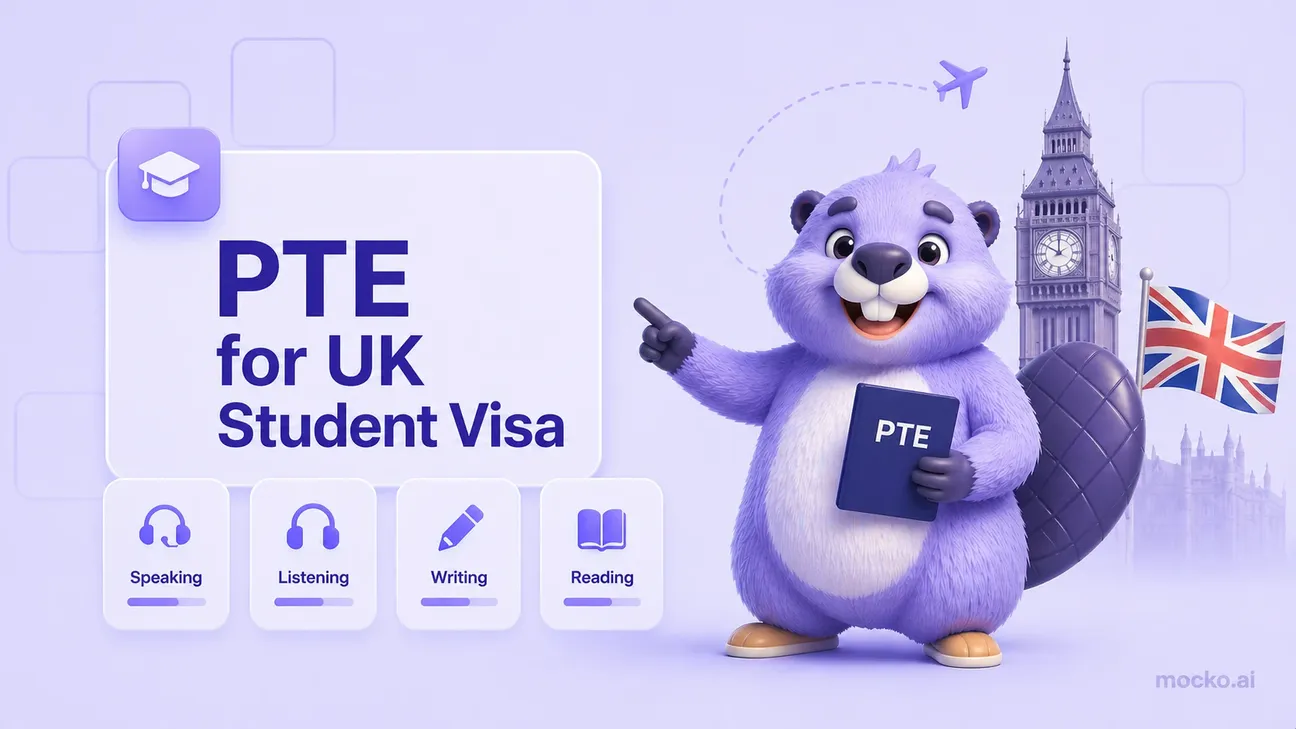
PTE for UK Student Visa: Score Requirements, & Prep Tips
Table of Contents9 sections
Pursuing higher education in the United Kingdom offers access to world-class universities and diverse career opportunities. However, securing a student visa requires proving your English language proficiency.
The Pearson Test of English (PTE) is a popular choice for this, especially the PTE Academic UKVI version. This guide covers everything you need to know about using PTE for your UK study visa, from score requirements to preparation strategies.
Whether you're applying for an undergraduate program or a master's degree, understanding these details will help you navigate the process smoothly.
What Is PTE and Why Choose It for Your UK Study Visa?
The PTE is a computer-based English language test that assesses your reading, writing, speaking, and listening skills.
It's designed to evaluate real-life English usage in academic settings. For UK visas, the key variant is PTE Academic UKVI, which is a Secure English Language Test (SELT) approved by the UK Home Office.
This test is identical in format and content to the standard PTE Academic but includes a Unique Reference Number (URN) required for visa applications.
PTE stands out for several reasons:
- Results are typically available within 48 hours, allowing quicker visa processing.
- It's fully computer-based with AI scoring, ensuring fairness and consistency.
- Accepted by 99% of UK universities and all visa categories.
- The test lasts about two hours, making it shorter than some alternatives like IELTS.
If you're applying for a UK student visa (formerly Tier 4), PTE Academic UKVI is often mandatory, especially for courses below degree level.
For degree-level programs, the standard PTE Academic may suffice if your university is a licensed sponsor and assesses your English internally.
Key Differences Between PTE Academic and PTE Academic UKVI
While both tests share the same structure, speaking and writing (54-67 minutes), reading (29-30 minutes), and listening (30-43 minutes), the main distinctions are in purpose and requirements:
- PTE Academic: Primarily for university admissions. Scores range from 10-90, and it's accepted globally for study in countries like Australia, Canada, and the US.
- PTE Academic UKVI: Tailored for UK visas. It provides the URN needed for your visa form and is required for work, study, or settlement applications. Always check if your course demands this version to avoid delays.
Both tests evaluate integrated skills, but UKVI ensures compliance with Home Office standards. If your university accepts standard PTE for admission but requires UKVI for the visa, plan to take the appropriate one.
PTE Score Requirements for UK Student Visas
The UK Home Office ties PTE scores to the Common European Framework of Reference for Languages (CEFR) levels. For student visas, the minimum depends on your course level:
Course Level | CEFR Level | Minimum PTE Score | Test Type |
Below degree level (e.g., foundation or pre-sessional courses) | B1 | 43 overall (minimum 43 in each skill: reading, writing, speaking, listening) | PTE Academic UKVI |
Degree level and above (e.g., bachelor's, master's) | B2 | 59 overall (minimum 59 in each skill) | PTE Academic or PTE Academic UKVI (depending on university sponsorship status) |
These scores must be achieved in a single test sitting. Note that some universities require higher scores for admission, even if you meet visa minima. PTE scores are valid for two years from the test date.
Exemptions apply if you're from an English-speaking country (e.g., Australia, Canada, USA) or have a UK-equivalent degree taught in English. If your degree was from outside the UK but taught in English, get an assessment from Ecctis.
PTE Score Requirements for UK Universities
Universities set their own thresholds, often higher than visa requirements to ensure academic success. Aim for at least 10-15 points above the visa minimum for competitive programs. Here's a breakdown for 2026 intakes:
For Undergraduate Programs
- Typical range: 50-65 overall (minimum 50 in each skill).
- Examples:
- University of Oxford: 76+ (minimum 66 in each).
- University of Manchester: 59+ (minimum 59 in each).
- Coventry University: 50-60 (varies by course).
For Postgraduate Programs (Master's and MBA)
- Typical range: 60-75 overall (minimum 59 in each skill).
- Examples:
- University of Cambridge: 76+ (minimum 60 in each).
- King's College London: 62-75 (varies by program).
- University of Westminster: 50-57 (for some courses accepting lower scores).
Top Russell Group universities like UCL or LSE often demand 69+. Always verify on the university's website, as requirements can differ by department (e.g., higher for law or medicine).
If your score falls short, consider pre-sessional English courses or retaking the test. Universities like the University of Hertfordshire accept PTE 50 for certain master's with minimums per section.
How to Prepare for the PTE Exam
Preparation is key to achieving your target score. Start 6-9 months in advance if English isn't your first language. Follow this structured approach:
- Understand the Format: Familiarize yourself with question types. Speaking includes read aloud and describe image; writing has essays and summaries; reading involves fill-in-the-blanks; listening covers highlight incorrect words.
- Take a Diagnostic Test: Use official PTE practice tests to identify weaknesses. Aim for regular mock tests to simulate exam conditions.
- Build Skills Section by Section:
- PTE Speaking: Practice fluency and pronunciation. Record yourself and focus on natural rhythm, group words in phrases.
- PTE Writing: Use templates for essays (introduction, body, conclusion). Proofread for grammar and vocabulary.
- PTE Reading: Build vocabulary through daily reading (news, academic articles). Practice skimming for main ideas.
- PTE Listening: Listen to podcasts or TED talks. Note key points and practice with accents.
- Use Resources: Official Pearson materials, apps with AI feedback, and online platforms like PTE Practice. Join study groups for peer reviews.
- Daily Practice Plan: Dedicate 1-2 hours daily. Week 1-4: Basics; Week 5-8: Intensive practice; Final weeks: Full mocks.
Common tips include managing time, avoiding filler words in speaking, and reviewing score reports for improvements. If stuck, consider coaching for personalized feedback.
Step-by-Step Process for Applying with PTE
- Research universities and confirm PTE acceptance.
- Book and take the PTE Academic UKVI (check test centers via Pearson's site).
- Apply to universities with your scores.
- Receive a Confirmation of Acceptance for Studies (CAS) from your university.
- Gather documents: Passport, CAS, financial proof, tuberculosis test (if required), and PTE score report.
- Apply for the student visa online via GOV.UK, paying the fee (around £490).
- Attend a visa appointment for biometrics.
Plan ahead, visa processing can take 3-5 weeks.
Common Mistakes to Avoid and Advanced Tips
Avoid pitfalls like ignoring sectional minimums, assuming standard PTE works for all visas, or not practicing under timed conditions. Also, double-check score validity and university-specific rules.
For better ranking and success:
- Integrate AI tools for instant speaking feedback to refine pronunciation.
- Track recent Home Office updates via official sites, as policies can evolve.
- Combine PTE prep with visa mock interviews to build confidence.
- Focus on holistic English improvement—read UK news for cultural context.
- If retaking, analyze previous reports to target weak areas efficiently.
These strategies can help you score 65+ and stand out in applications.
Read More: PTE Exam Day Rules, Instructions, and Tips
Conclusion
Securing a UK study visa with PTE is straightforward if you meet the score requirements and prepare thoroughly. By choosing the right test variant, aiming high for university admissions, and following a solid prep plan, you'll be well on your way to studying in the UK. Remember, persistence pays off, many succeed on their second attempt with better strategies. Start your preparation today to turn your study abroad dreams into reality.
FAQs
001Can I Use PTE for UK Work Visas Too?
Yes, minimums vary (e.g., 59 for Skilled Worker visas using PTE Academic UKVI).
002How Much Does the PTE Test Cost?
Around £180-200, depending on location; book early for availability.
003What If My PTE Score Is Below the Requirement?
Retake the test or consider pre-sessional courses; some universities offer conditional admissions.
004Do I Need PTE If I Have a Degree Taught in English?
Possibly not; get an Ecctis assessment if it's from outside the UK.
005Is PTE Academic Accepted for UK University Admissions?
Yes, by 99% of UK universities, but PTE Academic UKVI is often required for visas.
006What Is the Minimum PTE Score for a UK Student Visa?
For below-degree courses, it's 43 overall with 43 in each skill using PTE Academic UKVI; for degree-level, it's 59 overall with 59 in each.
007Is PTE Easier Than IELTS for UK Visas?
It depends on your style; PTE is computer-based with quicker results, while IELTS has human speaking assessment.